Manic Miner: The Definitive History
The Context
Britain in 1983 was not prepared for what was about to happen. The ZX Spectrum had arrived twelve months earlier. Clive Sinclair launched it in April 1982 at £125 for the 16K model, £175 for the 48K. It was rubber-keyed and unglamorous. It connected to a domestic television. It loaded programs from a cassette deck. The cassette deck often failed. You sat in front of it and typed, or you waited minutes for a program to load from tape, and sometimes the program did not load at all, and you typed a different number into the VOLUME control and tried again.
None of this mattered. The Spectrum sold. It sold in quantities Sinclair had not fully anticipated. By the time 1983 arrived, it was the dominant home computer in the United Kingdom. The games market that had grown up around it was fast, chaotic, entrepreneurial, and almost entirely teenage. Software houses operated out of terraced houses and spare bedrooms in Liverpool, Manchester, and Sheffield. The kids making the games were as young as their customers. The money was real. The industry was not yet sure what it was.
Into this came Manic Miner.
The Author
Matthew Smith was born in Penge, London, in 1966. His family moved to Wallasey, Merseyside, when he was seven. He received a TRS-80 for Christmas in 1979, when he was thirteen. He taught himself machine code from a book: Rodnay Zaks's heavy technical manual, Programming the Z80. This was not light reading. This was not a child's book. He worked through it.
His first commercial release was Delta Tau One for the TRS-80, a Galaxian clone. After that came Monster Muncher for the VIC-20, which he claimed to have written in three hours. Neither set the world alight. But by his early teens he had the fundamentals: he could code fast, he understood hardware limitations as design constraints rather than obstacles, and he had the particular disposition of the self-taught programmer who has internalized the machine deeply enough that the machine's logic becomes second nature.
Bug-Byte Software was a Liverpool company founded in 1980 by two Oxford chemistry graduates, Tony Baden and Tony Milner. It had found success on the ZX81 with games by Don Priestley. When the Spectrum came along, Bug-Byte needed Spectrum titles fast. Alan Maton, the company's despatch manager, knew Smith and brokered a deal: Bug-Byte would loan Smith a ZX Spectrum in exchange for a three-game contract. Smith accepted.
The first game, Styx, was a single-screen shooter. Smith himself later admitted it "was quite a flop." Bug-Byte paid him £3,000 for it outright. No royalties. The money was useful, the terms were not. When it came to the second game, Smith retained the licence. That single decision changed everything.
The Commission
Manic Miner was developed following a request from Alan Maton for a Donkey Kong-style arcade game. That is the official account. The reality is more interesting.
Smith had been playing Miner 2049er on the Atari 8-bit. Programmer Bill Hogue had blended ideas from Pac-Man and Donkey Kong, setting his game in a future uranium mine with an emphasis on collecting items across ten levels. It was a serious piece of game design. Ten distinct levels, each with its own logic. A miner as protagonist. An underground world that felt coherent rather than arbitrary.
Smith was, by his own account, captivated. In an interview he described Hogue as "very much an inspiration," saying of his game: "There was a game on the Atari written by an American called Bill Hogue." Following Manic Miner's success, Hogue noted that "the licensees of Miner 2049er were crying." The debt was real and acknowledged.
What Smith added was ambition of scale and a specifically British sensibility. Miner 2049er had ten levels. Manic Miner would have twenty. The original game spec had included teleporters, lifts, and escalators, but Smith decided to have lots of screens rather than lots of fancy mechanisms inside each one. Screens were cheaper to implement. More screens meant more variety. More variety meant the game could surprise you for longer. The logic was sound, even if the stated motivation, as Smith later admitted with some amusement, was partly laziness.
The cover art made the Miner 2049er connection visible. Both games depicted their protagonists as bearded, rugged miners on the inlay artwork. Neither looked anything like that in-game.
The Making
Smith sketched the screens during a holiday in Italy. He came back and wrote the code in eight weeks. He described the process in his 2000 television interview: "I was in Italy drawing pictures of some levels with some water running down and I came back and in eight weeks we were duplicating cassettes."
The development machine was not a Spectrum. Smith wrote Manic Miner using a Model III Tandy TRS-80. He coded at night because the TRS-80 crashed whenever someone put the kettle on. He worked in Z80 assembly language, targeting the Spectrum's architecture from a different machine. This was the standard workflow of a programmer who understood the hardware at a level that permitted complete mental simulation of the target platform. You did not need to be running the Spectrum to write Spectrum code. You needed to know exactly how the Spectrum behaved, down to cycle counts and memory addresses.
Initially the game had sixteen screens, until Smith found a way to add four more. He finished in August 1983. The completed game was first demonstrated publicly at the Computer Fair at Earls Court in June 1983, when only the sixteen-screen version existed. The final twenty-screen version went on sale shortly after.
The Technical Achievement
The ZX Spectrum was an 8-bit machine running a Z80 processor at 3.5 MHz. It had 48K of RAM. Its sound output was a single 1-bit speaker: the buzzer. You could set it high or you could set it low. That was it. Prior to Manic Miner, this had produced beeps and simple tones between gameplay sequences. It had not produced continuous in-game music while the game was simultaneously running.
Smith wanted both. He wanted music playing constantly while the game ran at full speed.
Matthew Smith achieved this by alternating the processor between playing the game and playing the music. This is why Manic Miner has its characteristic, instantly recognisable juddery effect in the music. It also explains the subtle juddery movements of Miner Willy and the guardians. The processor timesliced between two tasks, switching so rapidly that both appeared simultaneous. The music suffered a stuttering quality as a result. The gameplay suffered a slight jerkiness. But both were present. Both ran.
The technical approach owes something to a technique called granular synthesis, pioneered by the Greek composer Iannis Xenakis in his piece Analogique B. Smith almost certainly did not know Xenakis. But the solution he found independently was structurally related to that compositional method: breaking sound into tiny grains and sequencing them at speed to produce the illusion of a continuous tone.
The choice of music was Edvard Grieg's "In the Hall of the Mountain King" from the Peer Gynt Suite, Op. 46. The connection was obvious to the point of poetry: underground setting, mounting menace, relentless momentum. The piece accelerates. So does the game's difficulty. The pairing was not accidental.
For the title screen, Smith chose Johann Strauss Jr.'s "The Blue Danube." Not content with the Grieg, Smith included a few bars of Strauss's Blue Danube to accompany the opening screen, with an on-screen piano keyboard with keys that highlighted along with the music. The keyboard scrolled across the screen as the waltz played. It was a piece of pure theatre. It told the player that this was not the usual thing.
Manic Miner was the first ZX Spectrum title with in-game music. This is not a minor technical footnote. It established a new standard for what a game could be. Before Manic Miner, sound was intermittent punctuation. After it, the expectation of continuous music in home computer games was set.
The loading screen was another innovation. The Spectrum's video display allowed background and foreground colours to be exchanged automatically without software attention, and the animated loading screen appears to swap the words "Manic" and "Miner" through clever manipulation of this feature. It was also much faster than a standard loading screen. It was the first game ever to have an animated loading screen.
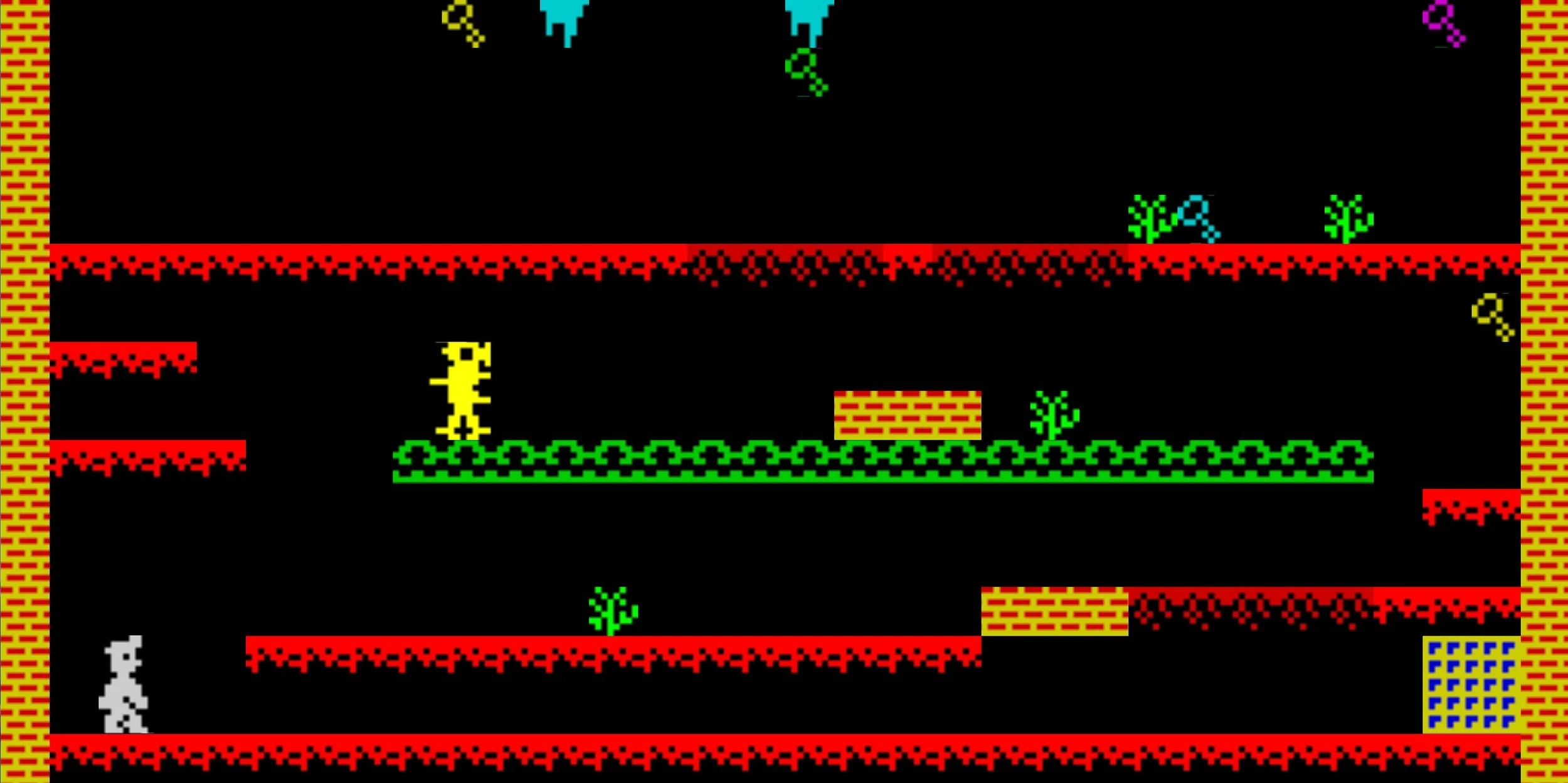
The character sprite was a 16x16 pixel figure with four animation frames. Miner Willy walked in one direction. The same frames served for walking in the other direction, reversed. Jumping used no dedicated sprite: it was the walking frames with vertical momentum applied. The economy was total. Every byte was accounted for.
Each cavern was allocated enough memory to hold eight frames of animation. This meant Smith had to be very clever in his guardian design. If a guardian sprite was obviously facing left or right, only one guardian of that type could appear in the level: four sprites for walking left and four for walking right. Therefore, the levels containing two guardian graphics feature sprites that do not face a specific direction.
The guardians were all 16x16 sprites. The collectible items and hazards were 8x8. The precision of the hitbox was exactly that of the sprite boundary. There was no mercy zone. Manic Miner has some serious pixel-perfect jumps that need to be made. This was not a bug. It was a design philosophy.
Every cavern definition contains a conveyor definition, and every conveyor has a non-zero length and is animated by a routine. But there are two caverns in which the conveyor is hidden or otherwise unusable: an unused conveyor of length 1 in The Endorian Forest, and an unused conveyor of length 3 in Amoebatrons' Revenge, where a bug causes the third row of pixels to animate as if it were a conveyor even though it is occupied by a platform. These vestigial elements are the fingerprints of the development process: code that was written and then covered over, not excised, because excision takes time and costs bytes.
The Cheat Code
The cheat code was the numerical sequence 6031769, based on Matthew Smith's driving licence, "with an error in it and twisted round a bit," as he put it in an interview for Retro Gamer magazine. Typing it during gameplay activated a mode that let Willy teleport to any cavern. A boot appeared next to the remaining lives count to confirm the cheat was active. The number was personal. It was hidden in plain sight.
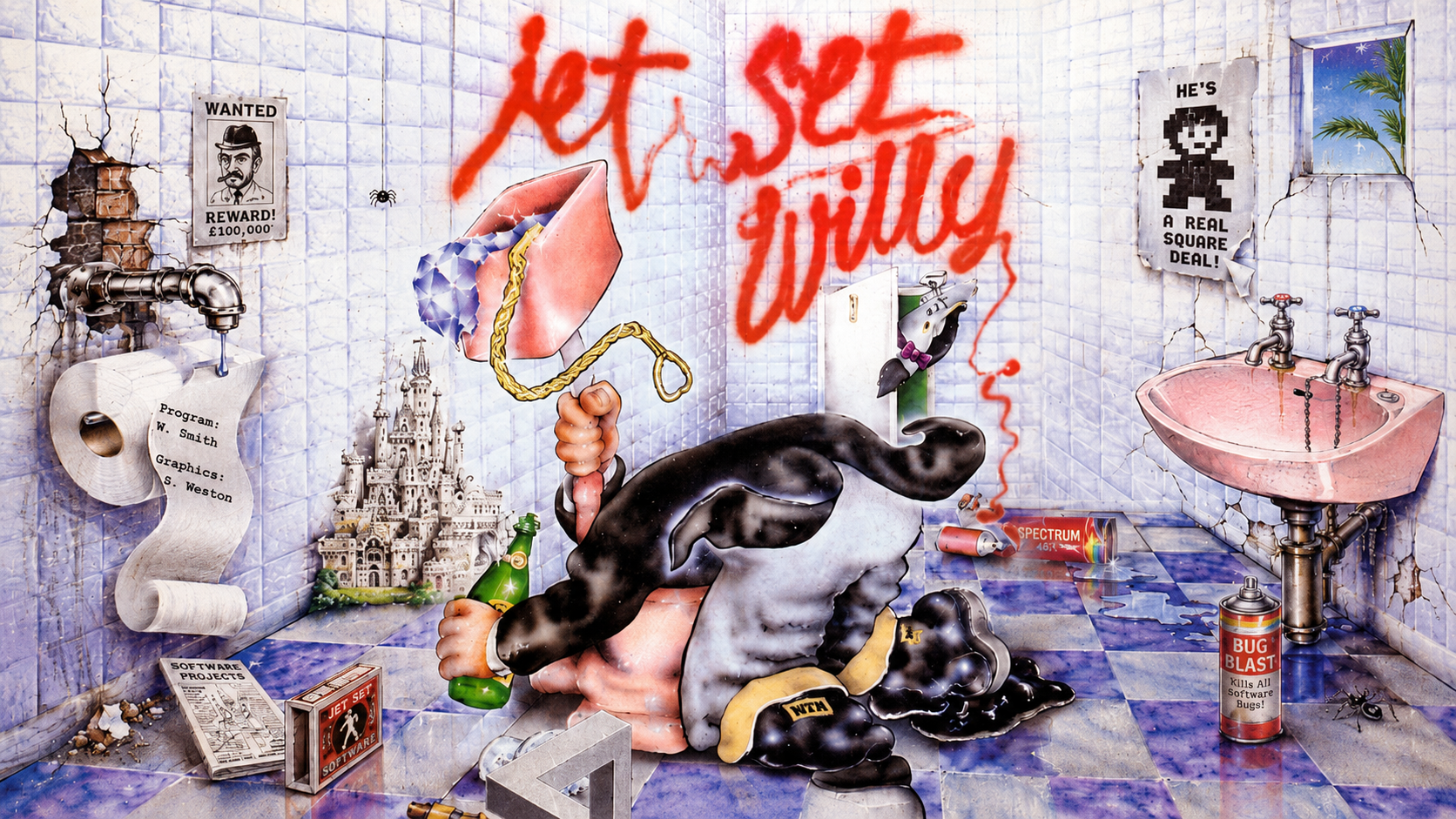
In the Software Projects version, this changed to "typewriter." Smith would later use the code "writetyper" for the cheat mode in Jet Set Willy.
The Twenty Caverns
The caverns of Manic Miner are worth examining in full, because they constitute the game's argument. Taken together, they describe a trajectory: from the recognisably industrial through the increasingly strange, arriving finally at the literal surface of the earth.
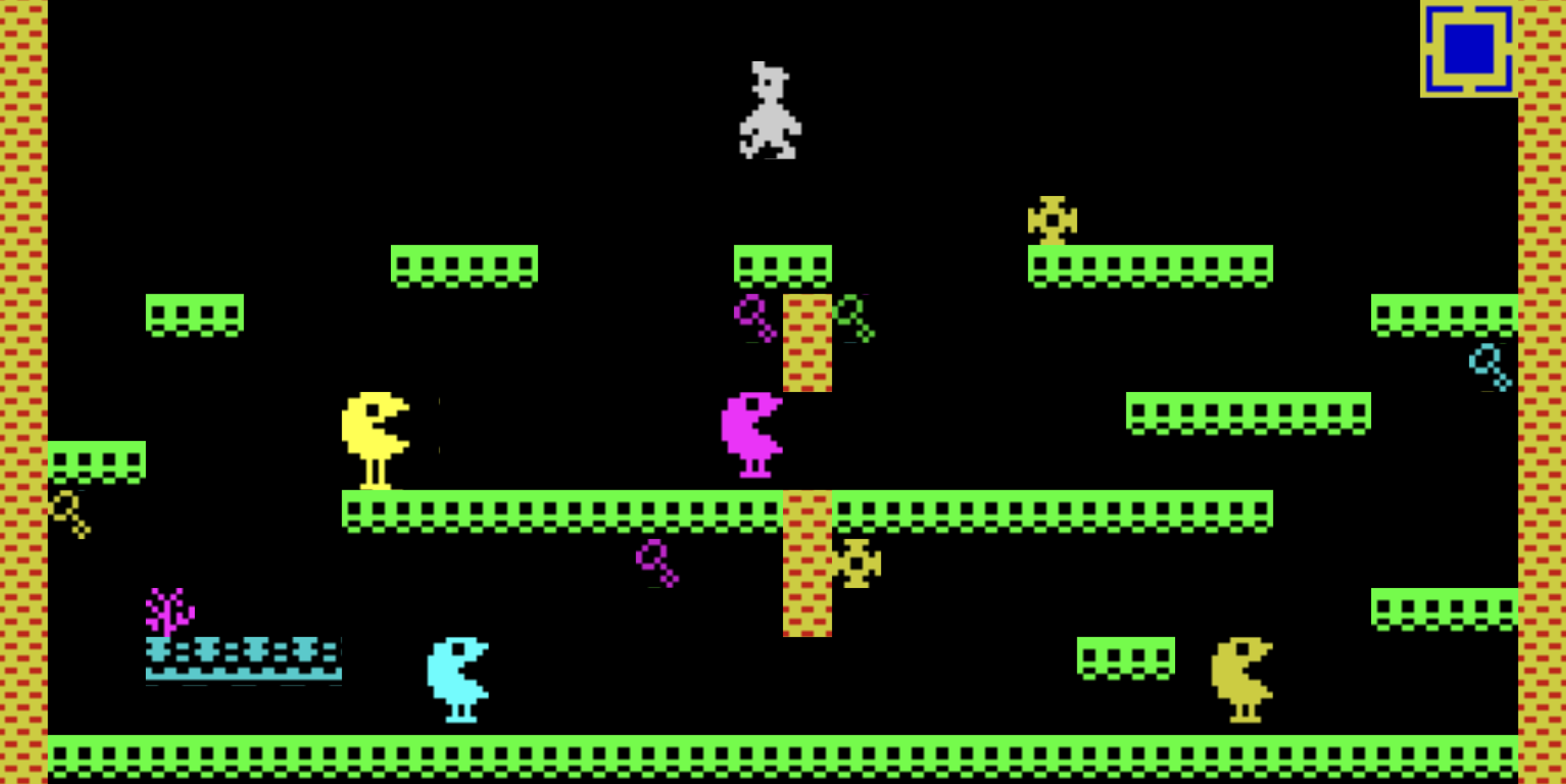
1. Central Cavern. The first screen is a tutorial disguised as a gauntlet. It introduces every mechanic simultaneously: moving platforms, patrolling enemies, fixed hazards, the conveyor belt. It is very hard. The game has what might be described as a tutorial by 1983 standards, in that the first level requires the player to learn the full range of Miner Willy's movements and execute them precisely at length. The plus side is that if you fail, you are immediately in place to start Central Cavern again. And once you master it, the following levels are a breeze by comparison, right through at least until the fifth cavern. The decision to front-load the difficulty was counter-intuitive and correct. It filters. It trains.
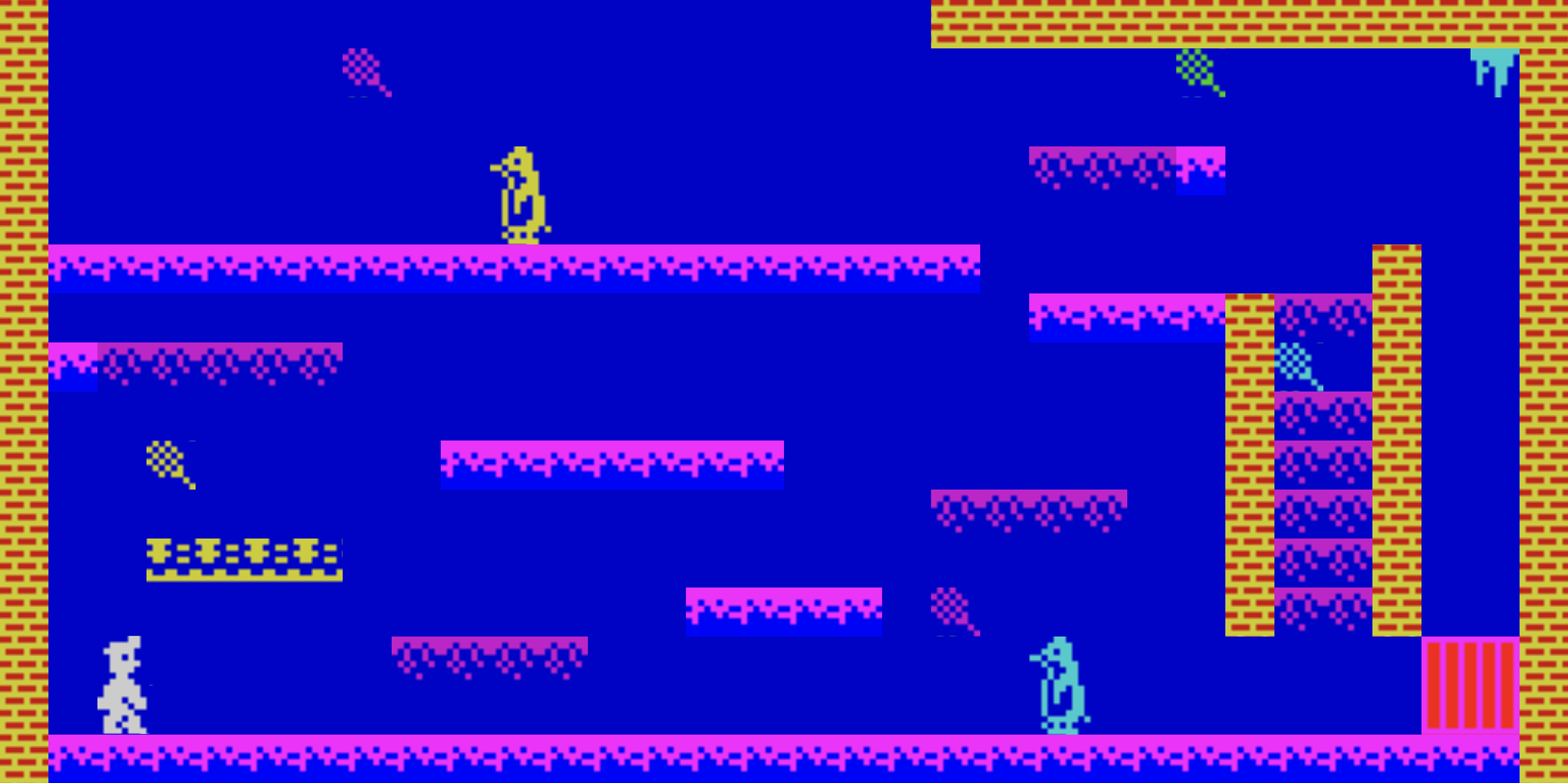
2. The Cold Room. Snow shoes in a refrigerated space. The guardians are stiff-jointed penguins. The penguins pace back and forth, oblivious to Willy's presence, absolutely predictable if you're paying attention. The Cold Room introduces the idea that enemies are not hostile actors; they are mechanical systems. They do not pursue you. They follow their paths. Your job is to understand the paths.
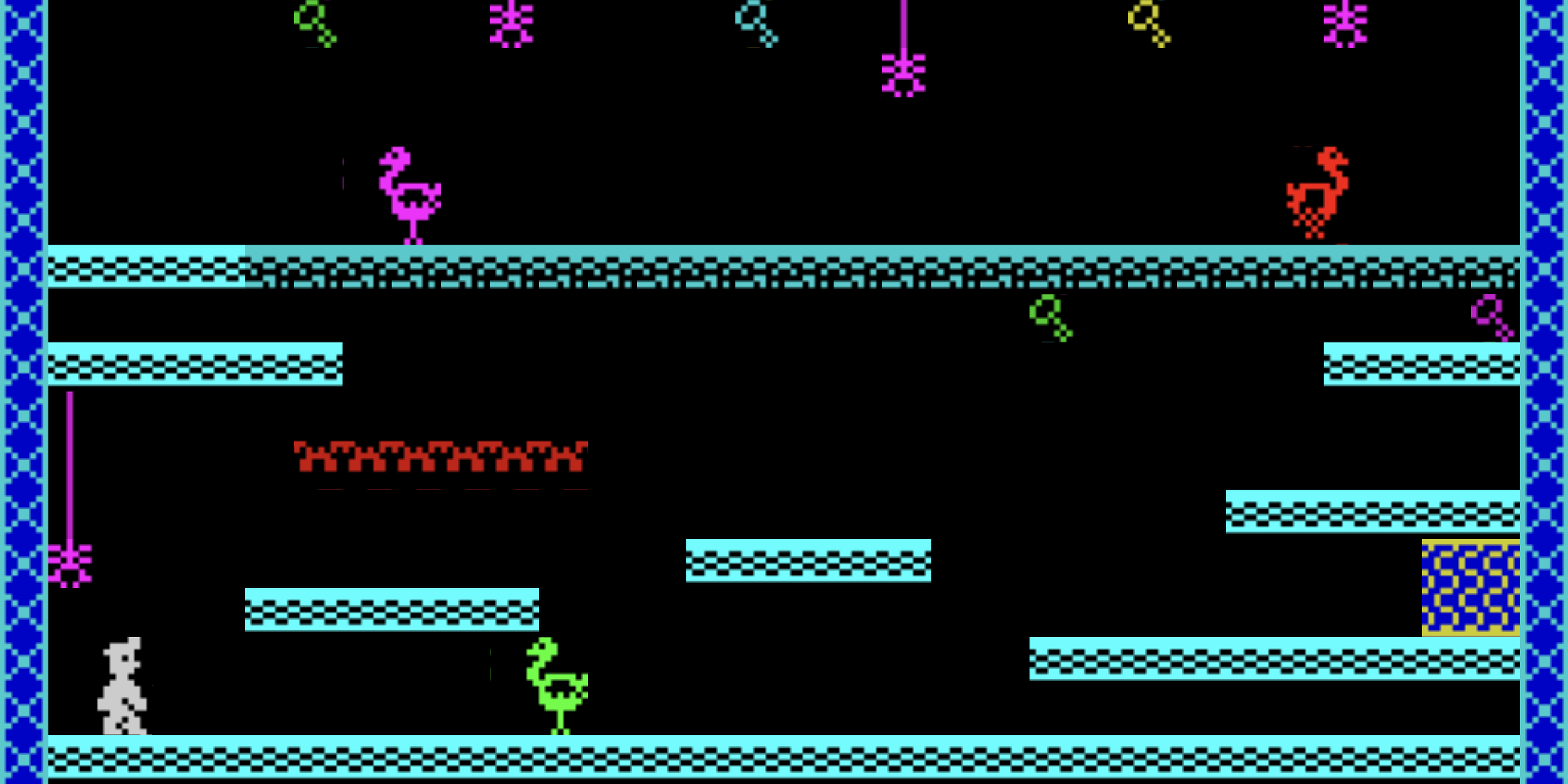
3. The Menagerie. Willy in a zoo. The wildlife is abstracted into simple two-frame sprites. The humour is already operating: this is not a zoo in any realistic sense. The name gestures toward chaos.
4. Abandoned Uranium Workings. The naming makes the Miner 2049er debt explicit. Uranium workings abandoned. The level has a radiation-green cast. It is the game briefly acknowledging its lineage.
5. Eugene's Lair. The most personal screen in the game. It started as a skit on Eugene Evans, a programmer at Bug-Byte known among his colleagues for driving a Ferrari at seventeen. The Eugene guardian is a large, oscillating figure that descends and ascends in the centre of the screen. Smith recalled Evans with some complexity: "He was famous for being young and driving a Ferrari. But he crashed his Ferrari." The level encodes professional rivalry as comic threat. Eugene can be evaded. The Ferrari-driving is noted and then discarded.
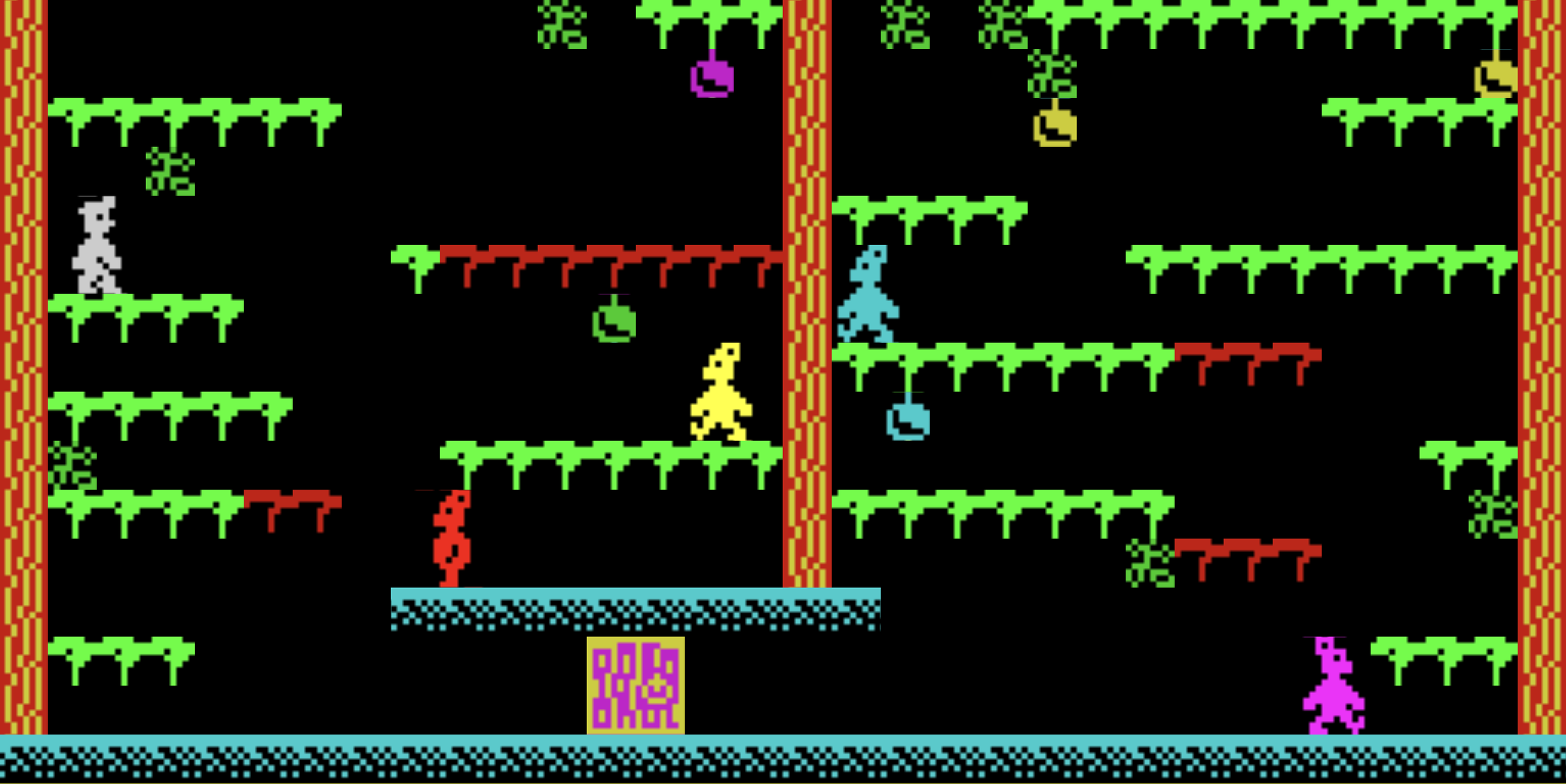
6. Processing Plant. An industrial middle section. The Bug-Byte version features a deadly bush in this cavern; the Software Projects version replaced it with a ghost. The change was small and the level design beneath it remained the same.
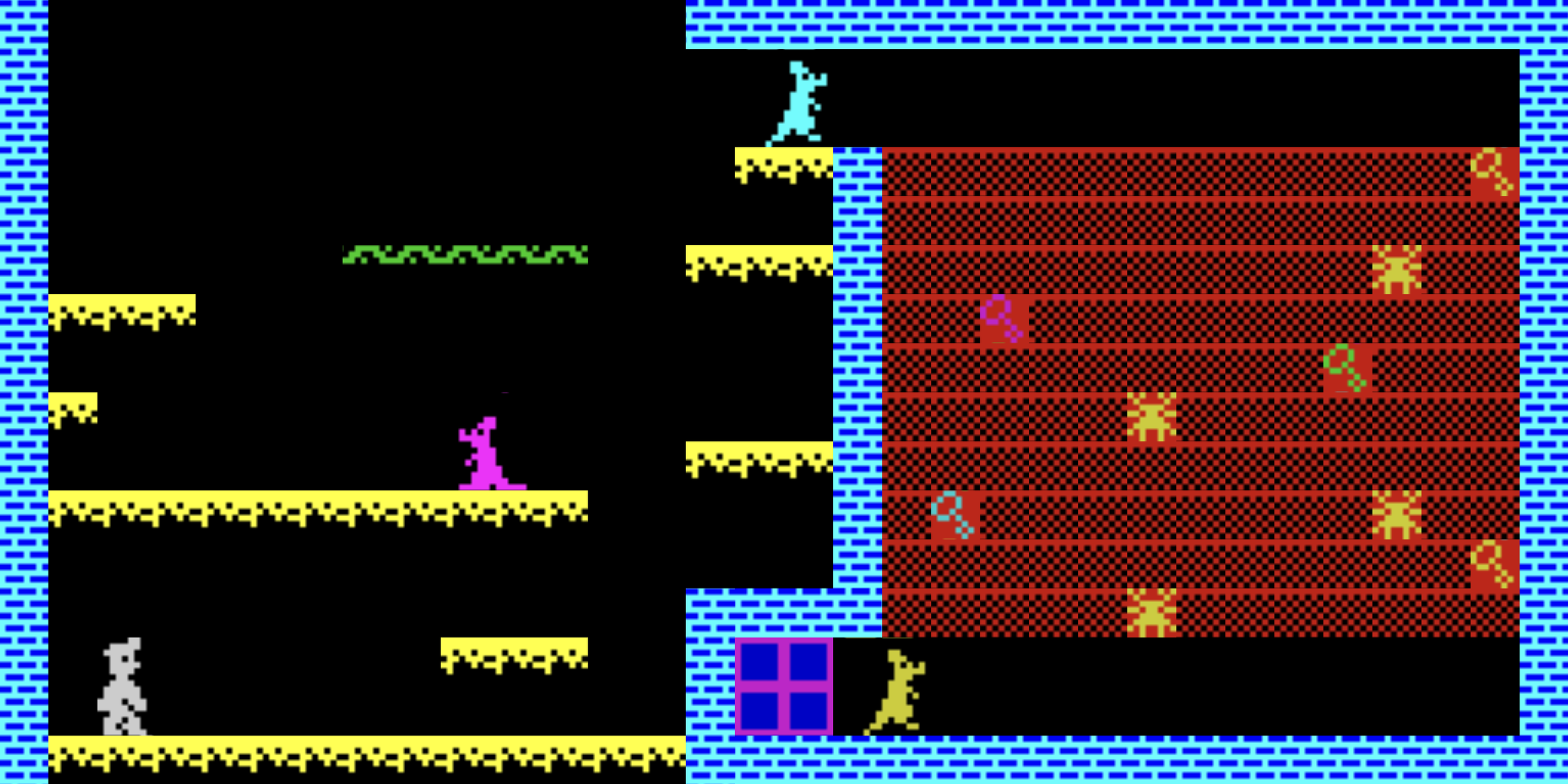
7. The Vat. There is a kangaroo above the vat. Why there is a kangaroo above the vat is not explained. This is Manic Miner at its most casually surreal: a piece of logic that is entirely self-consistent within the game's rules and entirely nonsensical outside them. The kangaroo bounces. You navigate around the bounce cycle.
8. Miner Willy Meets the Kong Beast. The Kong Beast is the game's most direct homage to Donkey Kong. It is a large gorilla figure that occupies the top of the screen. The name is a formal introduction. Smith was not hiding his influences; he was celebrating them while doing something different with them.
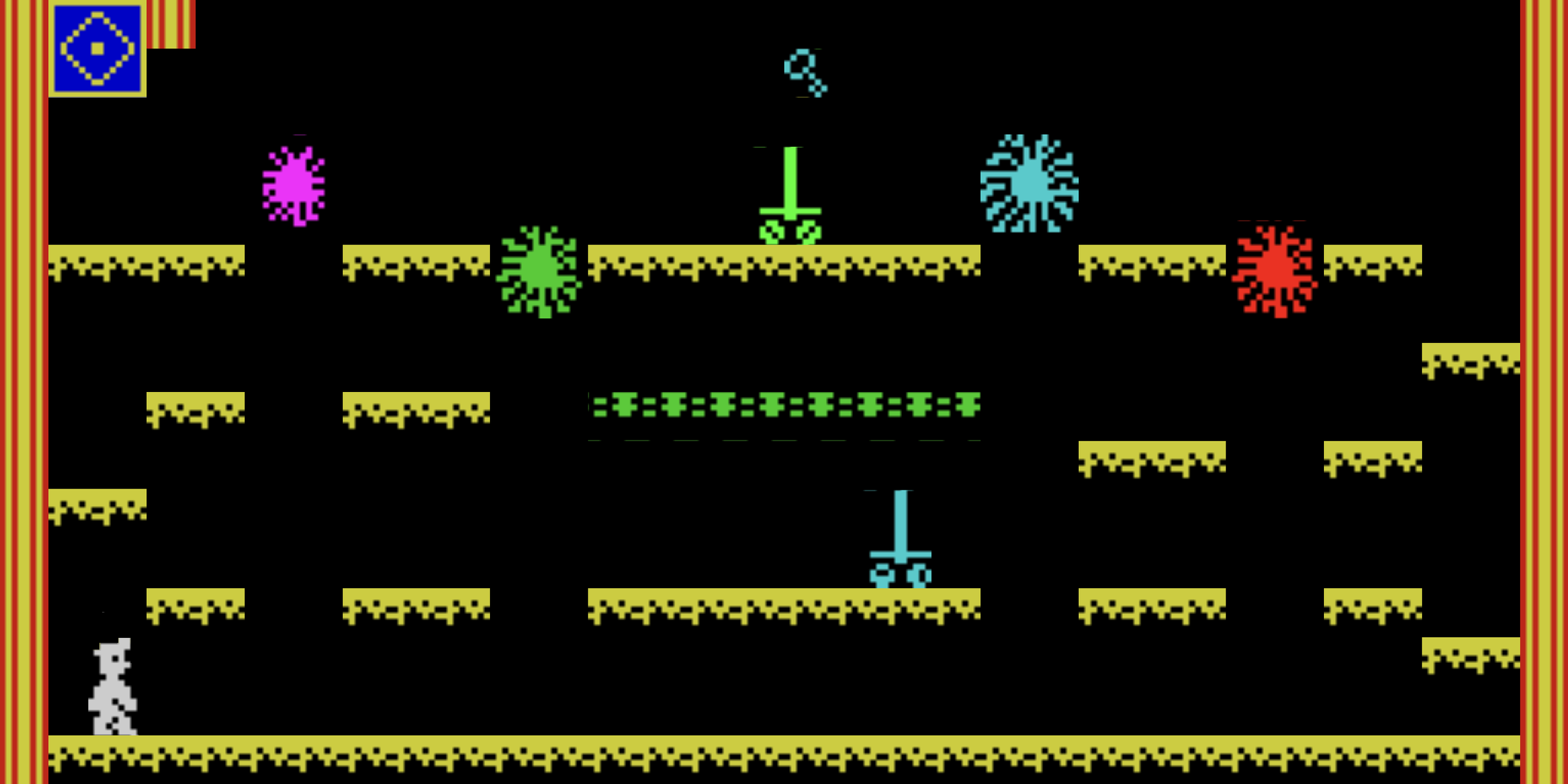
9. Wacky Amoebatrons. The amoebatrons are what they sound like: amoeba-shaped robots moving in patterns that imitate cellular logic. The name is cheerfully self-aware.
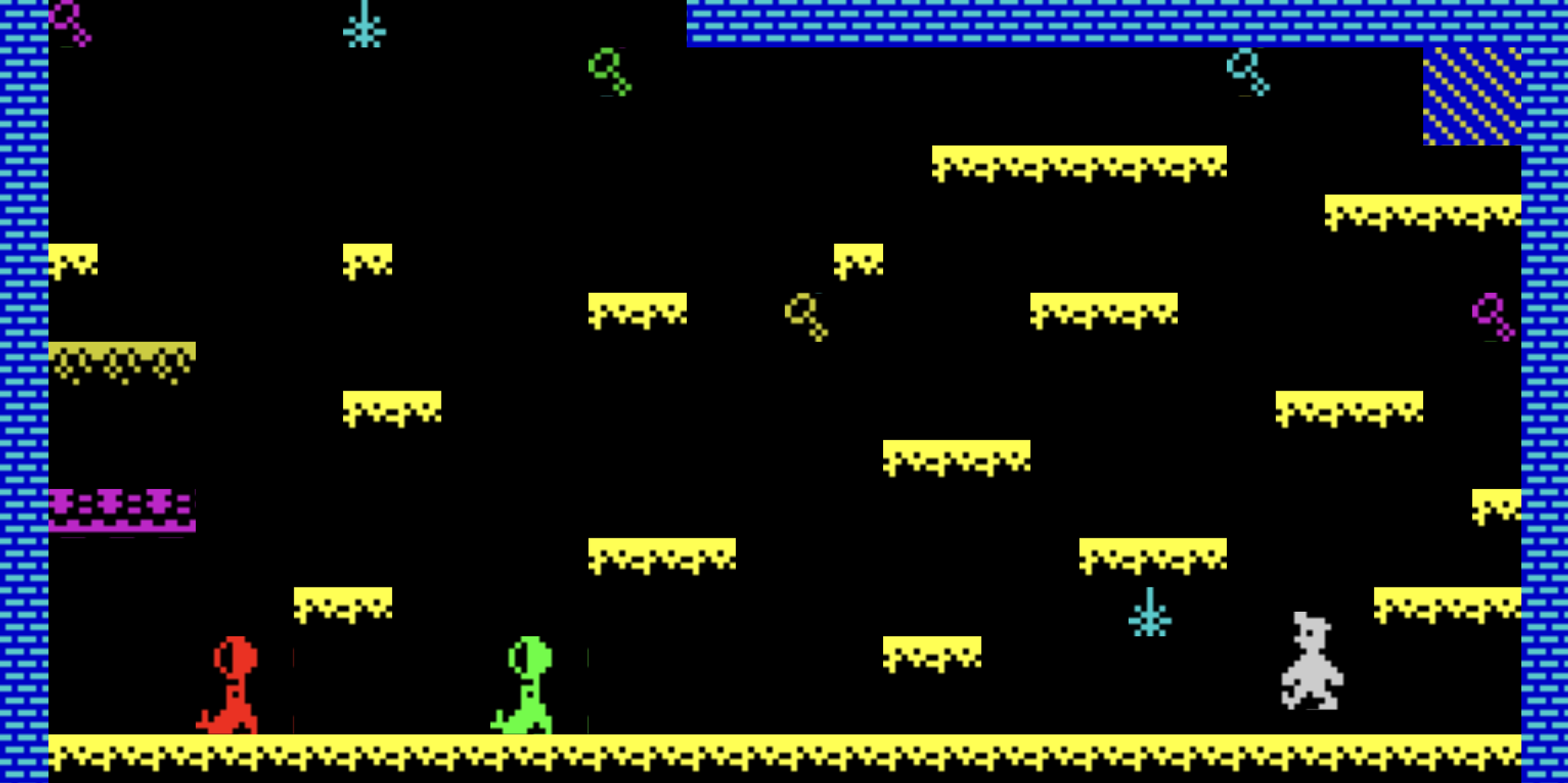
10. The Endorian Forest. An Ewok reference, three months before Return of the Jedi was released in the UK. The game came out in June 1983; the film arrived in Britain in late June 1983. This timing suggests advance knowledge from press coverage rather than from seeing the film. The level is a tree-platform sequence. The Endorian reference ages it precisely.
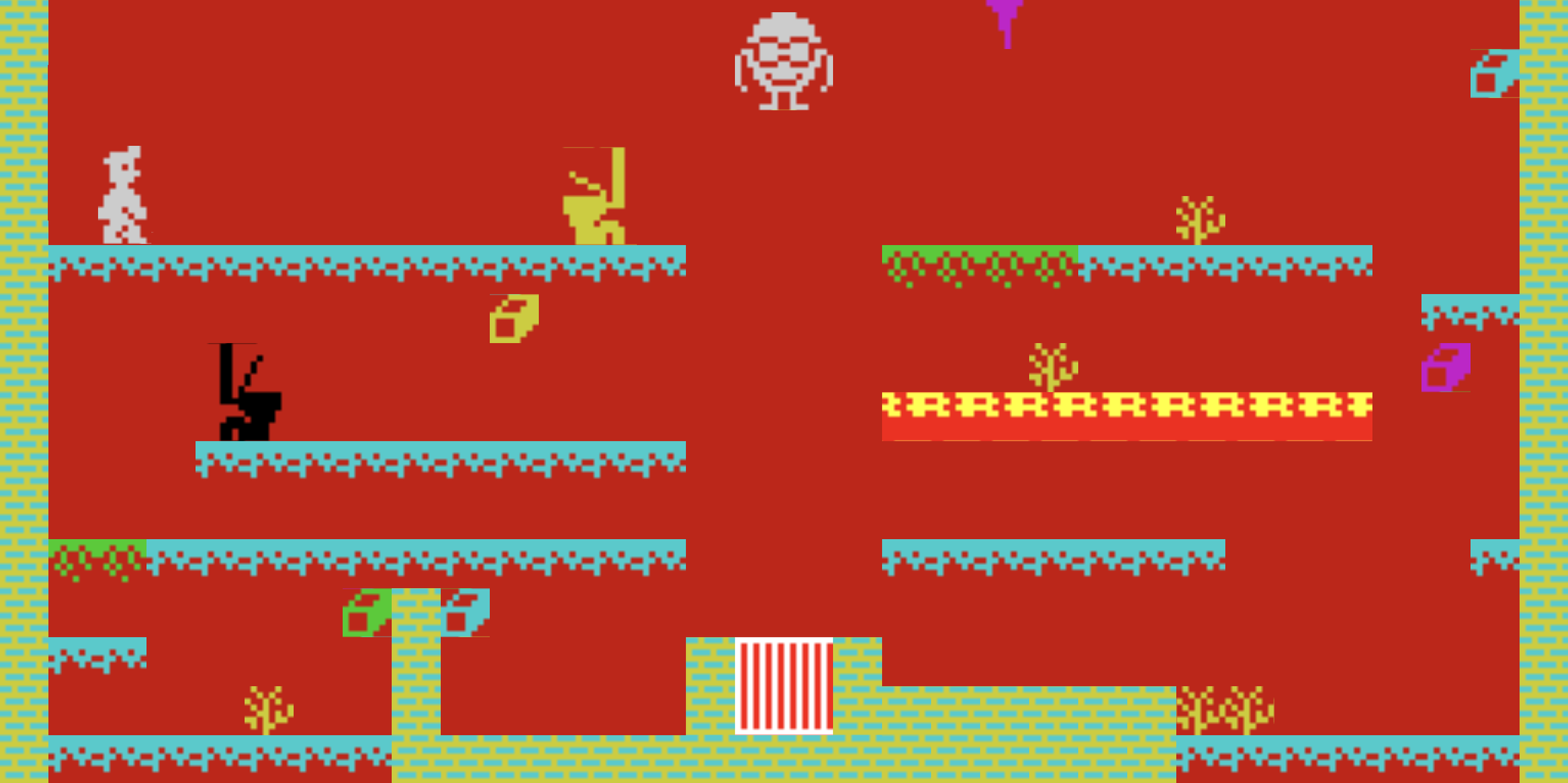
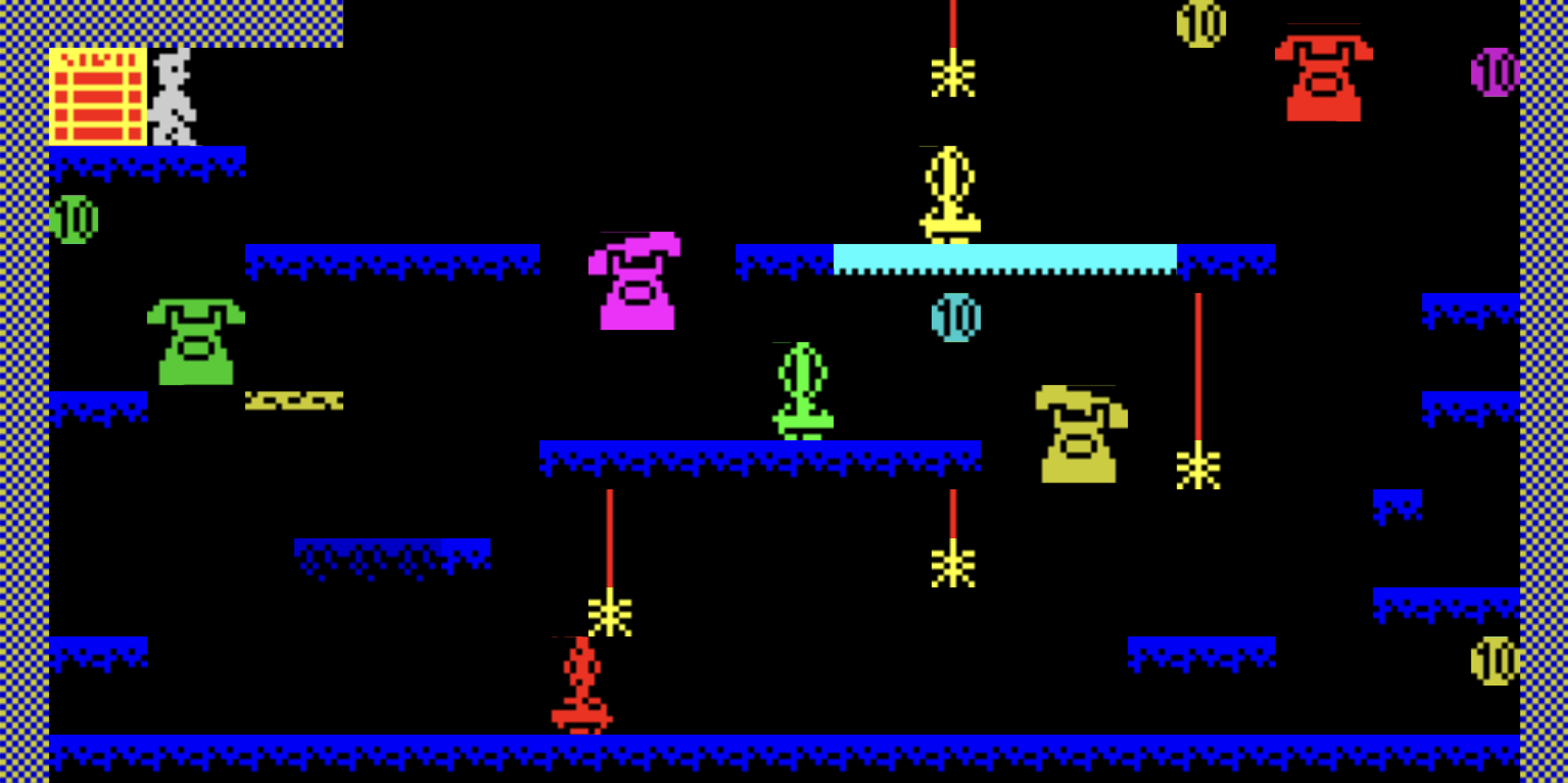
11. Attack of the Mutant Telephones. Smith said his favourite guardian was the telephone: "My favourite monster in Manic Miner, errm, I got the most compliments on the telephones." The animated toilet seats were his little brother's idea. Anthony Smith was three at the time. There are no toilet seats in Attack of the Mutant Telephones; those appear later. But the telephones themselves are objects of genuine comic invention. They ring as they patrol. They ring because they are telephones. This was 1983 humour at its most compressed.
12. Return of the Alien Kong Beast. A reprise of cavern eight's antagonist, now in a different configuration. The naming is a sequel title. Smith was already doing sequels within the game, three-word genre titles riffing on themselves.
13. Ore Refinery. Industrial again. Conveyor belts under horizontal hazards. The refinery aesthetic is the game returning to its stated premise: these are mines, there is ore, someone is supposed to be working here.
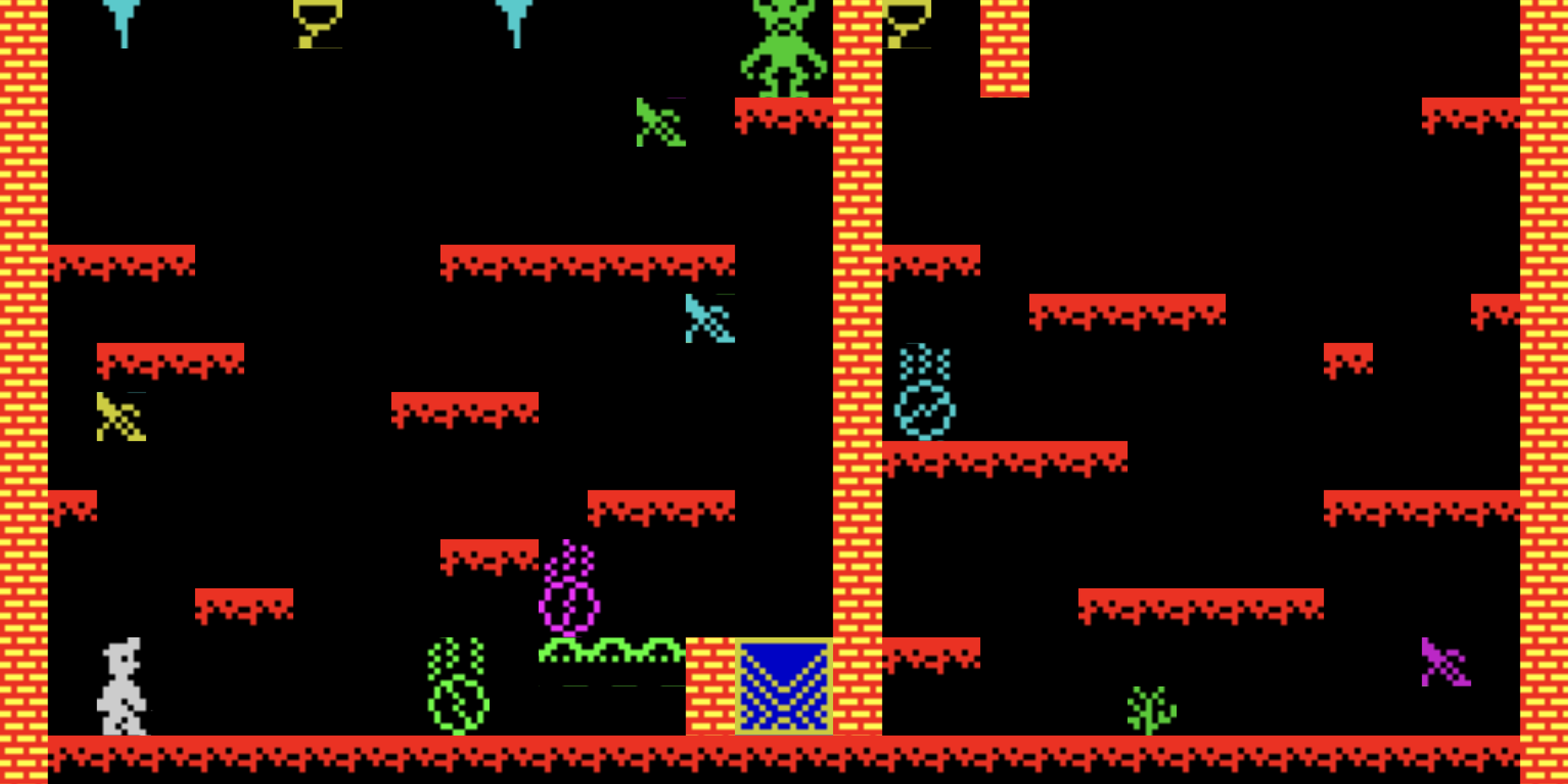
14. Skylab Landing Bay. Skylabs fall from above and shatter on the platforms. The Skylab space station had re-entered the atmosphere in 1979; this was still culturally live in 1983 as a piece of slightly absurd recent history, the American space station that fell to earth over Western Australia. Smith turned it into a level mechanic. The skylabs collapse the platforms where they hit. The crumbling floor tile in Skylab Landing Bay is unique to that cavern and, in fact, goes unused in the final game. The crumbling mechanic was designed and then never deployed.
15. The Bank. Willy is now robbing a bank. The shift in premise is handled without comment. He was a miner. Now he is in a bank. The platforming requirements are the same. The moral implications are unaddressed.
16. The Sixteenth Cavern. The name is the name. It is the sixteenth cavern. Smith ran out of thematic momentum here, or decided that minimal naming was funnier than invented naming. It is both. In The Sixteenth Cavern, Willy can get stuck if he enters the area below the portal before collecting all the items outside that area. He will then have to wait until his air supply runs out. This is a death by architecture: a softlock that requires patience rather than restart.
17. The Warehouse. The original Bug-Byte release featured "threshers" in The Warehouse. The Software Projects re-release replaced them with rotating Software Projects logos: the Penrose impossible triangle, the company's branding. The level contains what players have long considered the game's most brutal section: a strip of platforms with narrow margins that demands precision at the point of near-exhaustion, coming this late in the game. No mercy.
18. Amoebatrons' Revenge. The return of the amoebatrons, with a titular escalation. The level's sequel name signals that Smith thought in narrative terms even about individual screens, even when the narrative was essentially a joke about sequels.
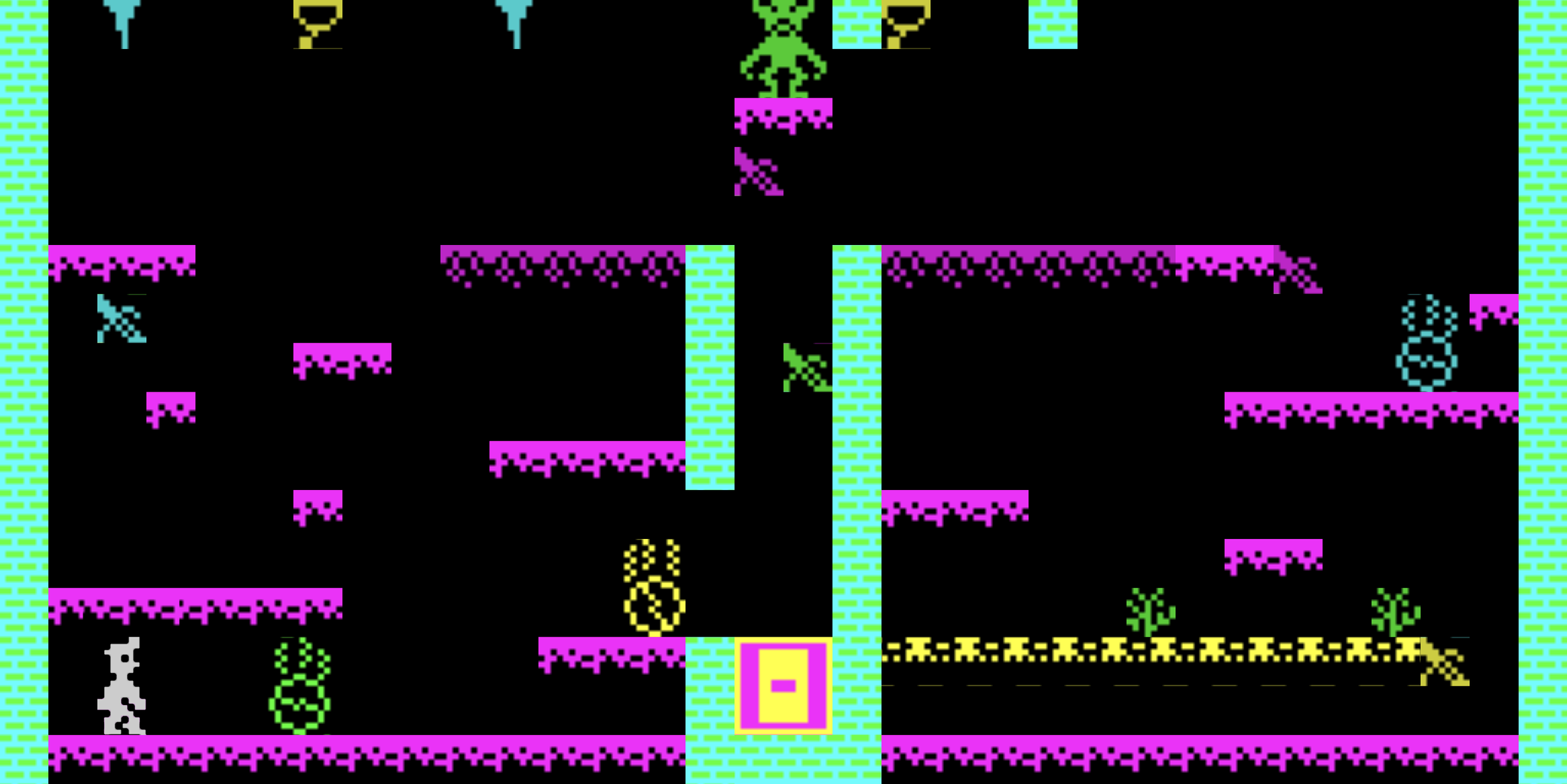
19. Solar Power Generator. The game escapes underground. Willy is in a facility on the surface, or near it. The central gimmick is a solar beam: the light beam's movements are predictable and follow specific rules. It travels vertically downward from the top, and changes direction between vertically downward and horizontally to the left if a guardian is in the way. For every frame the beam is in contact with Willy, the air supply is reduced by additional units beyond the standard drain. The solar beam is the game's most mechanically complex hazard. It moves. Its rules can be learned. Learning them is the level.
20. The Final Barrier. Willy has been underground for nineteen caverns. The Final Barrier is the surface: his house, his car, a fence, a sunrise or sunset (the game does not specify which), water. The level itself is considered by most players to be the easiest in the game: a relief after the warehouse and the solar generator. The title screen, which displays part of The Final Barrier, shows the surface where Miner Willy lives, with a sunrise, water, slight cloud, his house, a neat fence and his car. Once all the items are collected and Willy jumps through the portal, there is an ending sequence: after Willy has jumped through the portal to the ground above and the celebratory sound effect and colour-cycling effect have finished, the bottom half of Willy's sprite can be seen dangling below the swordfish graphic while the remaining air supply decreases to zero. This is a bug. It is also, in retrospect, a small piece of accidental poetry: Willy triumphant and yet still half-submerged.
After completion, the game loops from the beginning at increased difficulty. There is no end. The mine is infinite.
The Two Versions
There are two definitive versions of Manic Miner for the ZX Spectrum, and the differences between them matter.
The Bug-Byte version was published first, in the summer of 1983. It contains the driving licence cheat code. In The Warehouse, the guardians are threshers. In The Processing Plant, the hazard is a bush. The Amoebatrons in Amoebatrons' Revenge have a specific sprite design. The scrolling message on the title screen has Bug-Byte's text. The cover art exists in two variants: an early "Whistler" design and a later "Lantern" cover.
On 28th November 1983, Software Projects released their own version. Minor alterations were made to the graphics, changing some enemies from Bug-Byte logos and changing others to Penrose triangles, the Software Projects logo. The cheat code changed to "typewriter." The scrolling message changed. Several sprite designs in the affected caverns changed. The fundamental design of the game, all twenty caverns and their structures, remained identical.
Bug-Byte were able to continue selling their version over the Christmas period, with the Software Projects release not becoming the most circulated version until early 1984. Both versions circulated simultaneously for several months. Both are legitimate. Both are by Matthew Smith. The difference is branding and minor asset changes.
The Contract Clause
The mechanism by which Smith retrieved his game from Bug-Byte is worth understanding in full, because it was legally novel enough to surprise everyone involved.
Smith recalled in an interview that his contract contained a clause stating that should a game be withdrawn from the market upon written request, it would be returned to the programmer. "I don't think anyone had expected that a programmer would withdraw his own game!"
He withdrew it. He sent the letter. The clause activated. The game came back to him.
A Big K article from the period quoted Smith directly: "It's a popular misconception that I worked for Bug Byte and was then lured away. I never did; all they ever did was to manufacture and sell my game for me. I would have been quite happy to leave Manic Miner with them, but they bent the contract."
Bug-Byte owed him around £16,000 in royalties on the 40,000 copies of Manic Miner they still held in stock. Smith had already made that much again from his five per cent cut on the first 40,000 copies. The royalty dispute was the precipitating factor. The contract clause was the mechanism. Smith did not just leave Bug-Byte. He took his game with him.
Alan Maton explained that "the royalties were to be paid for the duplication of cassettes, not their sale. The contract was only a few sentences. They were almost verbal agreements in those days." This is the legal archaeology of a nascent industry. Contracts were improvised. Clauses were inserted without full understanding of their implications. Matthew Smith understood his clause.
Software Projects
Software Projects was formed by Smith, Maton, and Liverpool businessman Tommy Barton. Smith and Maton had left Bug-Byte together. Maton had been the despatch manager who commissioned Manic Miner in the first place. They went into business with the game that Maton had requested and Smith had written, now fully under their control.
The company was a Liverpool operation. It operated in the environment that had produced Bug-Byte and Imagine Software, the city's brief moment as the capital of British games development. Smith occupied the programmer's role. Maton managed the operation. Barton provided the business structure.
Manic Miner was the company's launch product. The plan, as Maton explained in a contemporary interview, was not to be simply a Manic Miner house. The intention was to build an internal development team, with Smith acting as technical advisor. The intention did not survive contact with what actually happened.
What actually happened was Jet Set Willy.
The Charts
In August 1983, sales of Bug-Byte's original ZX Spectrum release of Manic Miner took the game to the top of the UK video games charts, replacing Jet Pac. Jet Pac was an Ultimate Play The Game title: a much-admired shooter. Manic Miner displaced it.
The game topped the UK Software Top Thirty charts in September 1983 and maintained the number one position through much of early 1984. The Commodore 64 version, released by Software Projects, reached the number one position in early 1984 and went on to become the best-selling Commodore 64 game of the year and the third best-selling ZX Spectrum game of 1984.
The game sold over 50,000 copies initially. By some estimates it reached over 100,000 copies across versions. The seventeen-year-old Matthew was rewarded with what was described as a life-changing £30,000 payday. Then more royalties came in. Then Bug-Byte still owed him money. The numbers were substantial and disputed and incomplete.
Manic Miner was the winner of "Best Arcade Style Game" and placed third in the "Game of the Year" category at the 1983 Golden Joystick Awards, voted for by readers of Computer and Video Games magazine.
Big K readers voted it the "Most Plundered Concept of the Year" in 1984. This was accurate and complimentary. The platform game as a genre was now established and everyone was making one. They were all, in various ways, descended from Manic Miner.
The Ports
The official ports span more than a decade and several platforms.
The Commodore 64 version (1984, Software Projects) is the most commercially significant of the ports, and the most compromised. The C64 had superior sound hardware; the SID chip could produce music that didn't require the timeslicing hack. The music accordingly sounded better and smoother. The graphics used the C64's different colour handling, which produced a different feel. Most players who know the game from the C64 version know a slightly different game.
The Amstrad CPC version (1984) is effectively a port of the Software Projects Spectrum version, with one notable oddity: Eugene's Lair was renamed "Eugene Was Here" for reasons that have never been fully explained. The Final Barrier also has a completely different layout on the Amstrad.
The BBC Micro version introduced a cavern called "The Meteor Shower" that replaces the Solar Power Generator. It has meteors which descend from the top of the screen and disintegrate when they hit platforms, like the Skylabs in Skylab Landing Bay, and forcefields that turn on and off. The Final Barrier on the BBC version is completely different from the Spectrum version and considerably harder.
The Dragon 32 version, programmed by Roy Coates, had to make a sacrifice: to retain the resolution of the original, the Dragon version has black and white graphics. The colour was a casualty of hardware compatibility. The resolution was preserved. The cheat code on this version was accessed by typing "P", "P", "ENGUIN," which is the word PENGUIN with its first letter already pressed in sequence. This is the most oblique cheat code in the history of the game.
The Commodore 16 port, according to contemporary documentation, was produced under a two-week deadline. It was limited by the initial lack of developer material for the C16 machine, and a bug resulted in the game entering the first screen as soon as the tape had finished loading, instead of waiting for the user to start the game. The cassette also lacked a fast loader system, meaning it took nearly 23 minutes to load.
The SAM Coupé version (1990, programmed by Matthew Holt, music by František Fuka) is the most ambitious of the official ports. Like the ZX original it requires pixel-perfect timing. In addition to the original twenty caverns, forty additional caverns were included. The extra levels were designed by David Ledbury and by winners of a competition run by SAM Computers Ltd. Sixty caverns. The SAM Coupé version scored 84% in Your Sinclair and 88% in Crash.
The Game Boy Advance version (2003, Jester Interactive) brought the game to a Nintendo handheld with updated visuals and digital controls. It worked. It preserved the cavern structures. It felt like a different artefact.
The Xbox 360 version, Manic Miner 360 (2012, Xbox Live Indie Games), was delisted in 2017 when Microsoft closed the Xbox Live Indie Games store. It no longer officially exists.
Beyond the official ports, unofficial conversions exist for the Acorn Archimedes, Acorn Atom, Acorn Electron, Atari ST, Cambridge Z88, Commodore 128, HP48, Linux, Macintosh, Windows, MS-DOS, Neo Geo Pocket Color, Nintendo 64, PlayStation, Playdate, and the Microsoft Zune. The HP48 version scrolls the area rather than displaying the level as a whole, making it a very difficult port for those who have not previously mastered another version. The Zune version is the most unusual delivery mechanism for a 1983 platform game ever devised.
The Mythology
Matthew Smith disappeared after Jet Set Willy. Not immediately and not completely, but directionally and with increasing commitment.
He had celebrated Manic Miner's success with considerable enthusiasm. As he told computer magazine Sinclair User, he spent his time "partying, getting drunk and falling over a lot," once hitting the clubs of Liverpool clad in a Roman toga. This is the image that the mythology needs: the teenage millionaire in a toga in Liverpool, spending money that had not yet stopped arriving. He was seventeen.
Jet Set Willy took eight months instead of eight weeks. The game was more complex, more ambitious, and generated by someone who was simultaneously trying to run a company and had by his own admission stopped sleeping properly. Associates noted that the workload, coupled with demands from business partners at Software Projects, effectively broke him, leading to signs of depression that went unrecognized at the time. Smith himself, reflecting years later, called Manic Miner the most enjoyable game he ever made and Jet Set Willy "seven shades of hell."
Smith closed Software Projects in 1988 without completing any more programs. The intended third Miner Willy game, variously called "Miner Willy Meets the Taxman" or "The Mega Tree," was a Commodore 64 project that never reached completion. The narrative logic of the series was: Manic Miner (escape from underground) gave way to Jet Set Willy (life of irresponsible wealth), which would have given way to the taxman. The arc was autobiographical in ways Smith may or may not have intended.
He left. He went to the Netherlands in around 1995. He lived in a commune in Leiden. A Dutch commune, confirmed in his 2000 television interview. He said of the Netherlands: "That was a great time. I went there in '95." He tried to get a job in a fish-gutting factory and applied at the wrong time of year. This is the detail that everyone repeats because it is impossible to improve on.
He was deported from the Netherlands in October 1997 after failing to keep his residency papers in order.
The internet found this irresistible. A website called "Where is Matthew Smith?" collected sightings. According to some rumours, he was planting tulips in Amsterdam. Others claimed to have heard him call in on radio talk shows or seen him in a local supermarket. The sightings ranged from plausible to invented. The desire behind them was not voyeurism. It was something closer to concern. The people who played Manic Miner when they were eleven wanted to know that the person who made it was all right.
He was considered by some to be too good to be true, and at one stage was even considered by some to be the figment of a computer programmer's imagination. This is not something that happens to many people. It happened to Matthew Smith. He became, briefly, an urban legend. His games were played by millions of people who had not met him and could not locate him and were not sure he existed.
He returned to Britain and appeared on Channel 4's Thumb Candy in 2000. Matthew ends the interview by saying: "Five years after I did it I was a washout; ten years after I was history. It's coming up to twenty years now and I'm a legend." He said this in his bedroom, surrounded by Rock band posters, sitting next to a Spectrum. The bed was unmade. The room was exactly as you might have imagined it.
The Rights Question
The rights to Manic Miner and Jet Set Willy have followed a complicated path that does not end with Matthew Smith.
Smith retained the rights initially through the licence mechanism. Software Projects held them through the company's existence. When Software Projects closed in 1988, the rights disposition became unclear. A 2019 legal letter from Elite Systems claimed that Matt Smith no longer holds the rights to Manic Miner and Jet Set Willy, and that these had been purchased by Elite from a third party. The letter stated that Smith was not entitled to any royalties.
Smith confirmed at Play Expo Manchester in 2019, marking the 35th anniversary of Jet Set Willy, that he had made almost nothing from his games in the long run. He was pretty clear that he'd made almost zero out of the games he wrote. The man who created Britain's first software blockbuster owns no part of it.
This is not an unusual story for the era. The contracts were improvised. The industry was improvised. The teenage programmers who made fortunes in 1983 often did not keep them, and the legal structures that surrounded the work were rarely adequate to protect them in the long term.
Legacy and Influence
Retro Gamer called Manic Miner one of the most influential platform games of all time.
In 1991, ACE magazine listed Manic Miner and its sequel Jet Set Willy, alongside Hunchback, Impossible Mission, and the Mario series, as the greatest platform games of all time, calling Manic Miner "the first great home computer platform game."
The game was number 97 on Polygon's 2017 retrospective list of the 500 best games of all time. This is significant: a 1983 ZX Spectrum game, on a 2017 all-time list, sitting alongside games produced with budgets and teams and technology that Smith could not have imagined while coding at night on his TRS-80.
The specific influence is structural. Manic Miner codified several conventions that became the grammar of the British platform game. Single-screen caverns. Item collection as the gating mechanism for progression. A timed oxygen supply as the constant pressure system. Pixel-perfect jump precision. Enemy movement along fixed predictable paths. Surreal humour in enemy and level naming. Multi-level progression with escalating difficulty. The game after the game: the loop back to the beginning, harder, for players who wanted to know how deep they could go.
Every British platform game that followed worked within or against these conventions. Some followed them exactly. Big K's readers voted Manic Miner "Most Plundered Concept of the Year" in 1984, and they were correct. The plundering was not disrespectful. It was recognition.
The deeper influence was cultural. Manic Miner established that a single teenage programmer, in a bedroom, on a machine costing a few hundred pounds, could produce something that stopped a country. The technology had made that possible. Smith had demonstrated that it was possible. The demonstration mattered as much as the game.
A homage to the Manic Miner loading screen appeared in one episode of the 2005 British sitcom Nathan Barley. The animated swap of "Manic" and "Miner" in the loading sequence is specific enough cultural knowledge that its inclusion in a 2005 comedy series assumes the audience will recognise it. A generation did.
The Fan Community
The JSW Central community, which focuses on games using the Manic Miner and Jet Set Willy engines, has produced dozens of fan games, remakes, and level editors since the early 1990s. The engine is simple enough to be understood completely and complex enough to support endless variation.
Manic Miner 40th Anniversary Tribute was released in August 2023, forty years after the original. It redistributed the difficulty curve across the twenty caverns, making the easy levels slightly harder and the hard levels slightly more humane, while retaining the essential structure of every screen. The anniversary was marked. The game was played.
The first animated loading screen, the first in-game music on the Spectrum, the first software blockbuster, the contract clause that no one saw coming, the twenty caverns sketched in Italy and coded at night to the sound of a TRS-80 fan, the Roman toga in Liverpool, the fish-gutting factory application, the Dutch commune, the incomplete residency papers, the bedroom with the unmade bed and the Rock posters: all of it is now the history.
The game runs in eight seconds on an emulator. The music starts immediately. "In the Hall of the Mountain King" fills the room. Miner Willy begins to walk.