Sphinx Adventure: The Definitive History
The Problem of Obscurity
Most games have histories. Sphinx Adventure has a provenance. There is a difference. A history involves events, documents, reviews, contemporaneous accounts, and a public life that left traces. A provenance is more like attribution on a piece of furniture: you can trace it back to its maker, identify the influences that shaped it, and understand the milieu it came from, but much of what you are saying amounts to educated inference from physical evidence. The game exists. It was written by someone. That someone went on to do other things. The connections between these facts require reconstruction.
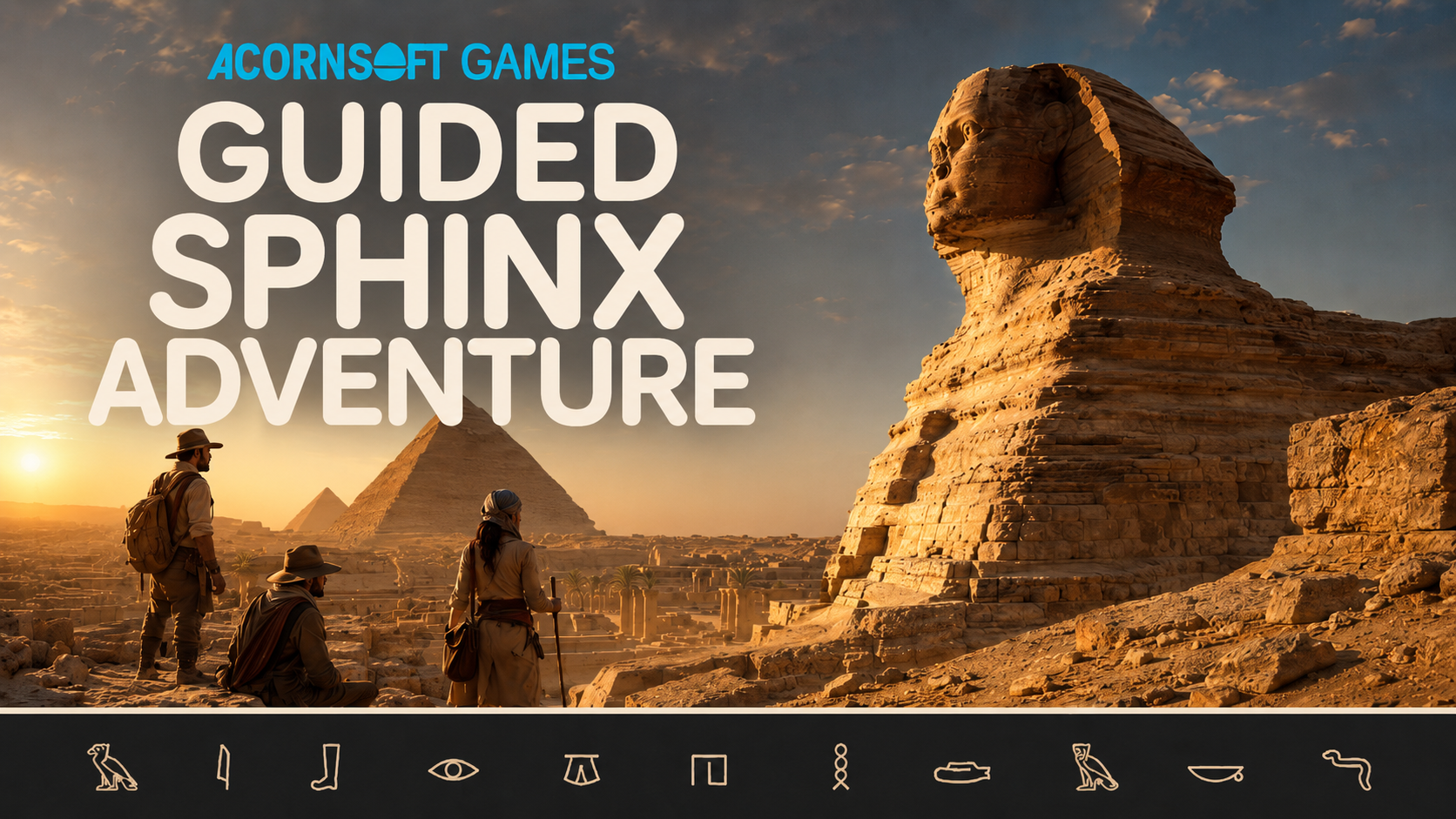
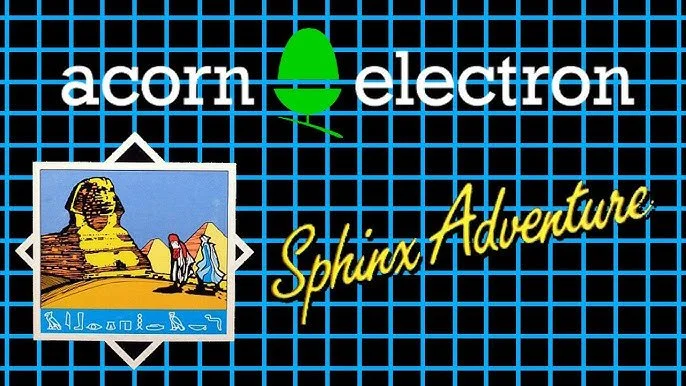
Sphinx Adventure was written by Paul Fellows and published by Acornsoft for the BBC Microcomputer Model B in 1982, with a disk version following in 1983 or 1984. It was Acornsoft's first text adventure game and one of the first interactive fiction titles available for the BBC Micro. It is Acornsoft catalogue item SLG07. It was also published for the Acorn Electron. It is the only game Paul Fellows ever published.
Paul Fellows went on to lead the team that created Arthur, the operating system that became RISC OS, which ran on the first ARM-based computers, the Acorn Archimedes. That operating system is still in use today, maintained as open-source software by RISC OS Open Ltd. The ARM architecture that grew out of the Acorn Archimedes project now runs inside the overwhelming majority of mobile devices on earth. Paul Fellows, the man who published exactly one game, spent his career at the intersection of moments that shaped modern computing.
Sphinx Adventure is not usually mentioned in that company.
The BBC Micro and the Context
The BBC Microcomputer was launched in December 1981, manufactured by Acorn Computers and commissioned by the BBC as the hardware component of their Computer Literacy Project: a national initiative to teach the British public about computing through a television series and accompanying educational materials. The machine was expensive, capable, and well-specified. It ran a 2 MHz 6502 processor with 32KB of RAM in the base Model A and 32KB or more in the Model B. It had an operating system designed for expansion, a well-documented architecture, and a BASIC interpreter of unusual sophistication.
It was also the machine that ended up in classrooms. Between 1981 and 1994, around 80% of British schools had a BBC Microcomputer. This was not accidental. The Computer Literacy Project was a government initiative and Acorn had the contract. What this meant in practice was that a generation of British children encountered computing through this machine, and that the software market it created was one of the most distinctive in the world: part educational, part gaming, part pure creative experiment, all operating within the constraints of a small beige box with a distinctive clicky keyboard that connected to the family television.
Acornsoft was Acorn's software publishing arm, a separate limited company from Acorn Computers itself, whose mission was to make money by selling software titles for Acorn's computers. It was based in Cambridge. This is relevant. Cambridge in 1981 and 1982 was not just a university city; it was the locus of the British computing industry in its formative years. Acorn itself had grown out of Cambridge. The BBC Micro had been designed there. The university mainframes contained games that students had been passing around since the late 1970s. The entire culture of early British computing had Cambridge at its centre, and Acornsoft was plugged directly into that culture.
Acornsoft had close links to the university, and it had a ready-made supply of adventure game designs because Cambridge University's IBM mainframe, known as Phoenix, had been running text adventures for years. Peter Killworth, a Cambridge academic, had been a key figure in the Cambridge adventure game tradition, porting and creating games for Phoenix that eventually made their way to the BBC Micro under the Acornsoft label: Philosopher's Quest, Countdown to Doom, Castle of Riddles. Killworth's games were the prestige end of the Acornsoft adventure catalogue, sophisticated and formidably difficult.
Sphinx Adventure arrived slightly differently.
The Author
Paul Fellows was a chemistry graduate student at Cambridge when he first encountered computing. A friend named Steve Barlow was building an Acorn Atom in his room. This was, in 1981, the kind of thing that happened at Cambridge: people building computers, passing programs around, staying up late with machines that were still more concept than product. Fellows described what happened: "I abandoned studying chemistry, which is what I was supposed to be doing, and started playing with computers all day."
He obtained a BBC Micro early, before most of the market had access to one. By the time he finished his degree, he had written a series of programs for Acornsoft. The chemistry degree that he was supposed to be studying for produced the first commercial output: Chemical Analysis, Chemical Simulations, and Chemical Structures, a trio of educational programs that converted his academic expertise into software while he was supposed to be applying that expertise to gaining a qualification. He later called this arrangement "a bit of a chemical theme going on here, using my chemistry degree that I should have been studying, but was writing programs about it instead."
The game that followed the chemistry software was Sphinx Adventure.
What motivated it was a specific encounter with a specific program. Somewhere on the network of Cambridge's mainframe computers, Fellows found Crowther/Woods Adventure. He described the discovery with a precision that suggests it stayed with him: "the idea that the computer could understand English text and react appropriately just seemed awesome." He did not describe falling in love with the world. He described falling in love with the parser. The distinction matters. It oriented everything that followed.
Fellows was not primarily captivated by the experience of being in the cave. He was captivated by the mechanism that produced that experience. He wanted to write his own text adventure "in an attempt to understand how parsing worked." The game was a means of exploring a technical question. The question was: how do you make a machine understand language? This is the question that has occupied computer scientists continuously from the 1950s to the present. In 1981, encountering it for the first time via a BBC Micro and an illegally circulated copy of Crowther's game, an undergraduate chemistry student wrote an adventure game in BBC BASIC to try to find out.
The parser he wrote for Sphinx Adventure, by his own account, was later repurposed in a conceptual sense when he joined Acornsoft and wrote the S-Pascal compiler: a language compiler that required its own parsing system for source code. The text adventure parser and the programming language compiler share a fundamental structure. Both take sequences of tokens, apply grammatical rules to them, and derive meaning. Fellows understood this. The adventure game was, among other things, practice for something more technically demanding.
Acornsoft and the Launch
Sphinx Adventure was published by Acornsoft as catalogue item SLG07, placing it seventh in their games series. It was released on cassette in 1982 and on disk in 1983, with the disk version appearing later and, as will emerge, introducing a bug that did not exist in the original. The Science Museum in London holds an example of the cassette version, donated by John Harrison, who ran the merchandising department of BBC Enterprises. It sits in their collection alongside other Acornsoft titles from the same period, documented as "an example of Acornsoft's Text Adventure games."
The game was the first text adventure Acornsoft published. Philosopher's Quest came from Killworth's Cambridge academic network; Sphinx Adventure came from a chemistry student who got his BBC Micro early. These two streams, the university mainframe tradition and the individual bedroom coder tradition, ran parallel through early British computing and converged in Acornsoft's catalogue without quite acknowledging each other. Killworth's games were longer, harder, more philosophically ambitious. Fellows's game was more immediately playable, more connected to the populist tradition of Crowther/Woods, and more obviously designed to be accessible to people who had just bought a BBC Micro and wanted to know what a text adventure was.
The Electron User magazine's review, appearing in 1986, called it "the first adventure to be released by Acornsoft" and placed it in direct lineage with "Colossal Caves." The review is measured in its praise, noting both the game's accessibility relative to Killworth's adventures and certain structural limitations, particularly the lack of a save game facility on the cassette version. The Science Museum description is blunter: "With no save or restore option, Sphinx Adventure is frustrating to play according to online reviews."
What Crowther and Woods Actually Made
To understand what Fellows was responding to, you need to understand what Adventure actually was. Will Crowther wrote the first version around 1975-1976, on a PDP-10 mainframe at Bolt Beranek and Newman in Cambridge, Massachusetts, where he was working on ARPANET. He was a caver as well as a programmer, and the cave geography in his game was based on his direct experience mapping the Bedquilt region of Mammoth Cave in Kentucky. Iron rods and axe heads in the game correspond to actual objects he encountered underground. The game was intended partly as something his daughters could play during visits.
Don Woods, a graduate student at Stanford, discovered Crowther's game on ARPANET, obtained Crowther's blessing, and expanded it significantly in 1977. His additions included most of the fantasy elements: the troll, the dragon, the treasure hunt structure, the dwarves with their thrown axes, the pirate who steals from you, the scoring system, the water bottle that can be refilled as well as drunk. The tension in the finished game, which Graham Nelson later identified precisely, is between "one intent on recreating an experienced world, the other with a really neat puzzle which ought to fit somewhere." Crowther contributed the geography and the simulation. Woods contributed the game.
The version that reached the British home computer market in 1982 did so through several routes simultaneously. Level 9 Computing released Colossal Adventure, their version of the game with seventy extra rooms appended because they had told everyone there would be two hundred rooms and counted only 130. Abersoft released Adventure 1 for the Spectrum. Various other parties had done various things to the source code across five years of distribution. By the time Fellows encountered it on the radio observatory server at Cambridge, he was not necessarily seeing the canonical version. He was seeing one of the many variants of a program that had been spreading through academic computing networks since 1977, transformed in the transmission.
What he took from it, by his own account, was primarily the parser. And what he wrote in response was something that preserved the structure of Adventure while changing its geography, its protagonist's task, and its ultimate destination.
The Game
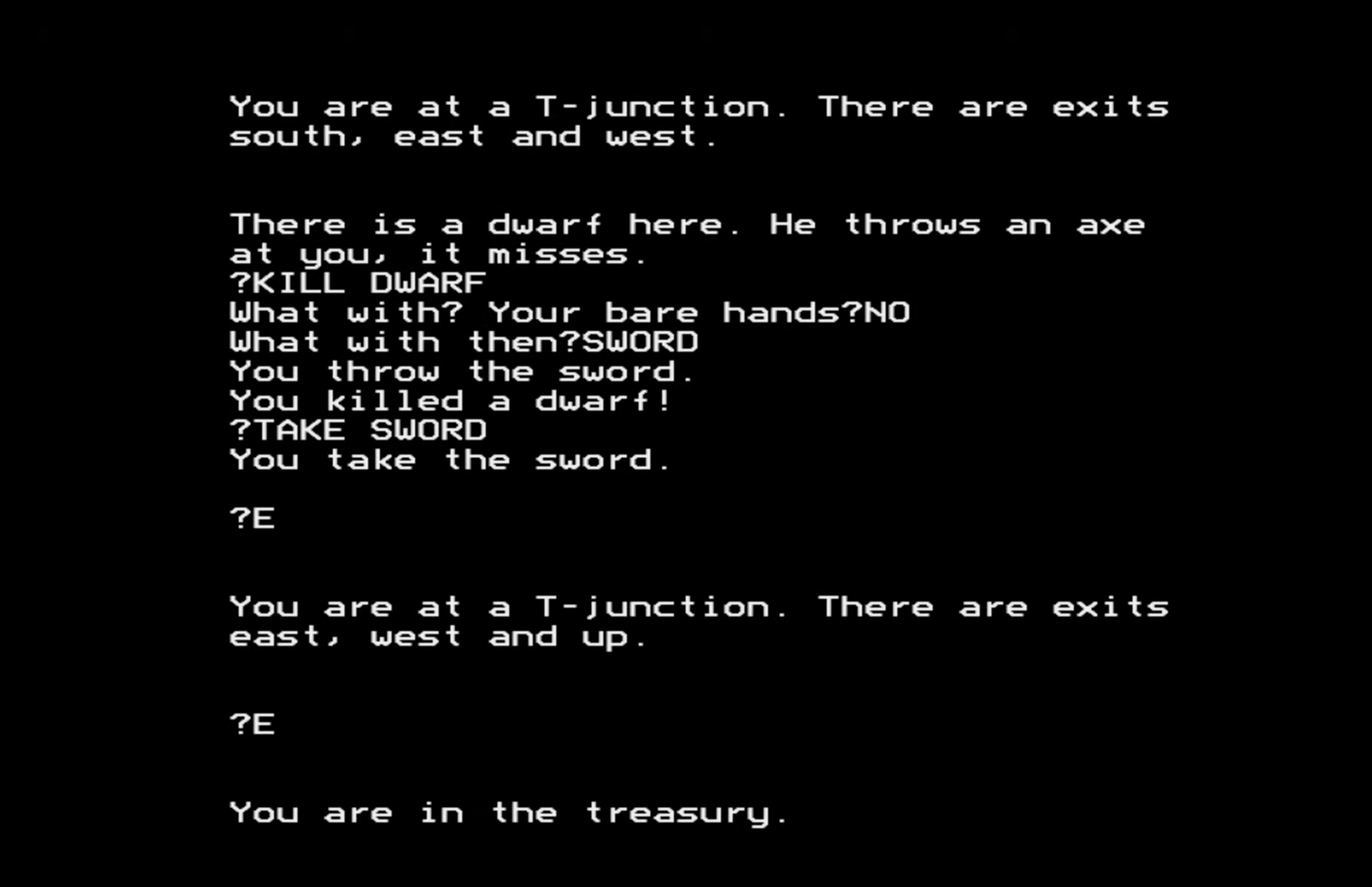
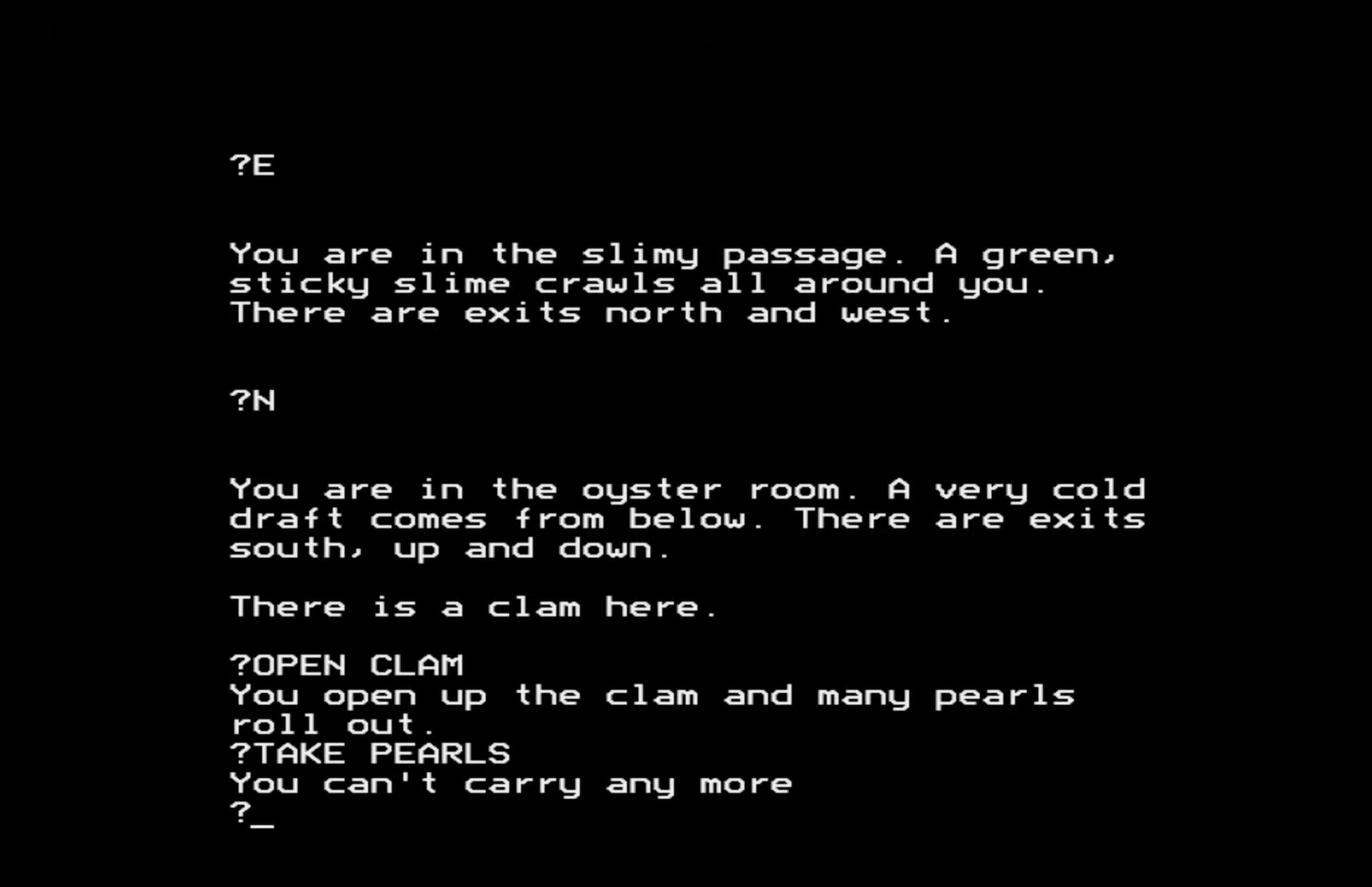
Sphinx Adventure is a treasure hunt. The player's task is to collect all available treasures and bring them to the Sphinx, which is the game's eponymous and goal-defining figure. The Sphinx sits at the end of the world, across the desert, at the conclusion of what is by general consensus one of the most tedious mazes in British text adventure history. You kneel before it and wave your wand. The game ends.
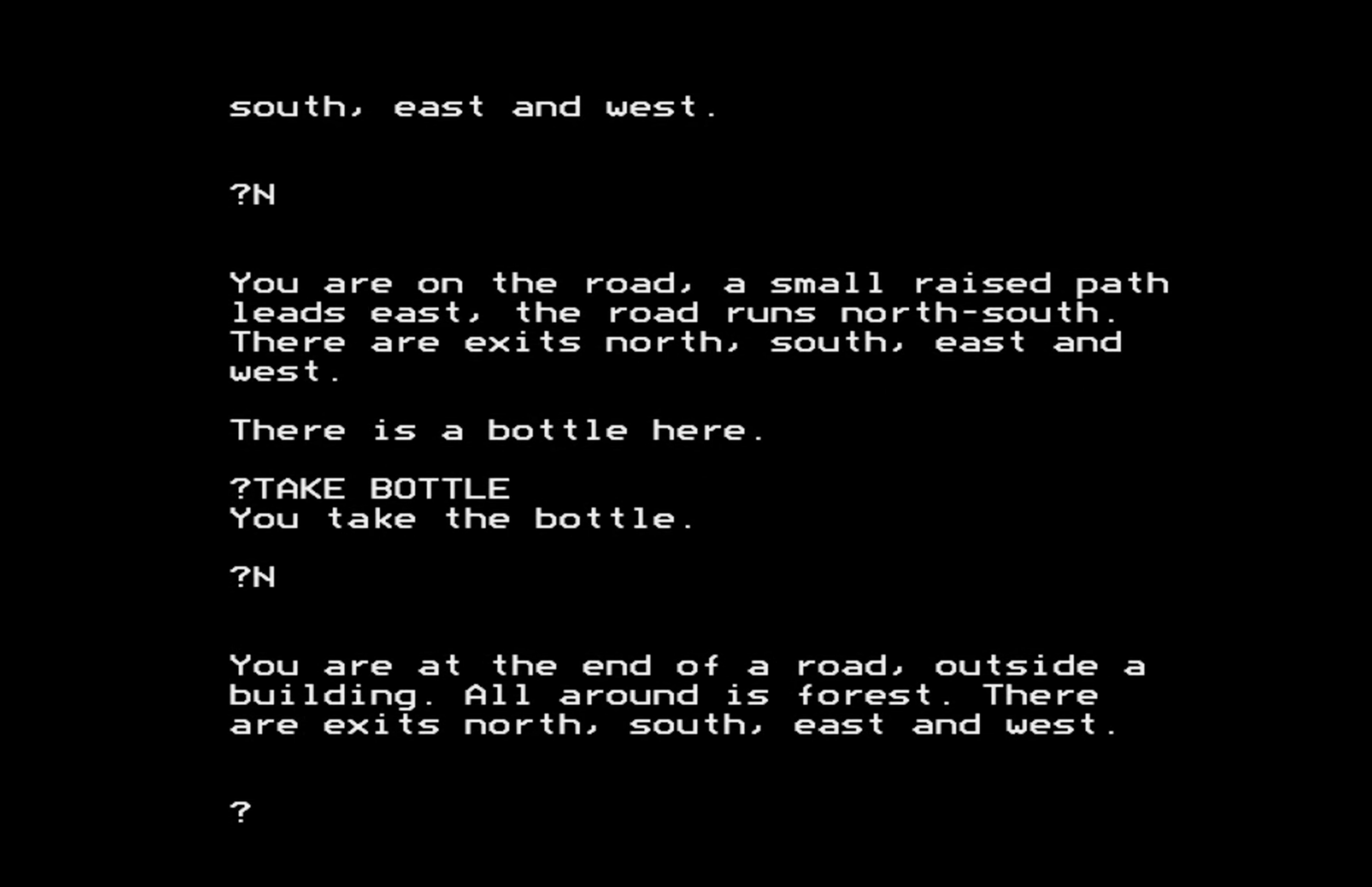
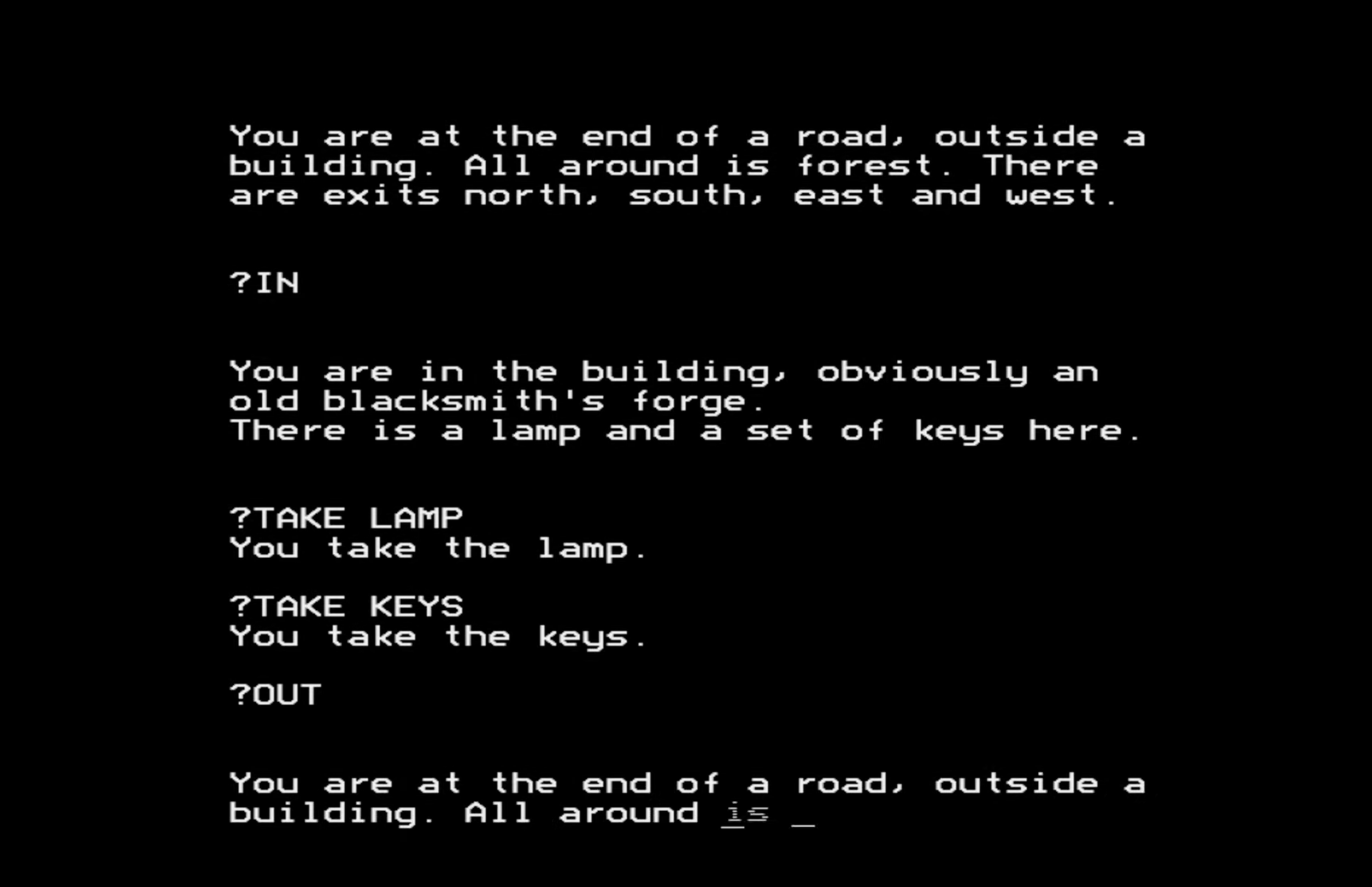
This is a slightly compressed account of what is in practice a large, complex, and frequently surprising piece of software. The game opens with the player standing outside an old blacksmith's forge, which stands in for the small brick building at the start of Adventure. Immediately to the south is a bottle, which can be filled with water at the lake south of the starting area. The lamp and the set of keys are inside the forge. The keys open doors. The lamp has a fuel supply that depletes over time, and can be replenished by rubbing it, Aladdin-style.
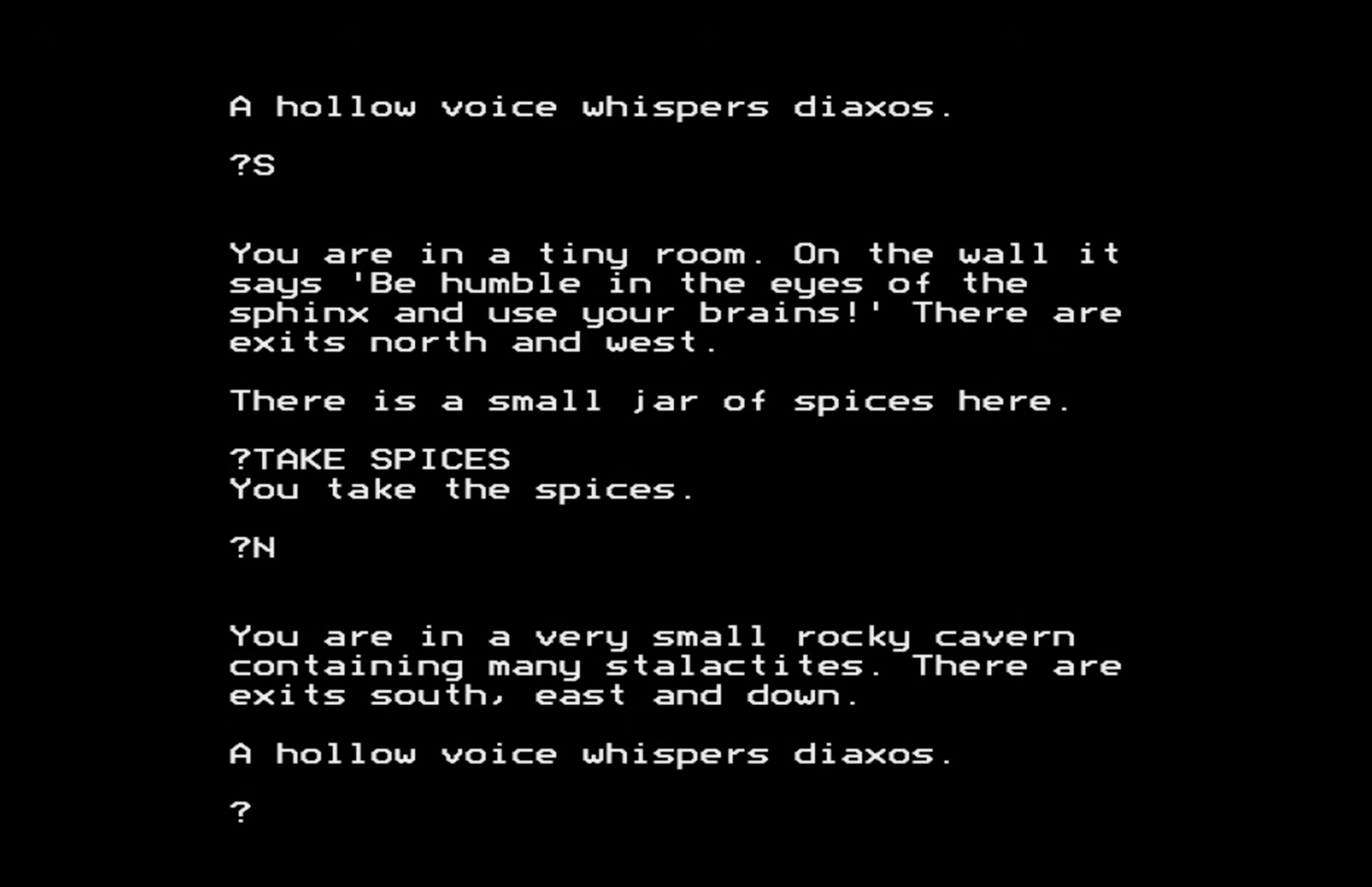
This is one of several points at which the game is doing something interesting that looks like a joke. The lamp that runs out and must be rubbed to continue is the Aladdin's lamp puzzle. The game contains a jar of spices that tells the player, in passing, to "be humble in the eyes of the sphinx and use your brains." The instruction to kneel before the Sphinx must be followed. The instruction to wave the wand must also follow. Neither the kneeling nor the wand-waving can be inferred from the game's world-building. They must be derived from the text of the spice jar message, which suggests humility and magical action, and from a careful reading of the game's verb vocabulary.
The map of the world that Fellows built expanded well beyond Adventure's cave system, into a geography that was eclectic, anachronistic, and cheerfully non-realist. Rooms that players of the game have identified across the years include: a yellow brick road, a rainbow room, a room decorated like a maharajah's palace, an alchemist's laboratory, a music room, a petrified forest, the Everglades, a Hall of the Mountain King (with goblins), a troll bridge, and various underground cave sections clearly inherited from Adventure's map. This is a collision of reference traditions that makes almost no geographical sense and perfect sense as an early text adventure by someone who had encountered one predecessor and was trying to produce something of similar scope without simply copying it.
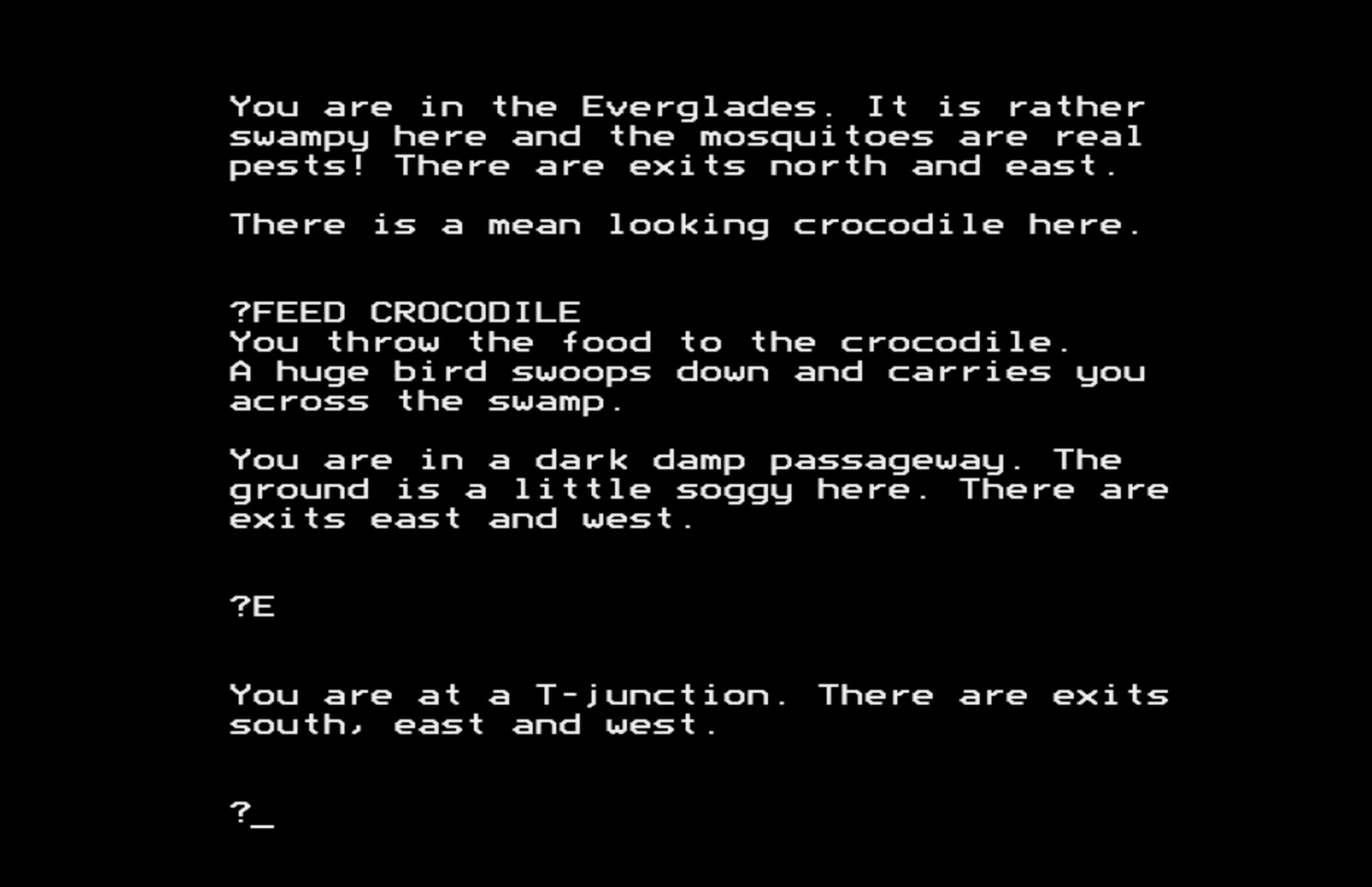
The Everglades in particular arrested at least one contemporary analyst, who noted its presence with open bafflement: "it's unabashedly old-school and in the way that doesn't bother to add realism to geography." The Everglades is there because it is a wilderness. The wilderness section of Crowther/Woods Adventure serves the same purpose: a space of forests and open country that loops back on itself, disorienting the player without lethal consequences, providing an area to place items and enemies in an environment that is not the cave. Fellows needed a wilderness. He made one. He called one section of it the Everglades, which is simply a name for a large wet wilderness. The logic is complete.
The Creatures and the Puzzles
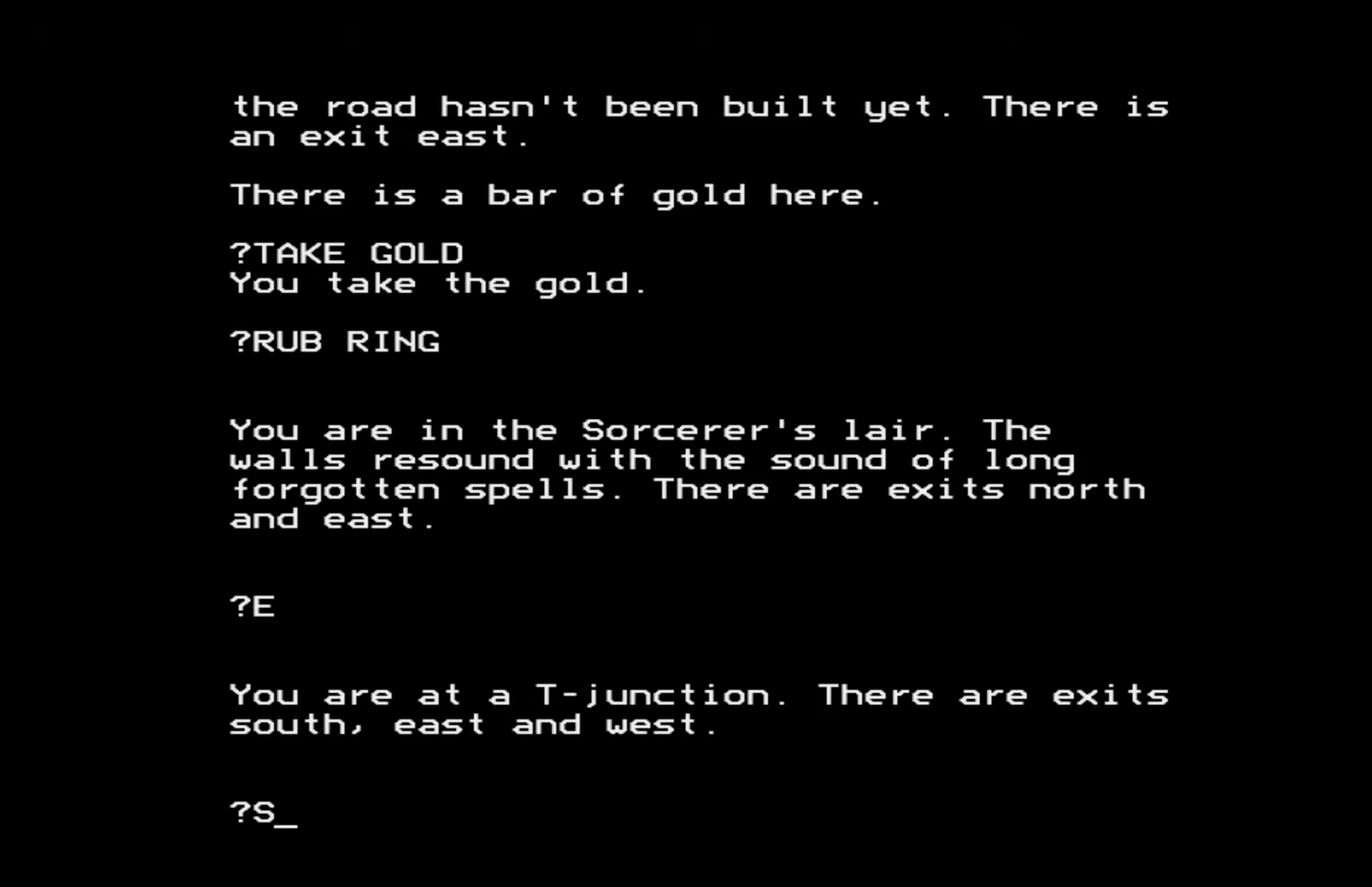
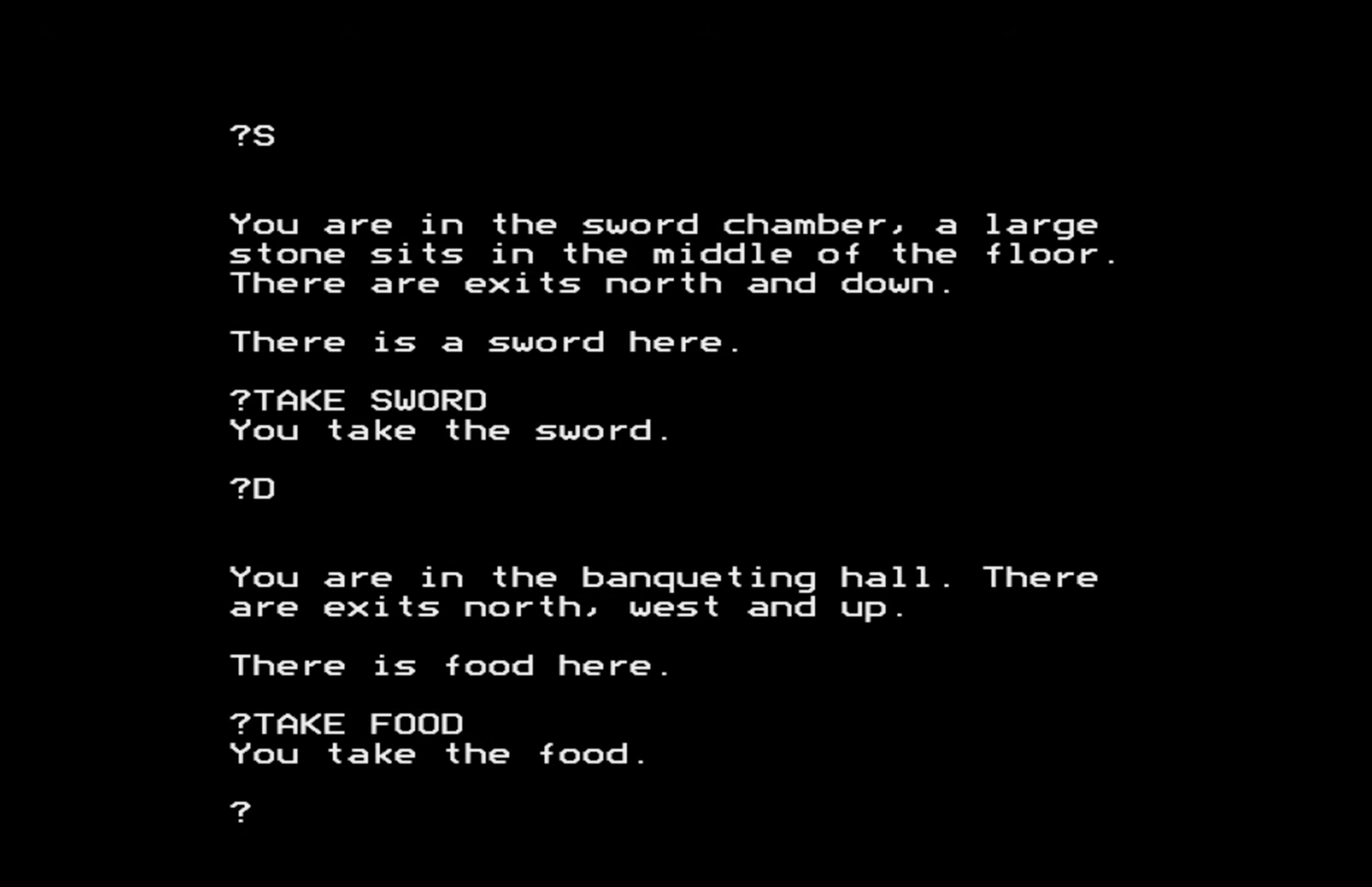
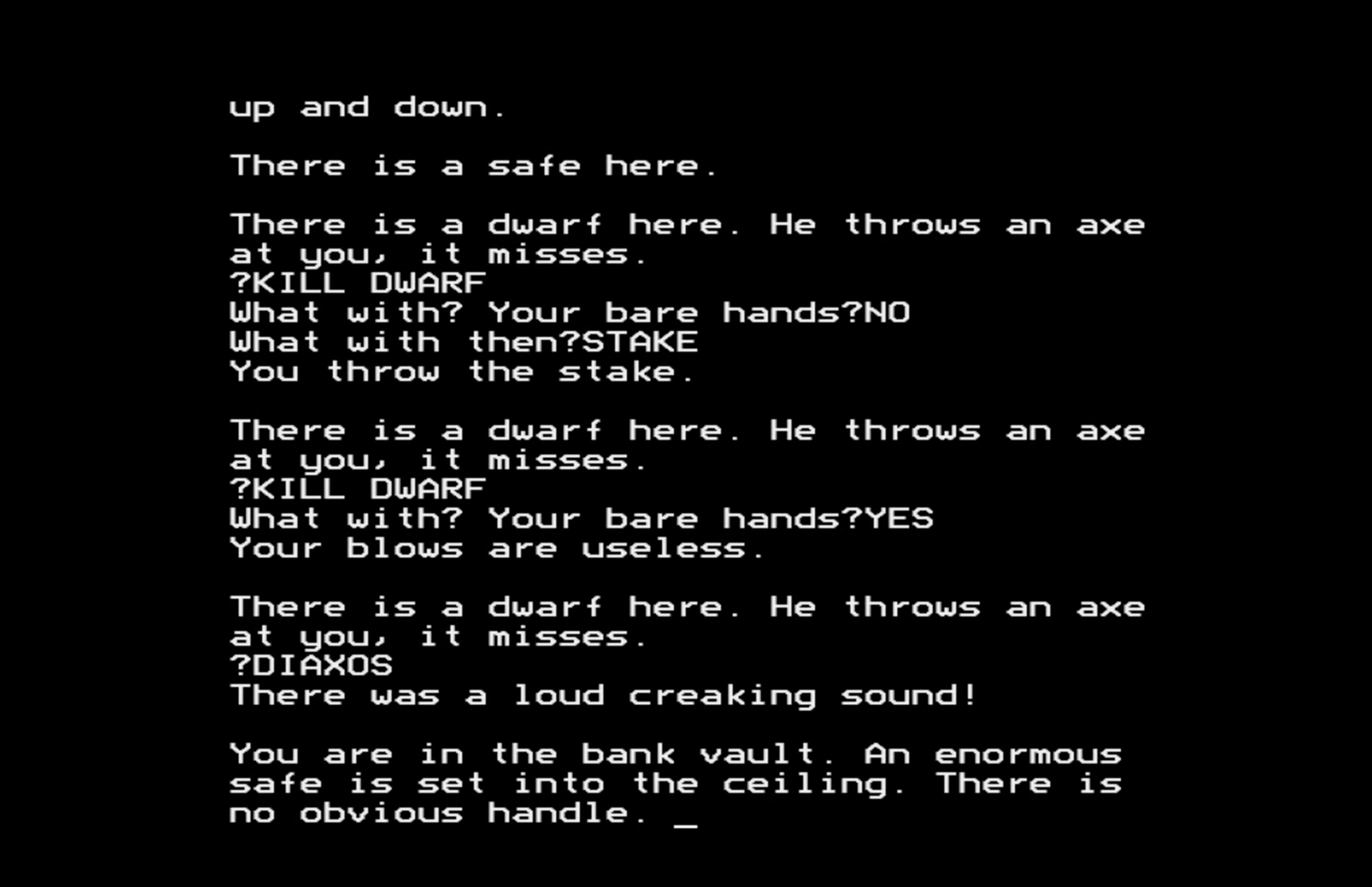
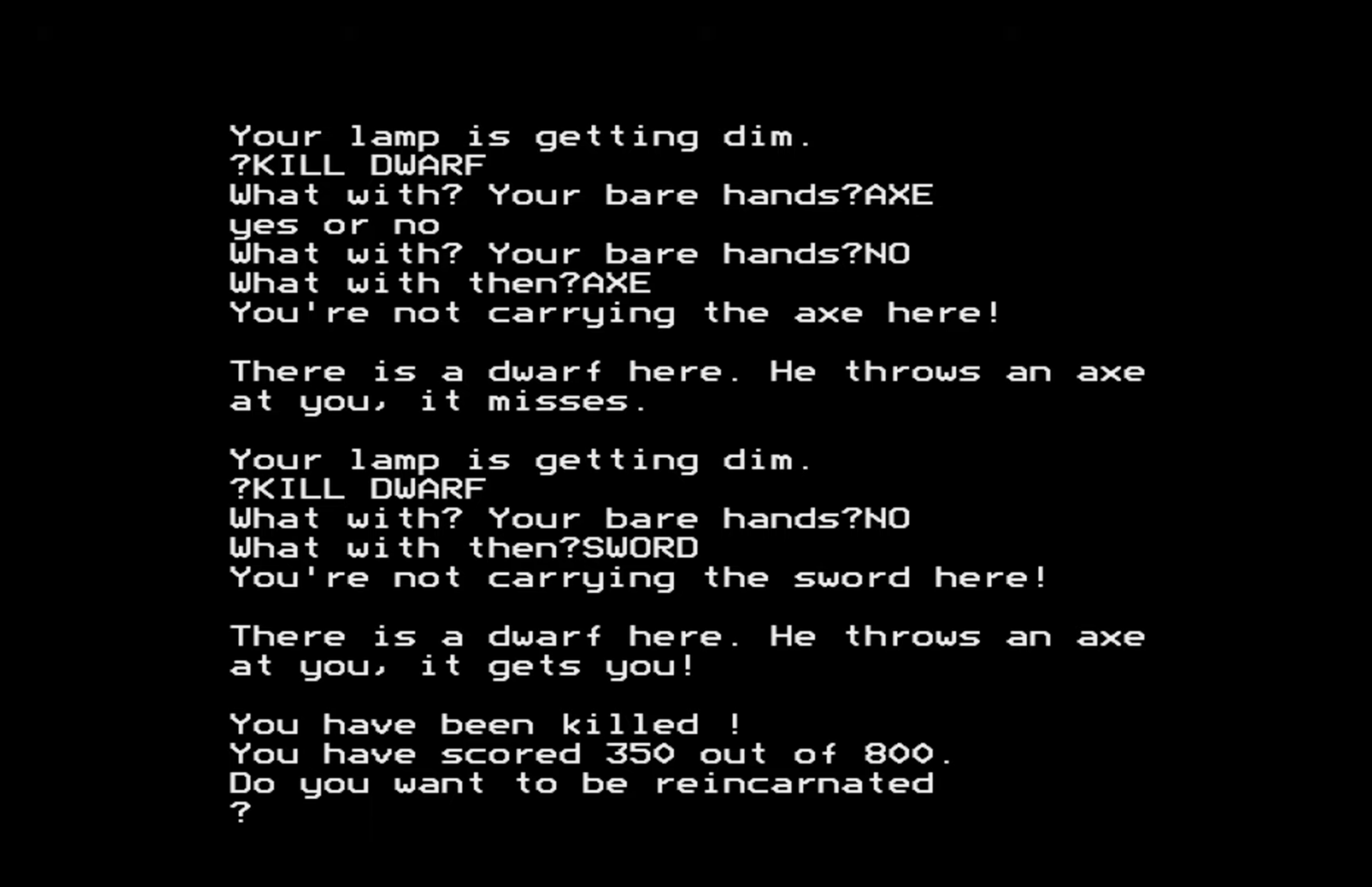
The game is populated by a cast partly inherited from Adventure and partly invented. The dwarves appear, throwing axes as in the original. The first dwarf you encounter throws an axe that you can keep; subsequent dwarves still throw axes, which then disappear. A pirate occupies a crossroads. He does not kill you if you attack him; he "dodges smartly away into the tunnels." He steals items from you as you pass, but his presence at the crossroads can be avoided, and he does not activate his theft behaviour until you have actually met him once. His hoard is stored somewhere you can retrieve it. The troll takes a toll: you can pay him anything, since you can recover the payment afterward.
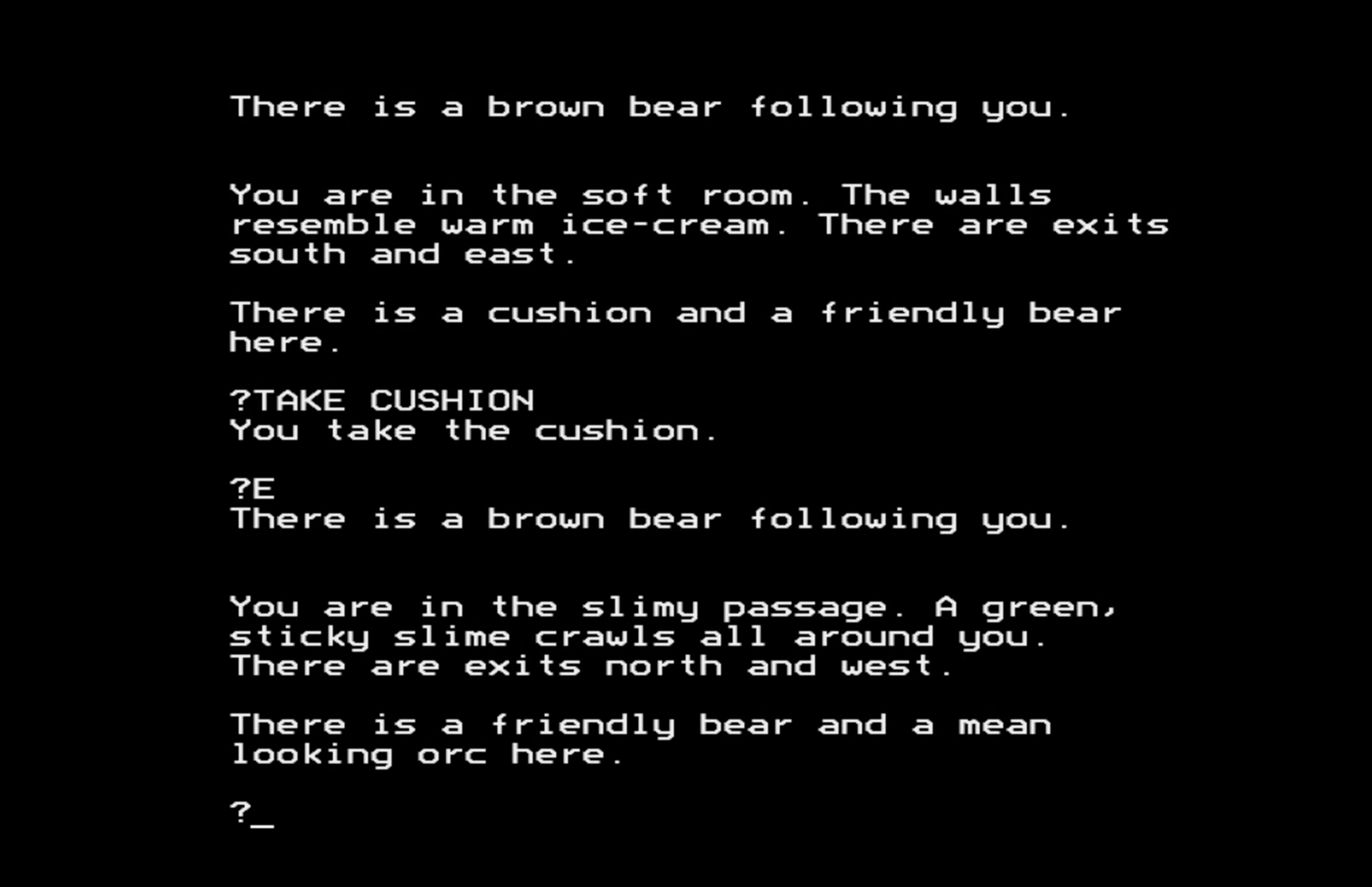
These creatures are presented with enough eccentricity to establish that Fellows was not simply copying Adventure but transforming it. The bear that follows the player in Adventure, notoriously, requires feeding before it will accompany you; in Sphinx Adventure, a friendly bear simply begins following you without any such requirement. It follows you around. It will eventually prove useful: orcs are frightened of bears, and you can use the bear to drive orcs away. You can frighten it with a mouse. The mouse can be picked up if you have the right item to entice it with: cheese. The Stilton cheese is in the west. This is a chain of creature-item dependencies that requires the player to have learned the relevant connections, usually through failed attempts.
The creatures that cannot be killed include the pirate, as noted. The creatures that require specific items to be killed include the dragon, the ogre, the vampire. The dragon yields teeth when killed, and those teeth are needed to frighten the goblins in the Hall of the Mountain King. The ogre requires a sword, but you lose the sword when you use it: "be bold and use no extra weapons at all" means that if you go in with only your bare hands, the ogre is killed differently and you preserve your weapon. The vampire requires a wooden stake.
The elephant, which you cannot remove, is removed by using a mouse: elephants fear mice. This is a puzzle whose logic is cultural rather than mechanical, depending on the player knowing a piece of folk wisdom about elephant psychology that is not stated in the game. This is entirely typical of text adventure design in 1982, and should be understood as such. The genre at this point assumed shared cultural knowledge. You were expected to know that Aladdin rubbed his lamp. You were expected to know that elephants fear mice. You were expected to know, by extension, that if you cannot shift an elephant, you should look for a mouse.
The crocodile, which blocks a passage, is fed: FEED CROCODILE. You need food for this. The food is underground.
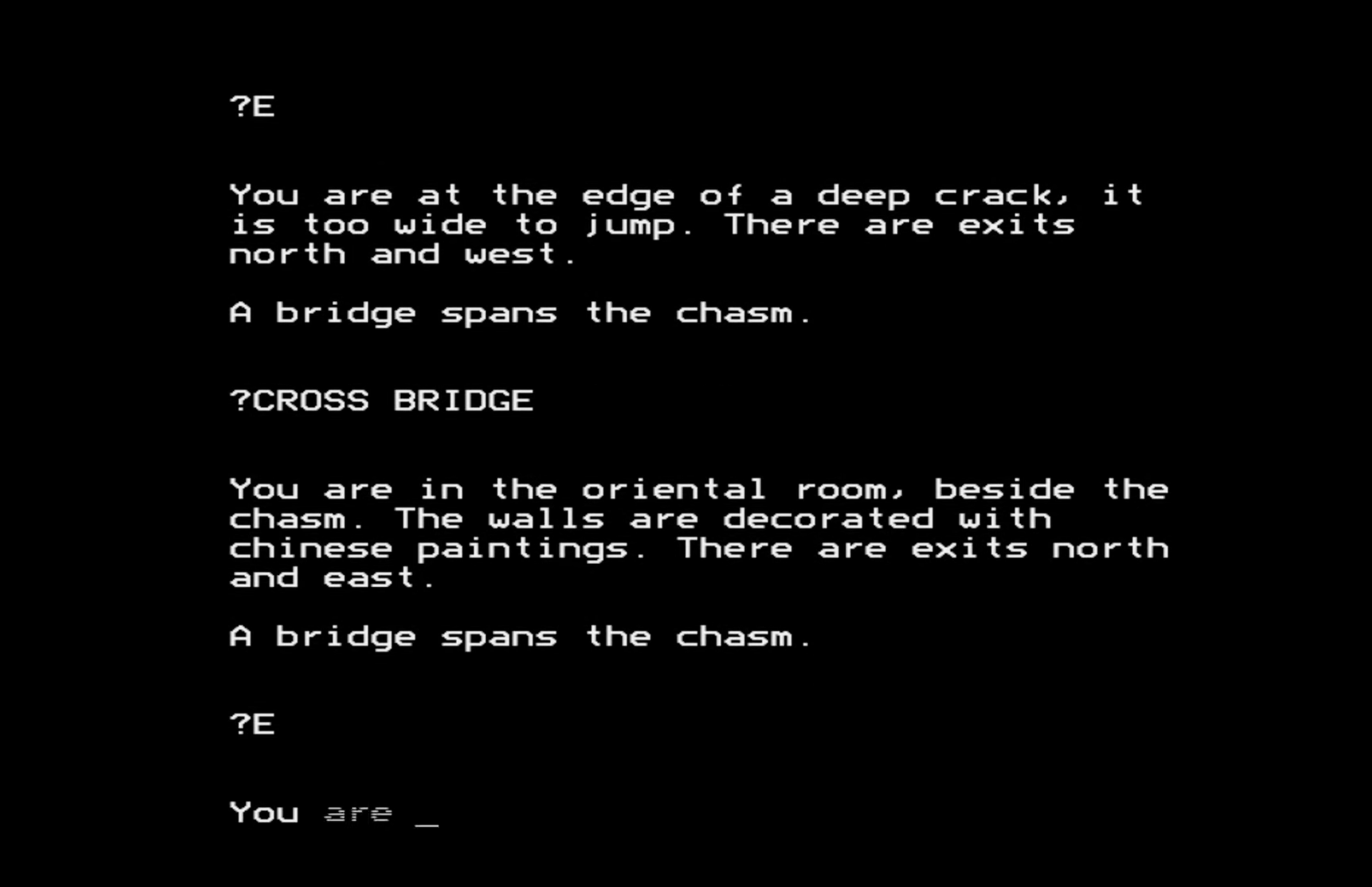
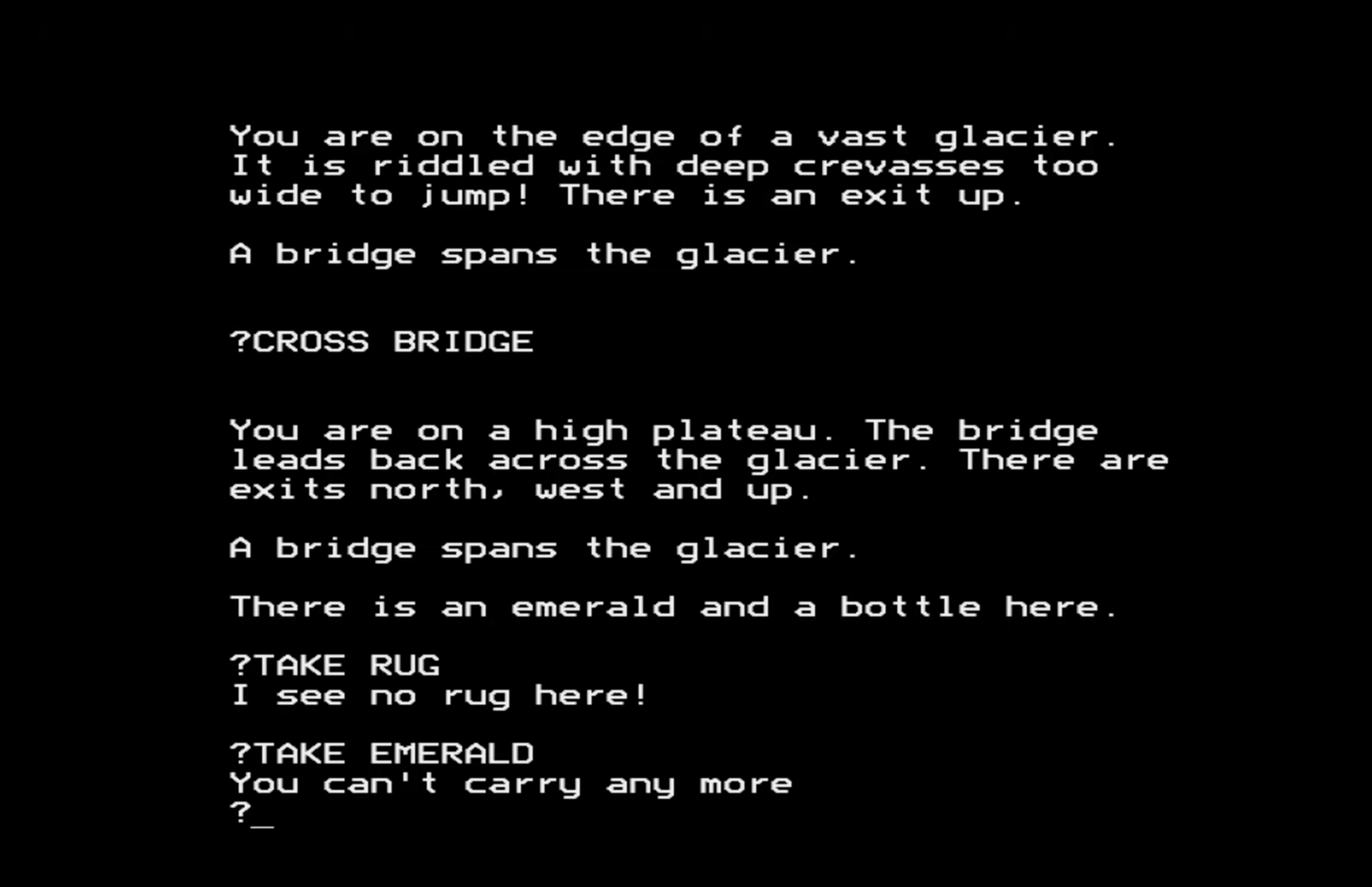
The clam requires a jack to open. The mithril ring is needed to cross the glacier, which breaks without it, and to escape from under a rockslide (RUB RING). The same ring can wave across chasms with WAVE WAND.
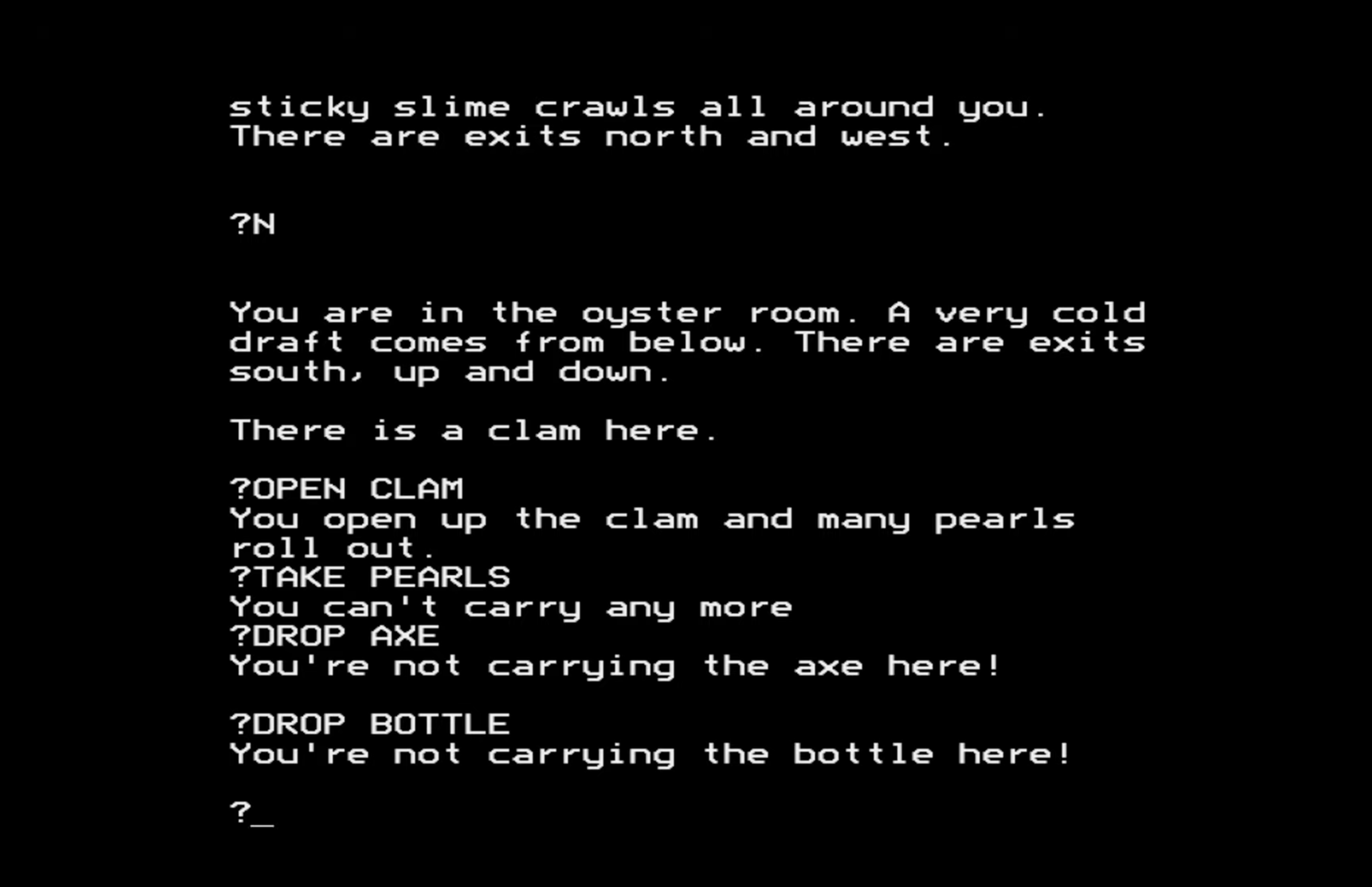
The full treasure list, recoverable from the game's BASIC code, includes: sapphires, diamond, gold, silver, platinum, rubies, emerald, pearls, coins, opals, books, spices, sceptre, cushion, rug, ring, bottle, and water. Each scores 30 points at the Sphinx, producing a theoretical maximum of 860 points. However, some items cannot coexist in the player's possession at the end of the game (you cannot have both the water and the bottle as separate score-generating items), placing the practical maximum at 800 points. A 1986 article in Electron User's Merlin's Cave column confirmed the breakdown: 630 points for the treasures collected and 170 for depositing them at the Sphinx.
The scoring system was one of the game's more distinctive features. The instructions state that the game "keeps careful track of score penalties for errors." This extended the Adventure tradition of score deductions for hints and resurrection into a more systematic penalty framework. Errors cost points. The maximum score of 800 is thus only achievable if you play efficiently, without making the mistakes that the game registers and penalises. In practice this meant that first-time players, exploring to learn the game's vocabulary and puzzle logic, would emerge with scores well below the theoretical maximum even when they had technically won.
The Compass and the Missing Diagonals
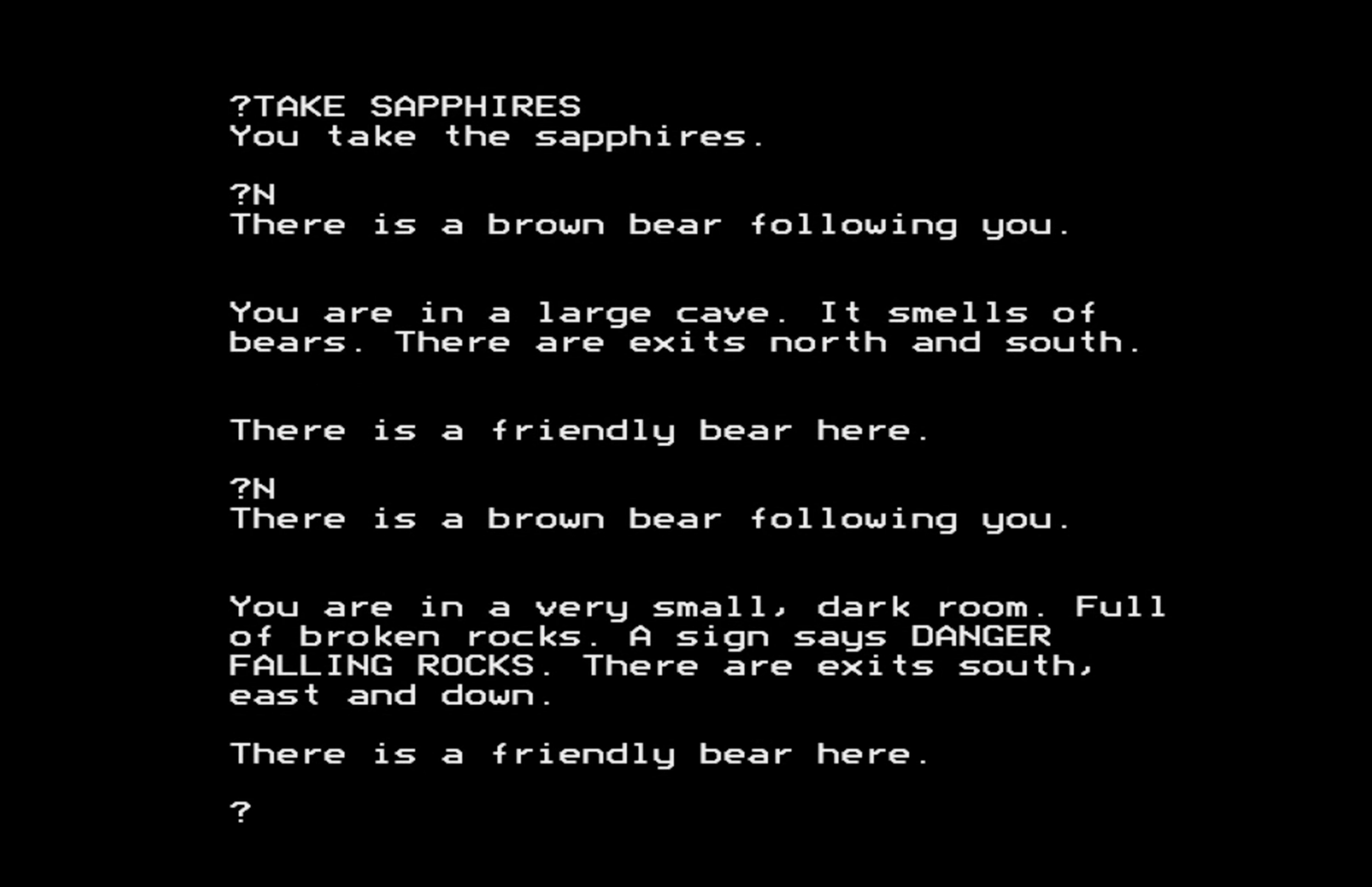
One significant departure from the Adventure template was the exclusion of diagonal movement. Crowther/Woods Adventure used cardinal directions (N, S, E, W) plus up and down, and Sphinx Adventure follows this pattern. It does not recognise NE, SE, NW, or SW. This makes the game easier to map in one sense: everything is at right angles. In another sense it produces an oddly constrained spatial vocabulary for a game that includes the Everglades and a maharajah's palace. You turn square corners in the Everglades. The manor is rectilinear.
The inventory limit, by contrast, was more generous than Adventure's. The original game enforced fairly tight carrying limits. Sphinx Adventure initially appeared to have no limit at all, which produced a distinctive strategy: since the Sphinx is hard to find and may be at the end of a one-way journey across a long desert maze, the sensible move is to carry every scoring item simultaneously before attempting the final traverse. The game does have a limit, but it is high enough that this massing strategy is at least plausible.
The Desert
The desert maze at the end of Sphinx Adventure is the game's most infamous element and the reason it received the unkindest contemporary reviews. The IFDB review is barely polite on the subject: "The final interminable maze may have you quitting through sheer exhaustion. Not since Peter O'Toole rode his blue eyes through a seemingly endless David Lean desert in Lawrence Of Arabia has one man or woman suffered on the sand so much as the player nearing the end of this."
The walkthrough on the Solution Archive, which is the reference document for anyone attempting a complete score, shows the desert section in its full horror: a sequence of cardinal-direction moves that takes dozens of steps, contains at least one exit that sends you back to the start, and provides no landmarks or distinguishing features. The Renga in Blue blogger, attempting to complete the game for a meticulous contemporary playthrough series, reached this point and simply looked up the solution: "From Stardot. Yes, it takes that many steps. Yes, there's a wrong exit near the end that sends you to the start."
The apologia for the desert is legitimate and worth stating. Fellows had encountered exactly one text adventure before writing this one. He had not played the many games that came after Adventure and consciously abandoned mazes as a design convention. He had absorbed mazes as a constitutive element of the adventure game form. The mazes in Crowther/Woods Adventure are famous: the "maze of twisty little passages all alike" is one of the most remembered locations in gaming history. Fellows, making an adventure game, included mazes because mazes were part of what adventure games were. He did not yet know they were a problem.
The desert is not poorly designed. It is designed in a tradition that had not yet been criticised, by someone who had no access to the criticism that would eventually develop. On those terms it is a period artefact, a specific kind of obstacle that the genre used extensively in its first decade and largely abandoned in its second. It is also genuinely awful to play through.
The Hall of the Mountain King Bug
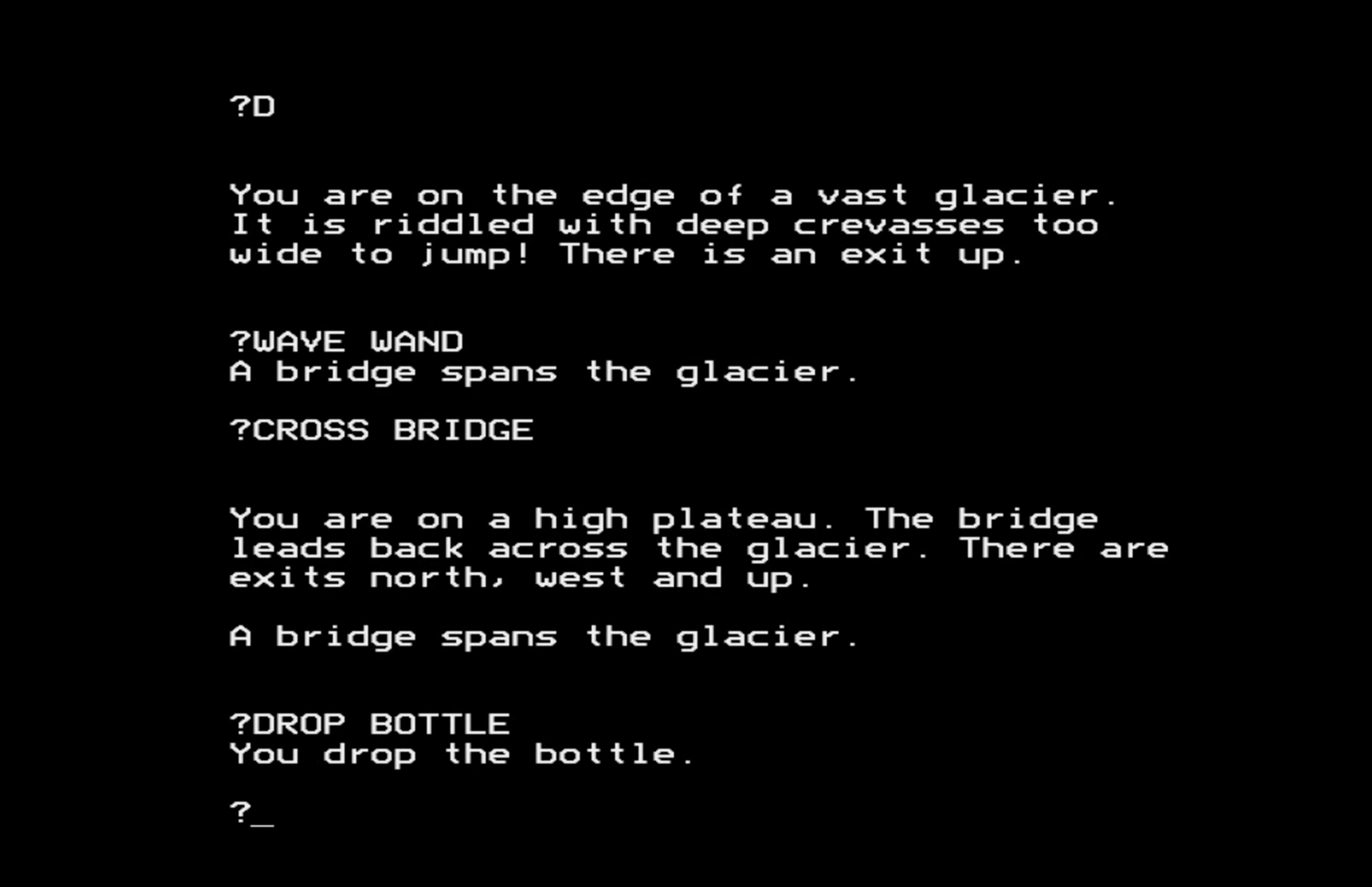
The Hall of the Mountain King is a location name borrowed directly from Grieg's orchestral piece, which Manic Miner would make more famous the following year in a different context. In Sphinx Adventure it is a cave chamber occupied by goblins, who can be frightened away with the dragon's teeth. To obtain the dragon's teeth you must first kill the dragon. The teeth are then found in the location, not carried by the dragon.
In the disk version of the game (Version 2), a bug in the goblin encounter code produces an error that crashes the game. The specific technical failure involves a function called PROCp that was changed during the process of "crunching" the BASIC to fit on a disk version of the game under DFS. The original PROCp took two arguments: a string and an integer for the word-wrap column. In the disk version, it was simplified to take only one argument, a string. But the modification was incomplete: one call to PROCp still passed two arguments, and that one call, on line 195 of the disk version, is the Hall of the Mountain King encounter.
When the player enters the Hall of the Mountain King for the second time in the disk version, the game crashes with an "Argument" or "Bad Program" error. This is the bug that Paul Fellows himself confirmed was real when contacted via the Stardot forum. He was still reachable by the retro computing community when the bug was investigated in 2021, and he provided his recollection of the game's structure via the forums. He did not remember the bug. He wished he still had the original source code: "Not the published 'crunched' code where all the long variable names have been stripped out."
The tape version, Version 1, does not contain this bug. The disk version, Version 2, does. The people who played the game in 1982 on cassette played a version that did not crash in the Hall of the Mountain King. The people who encountered the disk version played a version that did. Since the disk version was presumably the version that remained in circulation as hardware capable of using tape became rarer, this means that a proportion of the game's later players, including those who played it online via BBC Micro emulation sites after the game's preservation, encountered the bug without necessarily understanding what had happened.
A corrected version, sometimes listed as Version 3, circulates in the Stardot community. It uses mixed-case text where the earlier versions used ALL-CAPS output, runs faster, and has the Hall of the Mountain King bug fixed. It also includes, as an addition from the community, a fan-made map that was eventually packaged with later distributions.
The Versions
The three substantive versions of Sphinx Adventure represent the game's entire published and corrected history.
Version 1 is the original cassette release of 1982. It includes an introductory screen: "WELCOME TO THE SPHINX ADVENTURE / GOOD LUCK IN YOUR EXPLORATIONS HERE!! / Try to find all the treasure and take it to the sphinx." Version 1 uses ALL-CAPS output throughout. PROCp takes two arguments. No Hall of the Mountain King bug. No save facility. The Electron version of the game requests MODE 7 even though the Electron lacks MODE 7, a vestige of the BBC Micro original that was not caught before publication.
Version 2 is the disk release. The introductory banner was removed, probably to save bytes when "crunching" the code to fit on a Model B with DFS. PROCp was changed to take one argument, but incompletely. The Hall of the Mountain King bug is present. A save/load facility was added: the disk version allows you to save your position and restore it, which addresses the most serious practical complaint about Version 1. Various message texts were shortened. The Stardot forum has a complete listing of every text change between Versions 1 and 2, assembled by community members who compared the two in detail. The version 1 texts are, by common consensus, better written; the version 2 changes were driven by the need to save bytes rather than by editorial judgment.
Version 3 is the community-corrected version circulating via the Stardot preservation project. It fixes the bug, converts to mixed case, runs faster, and includes the fan-made map. It is not an official Acornsoft release and was never sold commercially.
The differences between versions reveal the specific character of early software production: informal, unchecked, made under time and memory pressure that produced changes whose downstream consequences were not fully tracked. Someone crunched the BASIC to fit on the disk. They changed PROCp. They did not test every call to PROCp. The Hall of the Mountain King, deep in the game, was not reached during whatever testing occurred. The bug shipped.
The BBC BASIC Question
Sphinx Adventure was written in BBC BASIC. This requires a moment. BBC BASIC was not a natural language for game development. It was a structured, relatively sophisticated BASIC dialect, better than most of the contemporary alternatives, but still BASIC. It was interpreted, which meant it was slow compared to machine code. It used line numbers. It required careful memory management to fit a game of any size within the BBC Micro's 32KB.
The game is large enough that its disk version was a problem to fit under DFS (the Disk Filing System), which left the PAGE register at a higher address than the tape system, reducing the available memory for the program. The "crunching" process, which is what produced Version 2's various changes, was an attempt to shrink the code. One person's account on Stardot describes the game's memory demands in educational terms: "I remember BITD [Back In The Day] we had the Sphinx running across our Level 1 Econet. This was quite an achievement considering the 12K file size limit of the server. We had to split the code into three sections and write a loader program that *LOADed each section to the right place in memory."
The game's code, once revealed by community analysis, shows the variables named with full long names before crunching (the published version has these stripped) and a structure that reflects BBC BASIC's constraint of integer variable arrays and string manipulation without dynamic memory. Fellows had built a working adventure game parser in a language that made parsing laborious. The parser itself, as he later noted, was structurally similar enough to what he would build into the S-Pascal compiler that the adventure game can be read as a prototype for a more serious piece of language engineering.
Peter Killworth and the Other Tradition
Understanding Sphinx Adventure requires understanding what it was not. The other tradition of Acornsoft adventure games, the one that defined the company's reputation in the genre, came from a completely different source.
Peter Killworth was a Cambridge academic who had been involved in the Cambridge computing scene since the 1970s. The Phoenix mainframe at Cambridge had hosted adventure games since 1978, when Jon Thackray and David Seal wrote Acheton, which was reckoned by many to be one of the most difficult and largest adventure games in existence. It was so large it could not fit on a cassette and came on two disks. Killworth began by modifying a game known as "Brand X" to produce Philosopher's Quest, his first release for Acornsoft, which came out in 1982 alongside Sphinx Adventure.
These two games represented the extremes of what Acornsoft was publishing. Philosopher's Quest was extraordinarily difficult, full of bizarre puzzles (requiring a gas mask to carry a piece of Gorgonzola cheese that would otherwise kill you with poisonous fumes), with an enormous map, and a reputation for unfairness that was worn almost as a badge of honour. Sphinx Adventure was accessible, clearly descended from Adventure, playable by someone who had just bought their BBC Micro and wanted to know what all this text adventure business was about.
The IFDB entry for Sphinx Adventure notes that "this game received a lot of negative reviews in days of yore" while also observing that the reviewer "was always impressed." Contemporary accounts suggest that the negative reviews focused on the desert maze and the lack of save facility. The positive assessments focused on the accessibility and the quality of the world-building within the Adventure tradition. "Warped the minds of a whole generation," in Fellows's own self-description at a conference many years later.
The No-Save Problem
The cassette version of Sphinx Adventure had no save facility. This was not unusual. Many early BBC Micro games had no save facility. But for a game of Sphinx Adventure's length and complexity, the absence was felt acutely. The game was long enough that a single session was unlikely to be sufficient. You could reach a state well into the map, close to the Sphinx, and then make a mistake or run out of time and have to start again from the road outside the blacksmith's forge.
The Electron User review addressed this directly: "You can find out your score at any point during the game by typing SCORE. An additional procedure on the disc version allows your current position to be saved and then loaded back into the adventure." This additional procedure on the disk version was one of the few genuine improvements over the cassette. It came with the bug in the Hall of the Mountain King, but it at least allowed progress to be preserved.
The community found a workaround for the cassette version's lack of a save facility, described somewhat cryptically in the Renga in Blue comments as "a clever way round it." The specific method is not fully documented in available sources, but likely involved either making a tape copy of the computer's RAM state at a particular point or finding a way to capture the BASIC variables. Neither would have been obvious to a casual player in 1982.
The disk version's save facility, while welcome, introduced its own complexities. The save/load mechanism stored the current game state to disk under a filename you specified. Restoring from the wrong save, or losing the floppy, meant starting over. The flexibility was real but the reliability was limited by the hardware of the period.
Paul Fellows After Sphinx Adventure
Sphinx Adventure was published in 1982. Paul Fellows joined Acornsoft as an employee shortly after, having written the game and the chemistry software while still a student. His title was Head of Languages. He was responsible for the Acornsoft languages group, which meant managing and testing the programming language implementations for the BBC Micro: LISP, Forth, Logo, BCPL, Pascal, COMAL, Prolog. He did not write most of these; he managed and tested them. Writing the S-Pascal compiler, which was his own technical contribution, was the project in which the parser skills he had developed for Sphinx Adventure found their next application.
The languages group operated with considerable autonomy. "Management didn't really care what we did as long as it made money," Fellows recalled. This autonomy allowed them to work on things beyond the immediate mandate. The Graphics Extension ROM for the BBC Micro, which added ellipses, flood fills, and other graphic operations to the standard ROM suite, was produced by Richard Manby in the languages group when he ran out of languages to implement. That extension was eventually incorporated into the BBC Master 128 operating system.
This incorporation was significant. It was the first time Acornsoft, as a separate company, contributed software that went directly into an Acorn machine. It established the credibility that led to what came next.
In 1986, Acorn was developing the Archimedes, its new ARM-based computer. The planned operating system, ARX, was being developed in Palo Alto by a team of highly paid Californian engineers. It was ambitious: preemptively multitasking, multi-threaded, multi-user, written in Acorn-extended Modula-2+. It was also, on the ARM silicon of 1986, catastrophically slow and nowhere near ready. Acorn had hardware that was going to market with no software.
Paul Fellows was hauled before the Acorn board of directors. They told him the hardware was being made and they had no software. They asked if the Acornsoft team could produce a BBC-like operating system in five months. "And like an idiot, I said yes," he recalled.
The codename for what they produced was Arthur, which stood for "A RISC by Thursday." Four people, including Fellows himself (who handled the VidC controller, palette, I2C interface, real-time clock, and EEPROM), built an operating system from scratch in five months. It shipped with the Acorn Archimedes in 1987. The Archimedes ran on the ARM processor that Acorn had designed. The ARM processor that Acorn designed became the foundation of the ARM architecture. The ARM architecture now runs in the phone in your pocket.
Arthur became RISC OS. RISC OS is still maintained, in open-source form, today. It was designed by a small team under pressure, in five months, by the person who had previously published one adventure game for the BBC Micro.
During the Arthur development, Fellows claimed another distinction: he invented the icon bar across the bottom of the screen. The Mac had a text menu bar across the top, and Acorn needed to be different. "We can't go across the top, we'll have to go across the bottom, and we can't use text, so we'll have to use icons." That is why RISC OS's desktop looks the way it does. An icon bar at the bottom rather than a menu bar at the top, because they needed to be legally distinct from Apple. One of the people on the Arthur team later joined Microsoft in Seattle, and shortly afterward Windows acquired a similar icon bar. "I know how that idea got there," Fellows said.
He left Acorn in 1987, worked on the Genesis multimedia system at Oak Solutions, then on Fireworkz for Colton Software, and was last known to be CEO of Kynesim, an electronics company.
What the Game Is
Sphinx Adventure is a specific kind of thing: the immediate response of an intelligent person to a major cultural shock, built in the medium of that shock. Paul Fellows encountered Crowther/Woods Adventure and wanted to understand it. He understood it by building a version of his own. The version he built was not a copy but a transformation: different geography, different mythology, different destination (the Sphinx rather than the trophy room), different vocabulary, and a different treatment of some of the inherited creatures.
The game has two qualities that mark it as the work of someone who cared more about the mechanism than the world. The first is the parser, which was the thing that captivated Fellows and which he built carefully and later rationalised into other contexts. The parser in Sphinx Adventure handles the standard two-word adventure command vocabulary: VERB NOUN, with a range of recognised synonyms. TAKE and GET both work. GO N and N both work. FILL and ENTER and PAY are in the vocabulary. The game's instructions explicitly invite exploration of verbs and nouns as the primary mode of discovery: "Don't be afraid to experiment with a wide range of verbs and nouns. Only in this way will you discover the vocabulary of the adventure."
This is the parser speaking. The game is, at least partly, a demonstration that a small machine could understand English text commands and react appropriately. The demonstration was the point. Everything else, the bear and the orc and the dragon's teeth and the Everglades, was the world that the demonstration required in order to exist.
The second quality is the scoring system's integration of penalty points. Original Adventure had point deductions for hints and resurrection. Sphinx Adventure extended this into a more systematic accounting of errors, penalising exploration in a way that Adventure had not quite done. This means the game has a dual character: it can be played casually, as an exploration, with a score that declines with each mistake; or it can be played optimally, as a puzzle of efficiency, attempting to recover the maximum 800 points by minimising errors. The two playing experiences are substantially different. Most players experienced the exploratory version. The optimal version is a kind of speed-run of the 1982 adventure game.
The Legacy
What Sphinx Adventure left behind is not influence in the usual sense. No one cites Sphinx Adventure as an influence on their game. The game did not have Manic Miner's reach or Atic Atac's design ambition. It did not have Peter Killworth's reputation or Level 9's technical innovation. It was the first Acornsoft text adventure, and it was good enough to satisfy that role, and then a harder, more complex, more ambition-saturated tradition of British adventure gaming came along and Sphinx Adventure receded into the background.
What it left, though, is a small but durable community of people who played it in childhood and remember it with specific vividness. The stardot.org.uk forum, the primary community for BBC Micro enthusiasts, has threads on Sphinx Adventure that extend over years: people rediscovering the game, mapping it, debugging it, porting it to run natively on multiple platforms, discussing the relative merits of Version 1 and Version 2 messages, arguing about whether the desert is actually solvable without a guide. Second-hand copies sold for a few pounds come with hand-drawn maps made by previous owners who had spent weeks working out the geography.
The hand-drawn map is the artifact that means something. You could not buy one in 1982. You made one. You had to make one. You took graph paper and a pencil and you sat in front of the BBC Micro and you typed commands and you recorded where each one took you and what was there and what you had tried and what had worked, and the map grew over sessions that were not saved (or were saved on disk if you were lucky), and the map was the game as much as the game was the game.
Paul Fellows, who went on to build operating systems and argue that he accidentally invented the icon bar that influenced Windows, left behind one game. It warped the minds of a whole generation. He said so himself. The Sphinx is still out there. You still have to kneel.