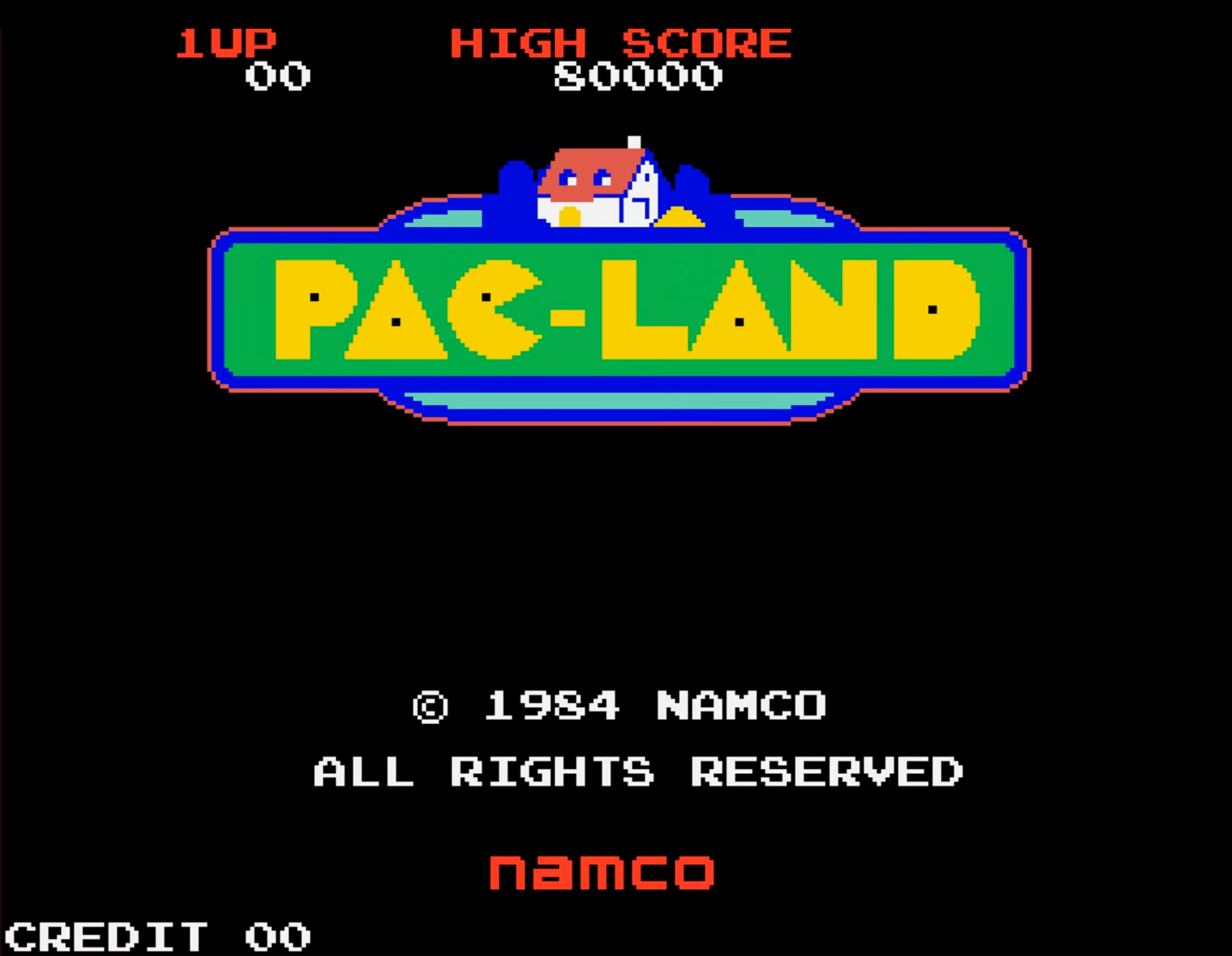
Pac-Land: The Definitive History
The Character Problem
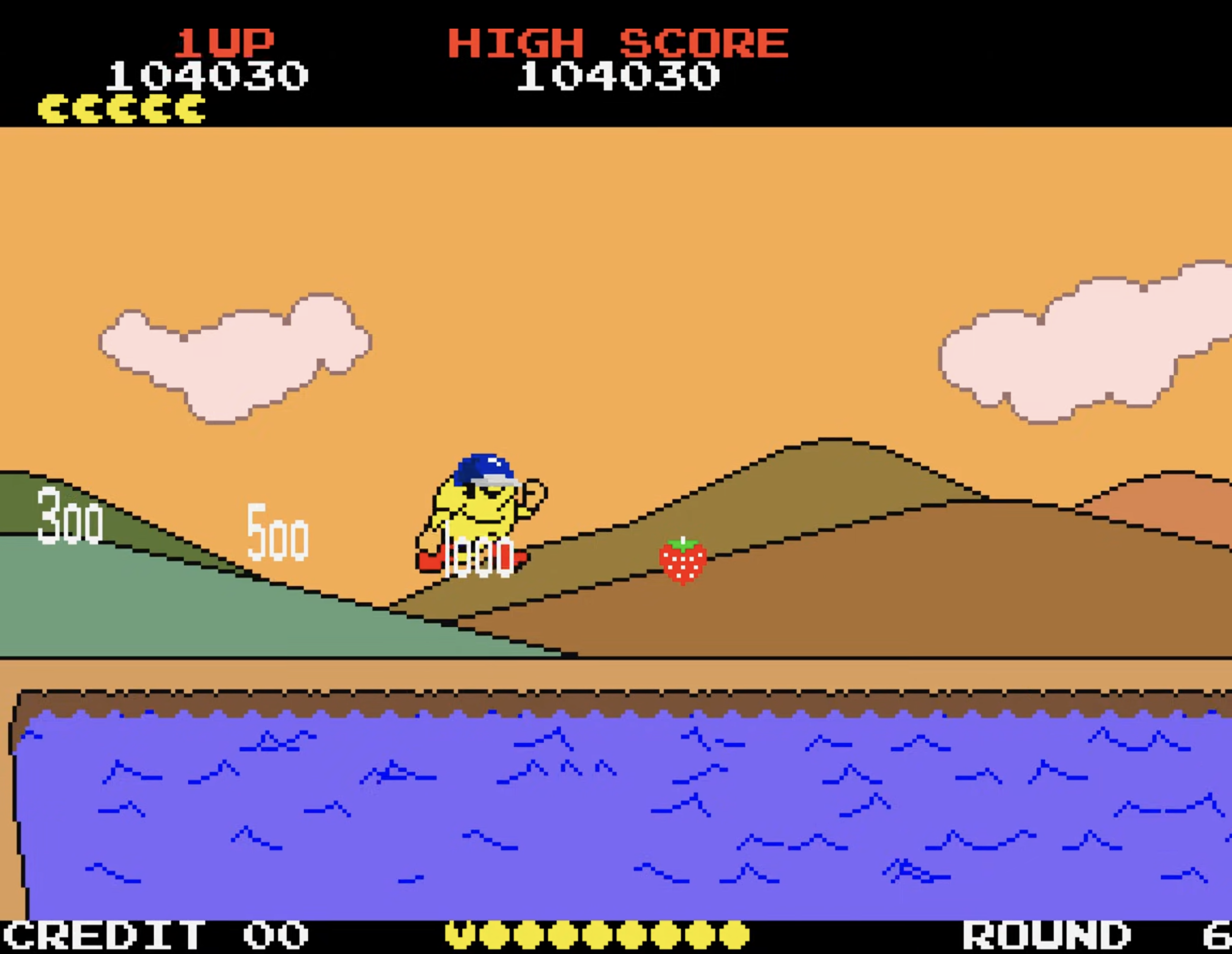
Pac-Man has no body. This is the point. Toru Iwatani wanted to create a game that could appeal to women as well as men, because most video games of the time had themes that appealed to traditionally masculine interests, such as war or sports. The solution was a character defined entirely by appetite. A shape whose only attribute is its mouth, whose only action is eating, whose relationship to the world is purely consumptive. The maze exists to be cleared. The dots exist to be eaten. The ghosts exist to eat and be eaten. The game concept was inspired by food and eating, as opposed to the shooting of space aliens and other foes that prevailed in most arcade games of the time.
The radical thing about Pac-Man was that this reduction. This stripping away of body, of physicality, of all attributes except hunger, was not a technical constraint. It was the design. Pac-Man has no legs because legs imply locomotion through space, which implies a relationship to the world that the maze deliberately forecloses. The maze is not a world. It is a system. You do not inhabit it; you solve it. The character who solves it is appropriately bodyless.
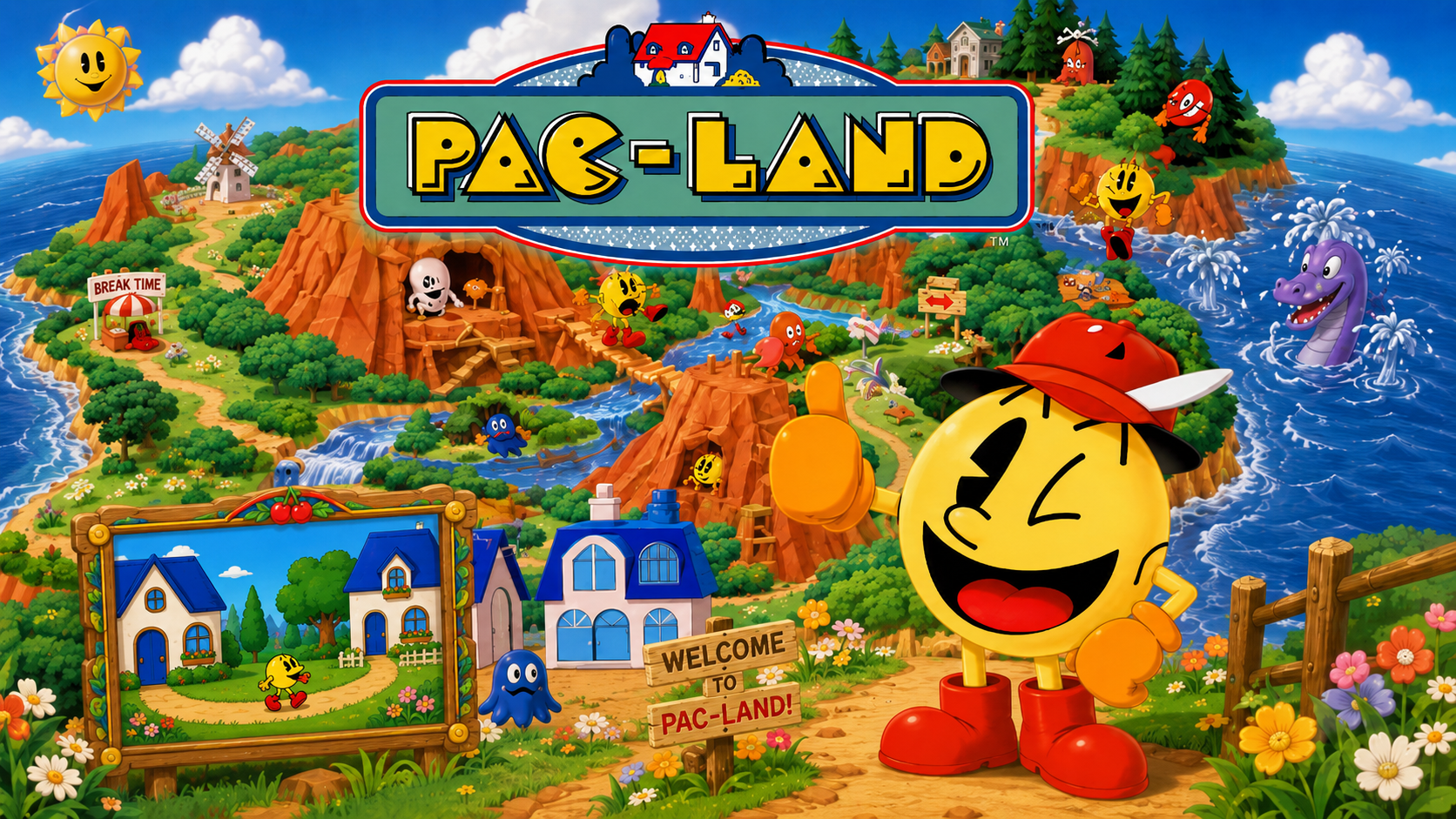
Pac-Land (1984) gave Pac-Man legs. This was either a creative act of some audacity or a fundamental misunderstanding of what Pac-Man was. The evidence suggests it was both simultaneously, and that the tension between them is the game.
The Commission
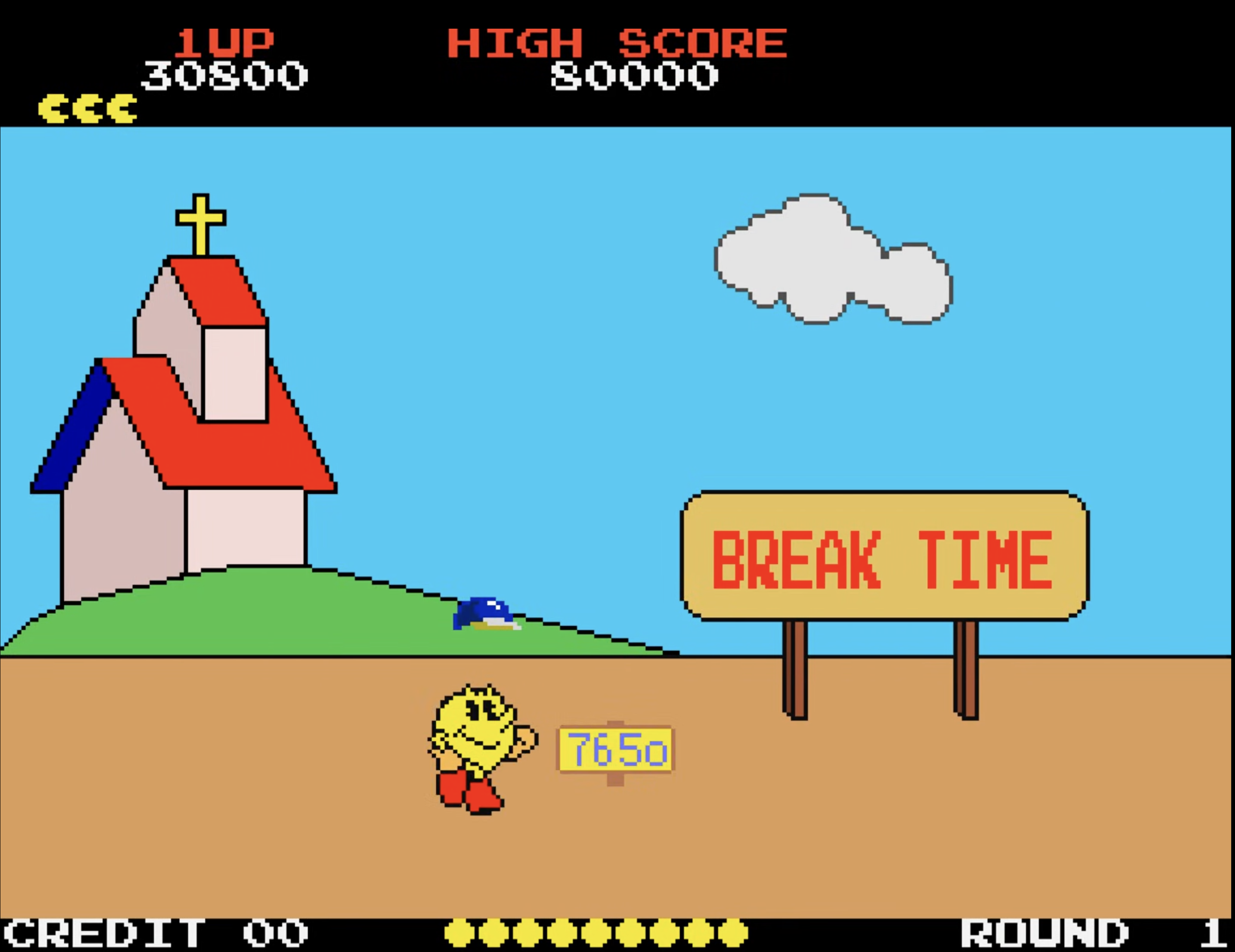
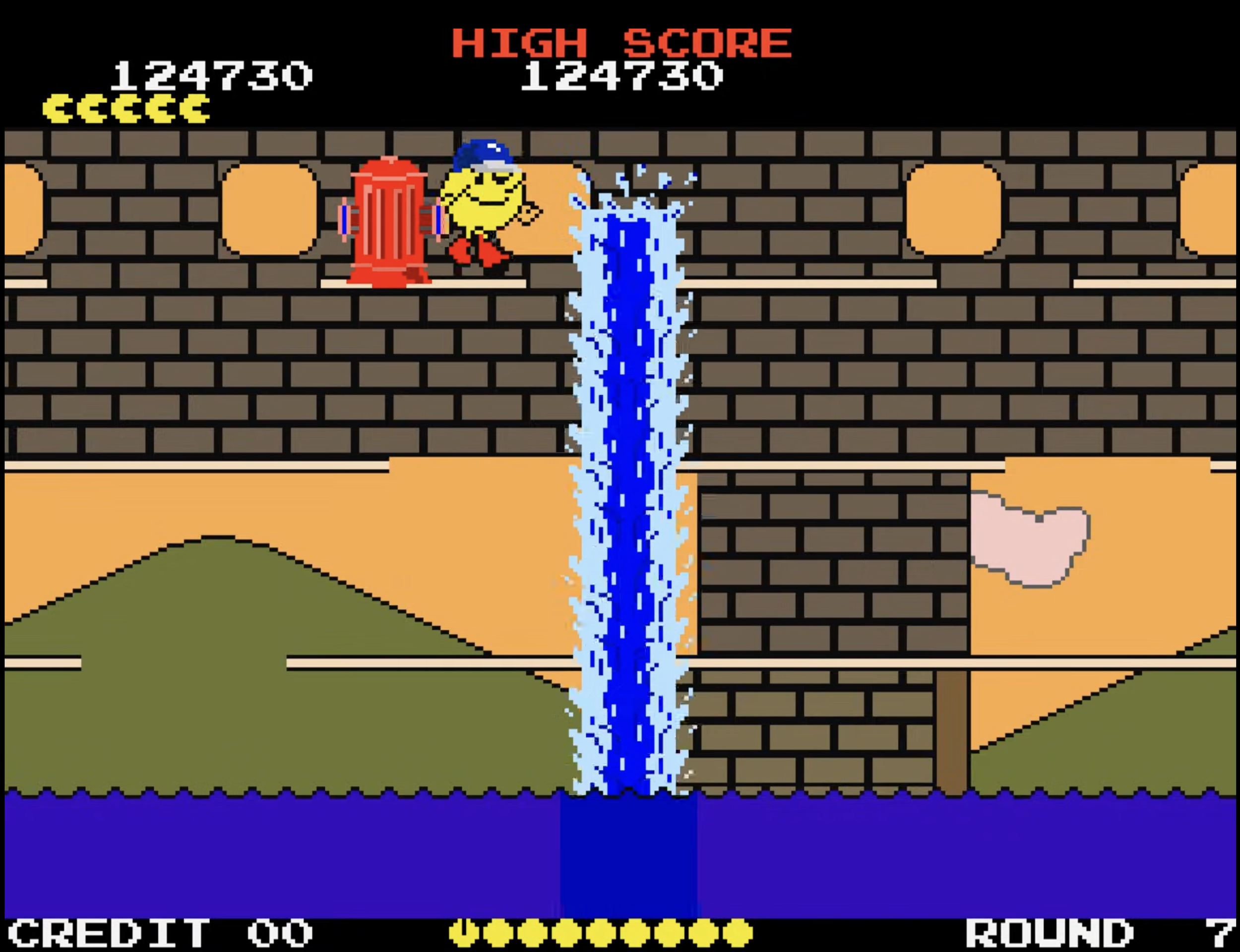
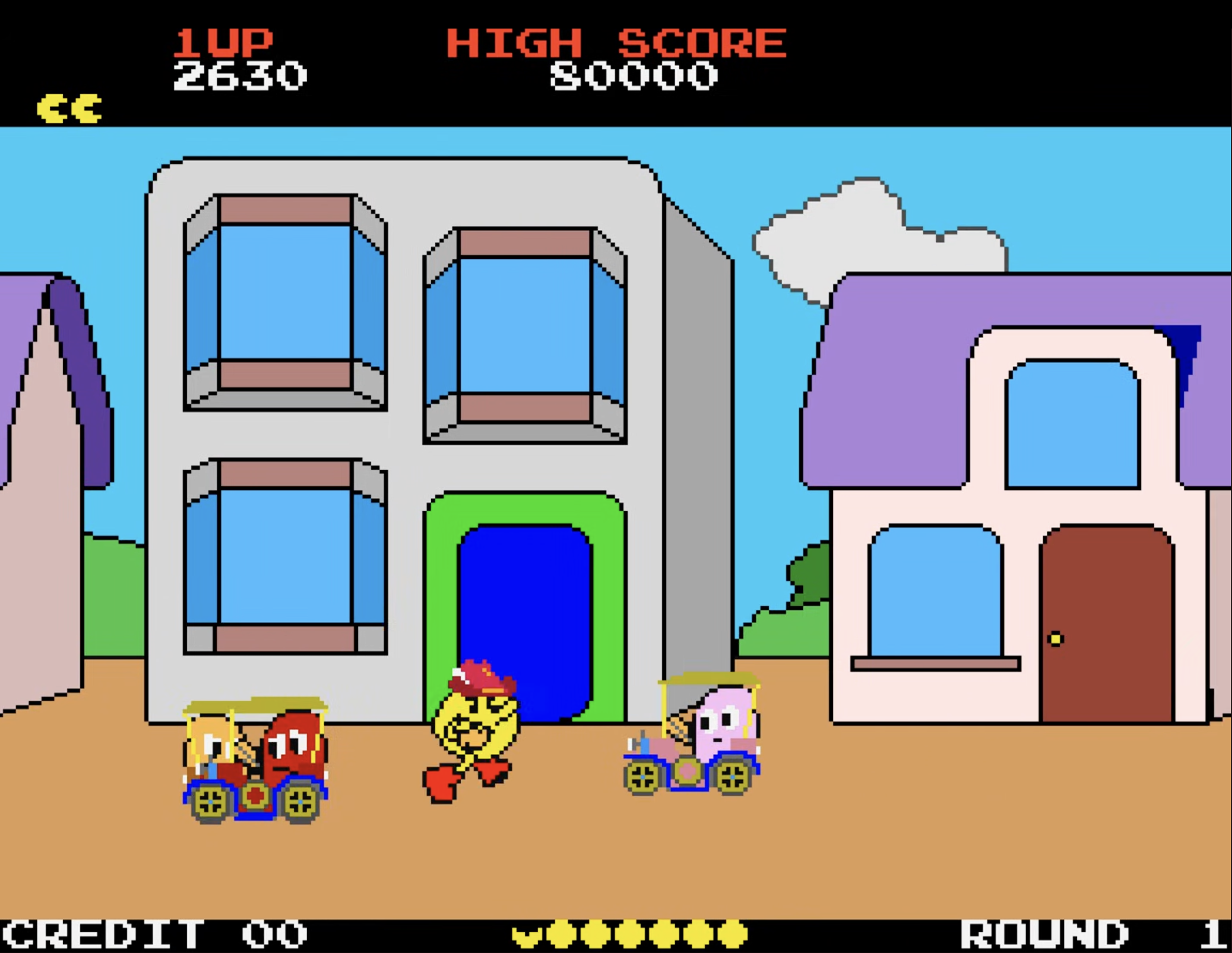
Following the success of the Hanna-Barbera Pac-Man animated series, Namco requested the production of a Pac-Man game based on the cartoon. The cartoon had been running in America since 1982. The anime was not broadcast in Japan, so videos of the series were sent to the developers for inspiration. Yoshihiro Kishimoto, the programmer who would lead the project, was working at Namco's Research and Development Division 1. He had not seen the cartoon. Neither had most of his team. They absorbed a show they had never watched through video recordings shipped across the Pacific, and built a game that looked like it.
This is the founding condition of Pac-Land. It is a Japanese developer's second-hand reconstruction of an American cartoon adaptation of a Japanese game. The original Pac-Man, Iwatani's, the design argument, the philosophy of appetite and bodylessness, is already three removes away before Kishimoto writes a single line of code. What Hanna-Barbera had done to Pac-Man was give him a suburban domestic life: a house, a wife named Pepper, a baby, a dog named Chomp-Chomp, a cat named Sour Puss. What Namco was now being asked to do was put that Pac-Man, the one with the hat and the nose and the feet, into an arcade game.
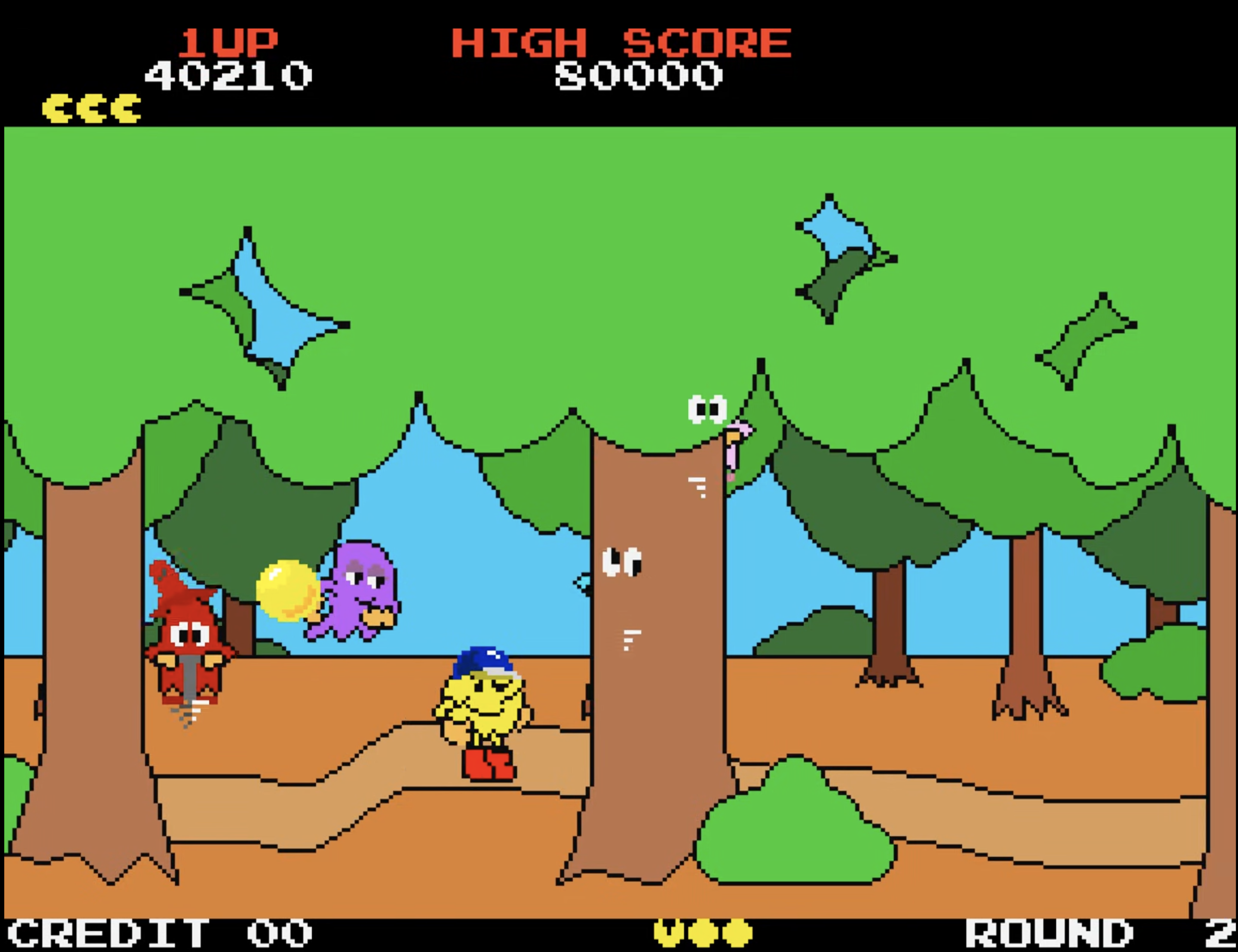
To suit the platform genre, the team anthropomorphized Pac-Man by adding arms, legs, and expressive facial animations, directly mirroring the legged, limbed portrayal from the Hanna-Barbera series to enable fluid running, jumping, and emotive responses like waving or frowning. Kishimoto stated that the hardest part of development was Pac-Man's animations. Most arcade games in Japan at the time simply used two or three frames to convey movement, which he found unconvincing. The team wanted the game's backgrounds to be vibrant and colorful, and to have the characters move smoothly to replicate the show's animation style. Pac-Man himself was given 24 different frame patterns, alongside several facial expressions and clothing swaps.
The ambition here is real and worth understanding. Kishimoto was not coasting on a licensed property. He was attempting something technically unprecedented in Japanese arcade development. Character animation that approached the fluidity and expressiveness of broadcast television. The fact that this was in service of a cartoon he'd only seen on tape, for a character whose original design philosophy argued against embodiment entirely, does not make the technical achievement less significant. It makes the game stranger.
The Hardware Argument
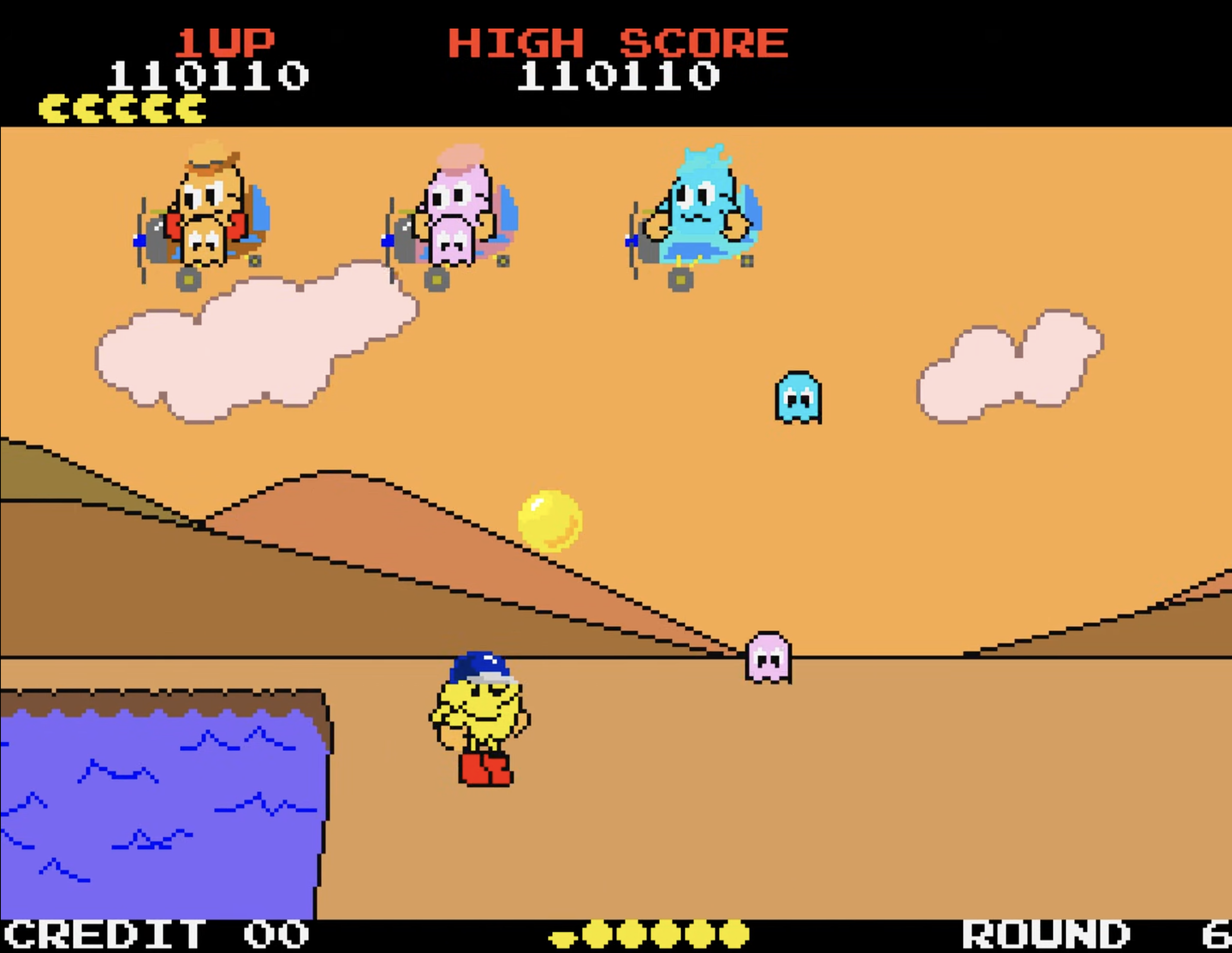
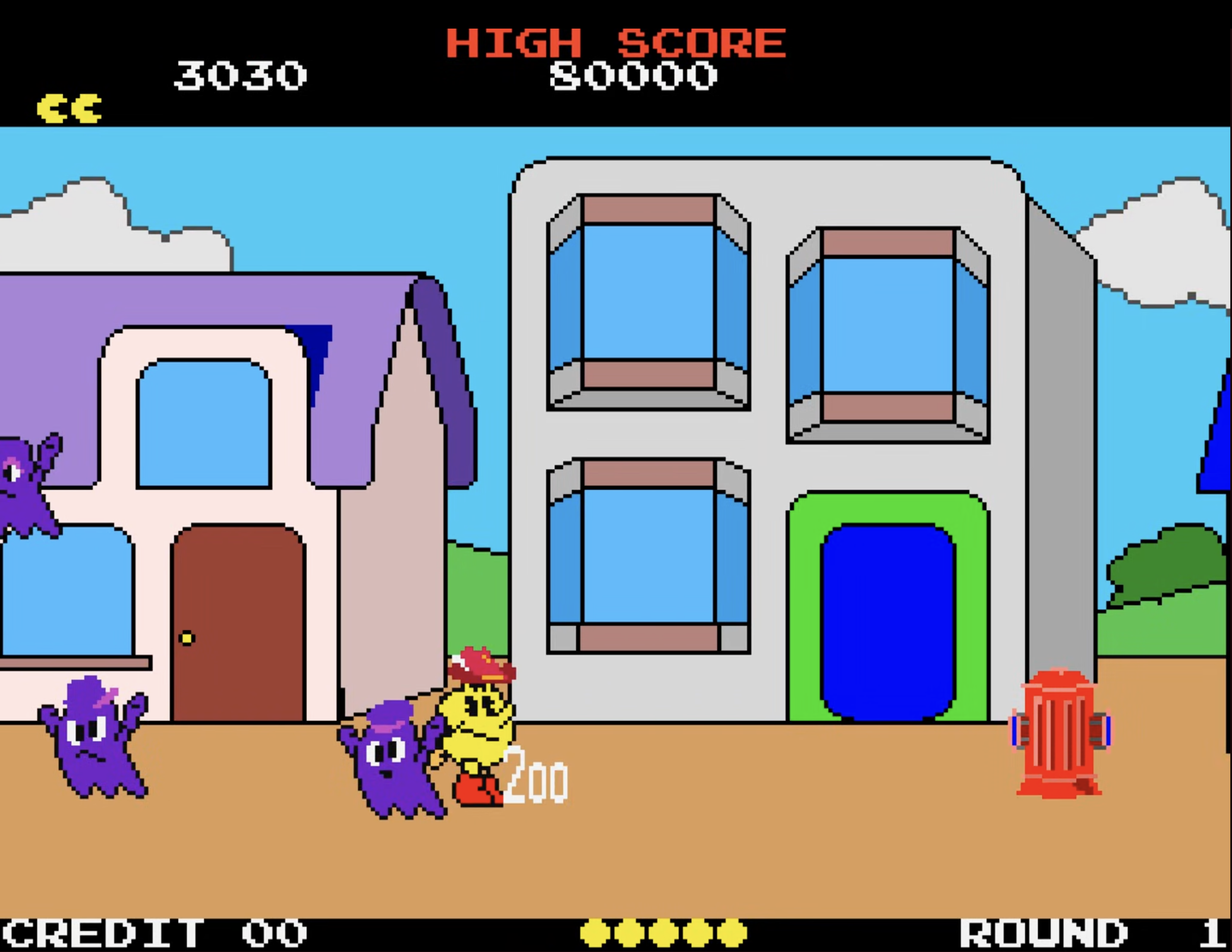
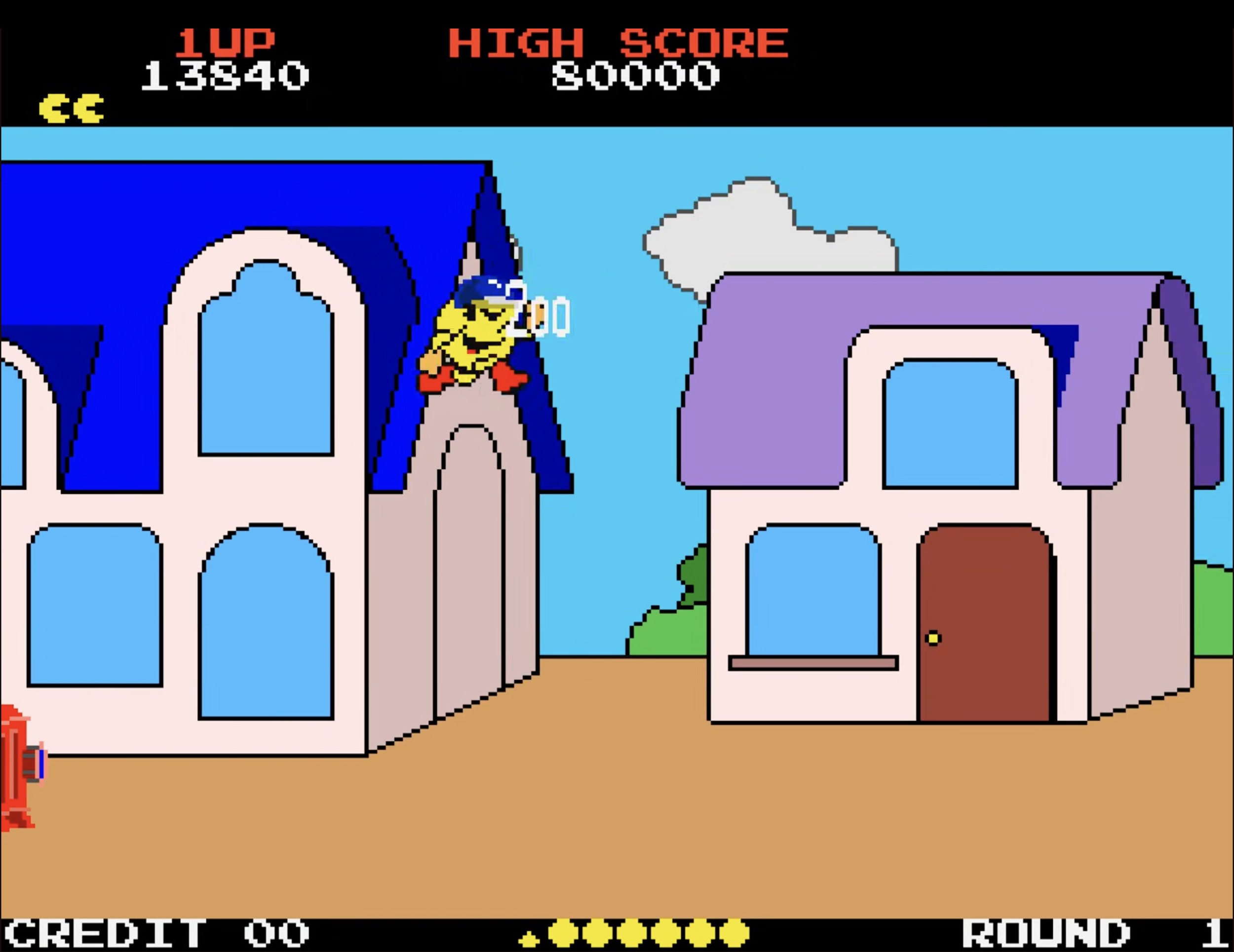
To achieve what Kishimoto was attempting, new hardware was required. To allow for two-layer scrolling backgrounds, more sprites, and more colors, the team created the Namco Pac-Land arcade board, which was used for several later Namco games including Baraduke (1985) and Metro-Cross (1985). This is not a peripheral detail. The Namco Pac-Land board was built specifically to make this game possible. A custom hardware solution to the problem of making Pac-Man look like a cartoon. The board then became the platform for subsequent Namco games, which means Pac-Land's technical requirements shaped Namco's hardware development for years.
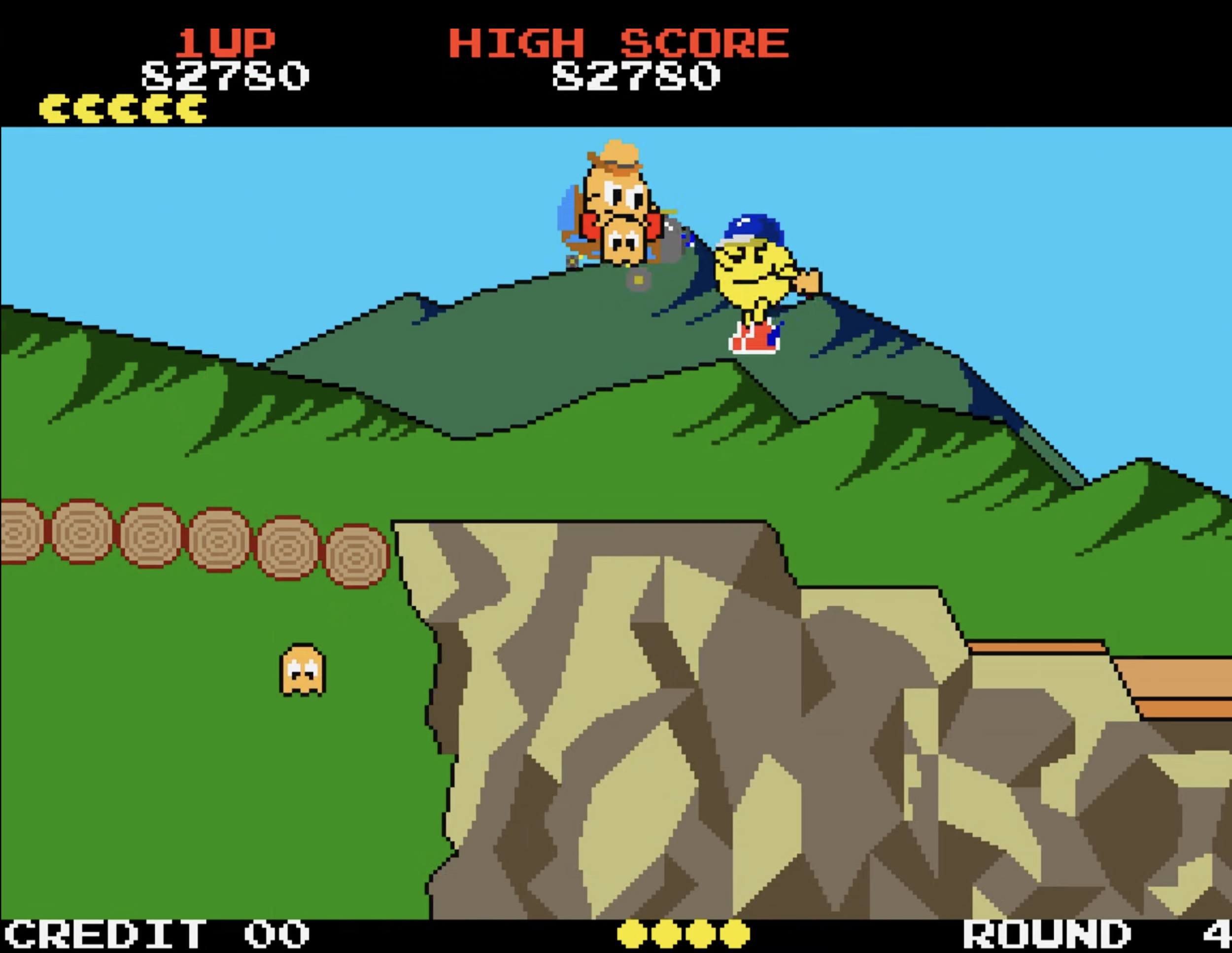
The game that resulted from this hardware was visually unlike anything in Japanese arcades in 1984. Pac-Land features parallax scrolling for some of the background elements, a feature that would not become commonplace until the 16-bit console era began much later. Trees in the foreground move at a different rate from buildings in the background. The world has depth. It has the particular visual quality of a world you move through rather than a system you solve, which is precisely the problem.
The Controls
Kishimoto cited Konami's sports video game Track & Field (1983) as the "number one influence" on Pac-Land. Track & Field is a game about athletic performance, where speed is produced through button repetition. The faster you press, the faster you run. Kishimoto transplanted this logic into a platformer. The Pac-Land cabinet uses three dedicated buttons, run left, run right, and jump. There is no joystick. Tapping the direction button makes Pac-Man walk; pressing repeatedly makes him run. The faster he runs, the further he jumps.
It was the planner who decided not to use a joystick. He thought it was easier and more fun to use buttons to vary the speed, with Track & Field having an influence on this. This is a distinctive and somewhat counterintuitive design decision which deserves attention. In 1984, every other platform game used a joystick or directional pad for movement. Pac-Land committed to a button-only scheme that produces momentum rather than discrete positional commands. The relationship between the player's inputs and Pac-Man's movement is analogue rather than digital. More pressing produces more speed produces more jump distance. Precision requires understanding the physics, not memorizing platform positions.
This also means that Pac-Land, the game that gave Pac-Man a body, gives that body a distinctly non-standard relationship to space. You do not position Pac-Man by choosing where to move him. You manage his momentum. He is a mass in motion rather than a cursor in space, and controlling him requires something closer to kinetic intuition than spatial planning.
The springboard sections, which Kishimoto noted tested badly in Yokohama, are where this control philosophy produces its greatest difficulty. Momentum-based jumping onto a small springboard that must then catapult you across a large gap tolerates no imprecision. The game teaches patience not by rewarding careful movement but by punishing movement that is too slow, too fast, or mistimed.
What Kind of Game This Is
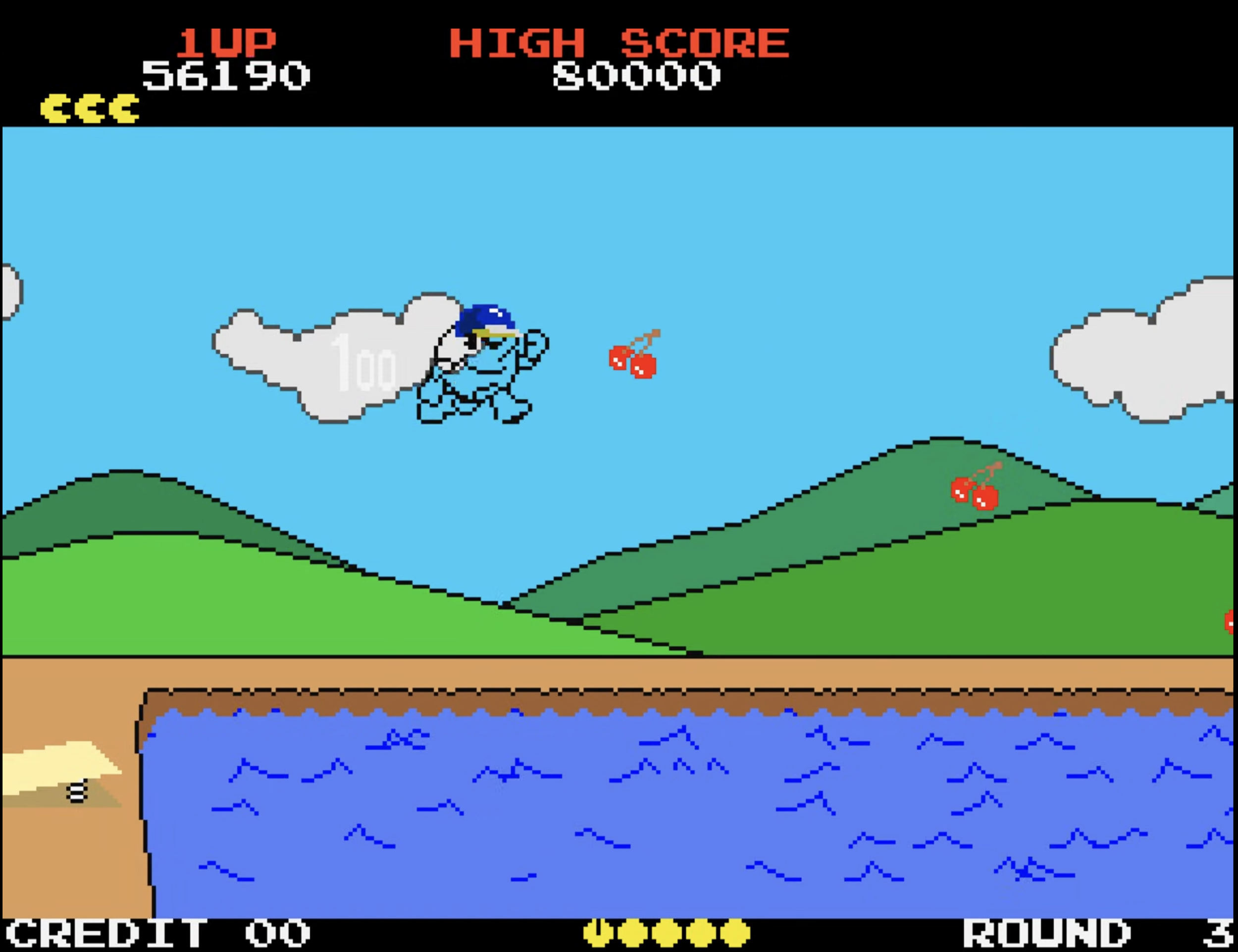
The question Pac-Land poses, and that criticism has never quite settled, is what genre it actually belongs to. It is formally a platformer, horizontal scrolling, jumping, hazard avoidance, and it preceded Super Mario Bros. by a year, which is the source of its canonical historical significance. Pac-Man creator Toru Iwatani described the game as "the pioneer of action games with horizontally running background." According to Iwatani, Shigeru Miyamoto described Pac-Land as an influence on the development of Super Mario Bros.
But Pac-Land is not quite a platformer in the sense Super Mario Bros. codified. It does not reward exploration. It does not have discrete secrets that alter the game's structure. Its levels, called trips, are scored endurance runs through continuous hazard environments rather than designed spatial puzzles. Pac-Land consists of eight trips that entail four rounds each, totalling thirty-two unique levels. The game loops. Completion brings harder difficulty, not an ending.
This is the maze game's logic transposed into horizontal space. Pac-Man's original game loops infinitely. The maze resets; the score accumulates. You play until you lose. Pac-Land does the same thing with different geometry. The horizontal scroll replaces the enclosed maze, but the game loop is identical. The character has legs now, but he is still inside a system. He is not exploring a world. He is running through a repeating pattern at increasing difficulty until the pattern defeats him.
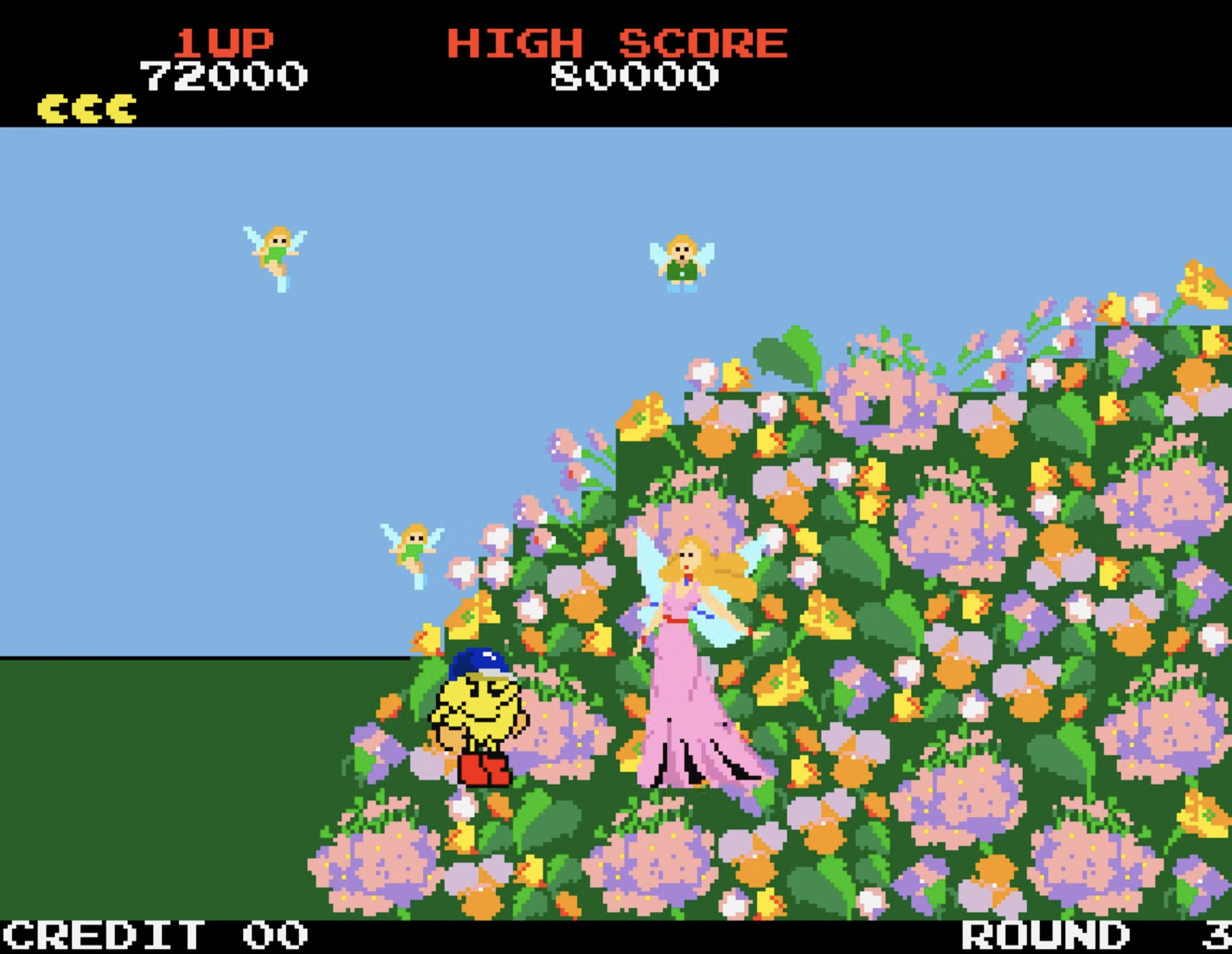
The game's deepest design decision is the return trip. After delivering the fairy to Fairyland, Pac-Man must navigate home through the same environments in the opposite direction. This isn't a reversal, the hazards change, but it creates something unusual. A game that makes the outward journey and the homeward journey formally distinct. The return trip, after the Fairy Queen bestows the magic boots, allows free aerial jumping without needing a platform beneath. It was Kishimoto's idea to allow the player to go back and fly. He programmed these elements without asking the planner first. This detail, added autonomously, without approval, gives the return journey a different physical logic from the outward one. Escape from gravity as a reward for having mastered it.
The Feedback Loop
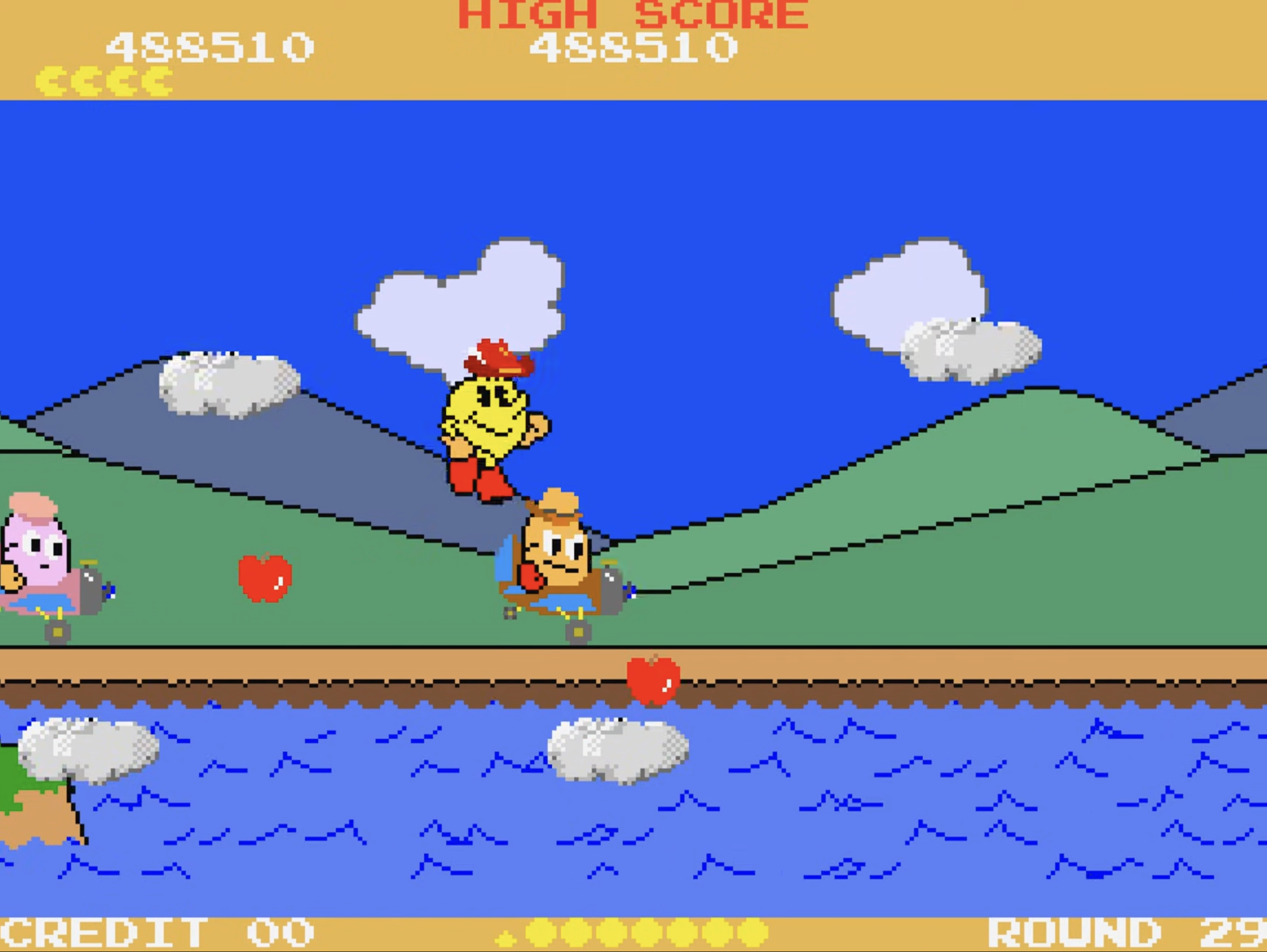
The most extraordinary thing about Pac-Land's historical position is the recursive relationship between its components. Pac-Man (1980) was a Japanese game. It became an American cultural phenomenon. Hanna-Barbera made it into an American cartoon (1982). A version of Pac-Man that had never existed in Japan, in which the character had a body, a family, a domestic life. Namco, seeing the cartoon's success, commissioned a game based on the cartoon (1984). That game, Pac-Land, was then seen by Shigeru Miyamoto in Tokyo, and influenced him to develop a horizontal platform game of his own. That game was Super Mario Bros. (1985). Miyamoto also wanted to create a game that would be the "final exclamation point" for the ROM cartridge format before the forthcoming Famicom Disk System was released. Development for Super Mario Bros. began in the fall of 1984.
The loop runs: Japanese arcade game begets American cartoon. Japanese arcade game begets Japanese console game. Death of the genre conditions that made Pac-Land possible. Super Mario Bros. didn't just eclipse Pac-Land. It retroactively defined what a platform game was, and Pac-Land, which had arrived first and established the formal conventions, became a footnote to the game it had helped inspire. The original Wonder Boy in 1986 was inspired more by Pac-Land than Super Mario Bros., with skateboarding segments that gave the game a greater sense of speed than other platformers at the time. But Wonder Boy is its own footnote. The lineage runs to Mario, and Pac-Land sits behind it.
Shigeru Miyamoto himself says that Pac-Land had an influence on Super Mario Bros., but to a lesser extent, saying that while he was in Tokyo seeing Namco had developed a platforming game he decided that he should follow suit. The only feature of Pac-Land Miyamoto cites as a direct inspiration was the blue background of the game as opposed to the black ones he typically would put in his games.
That Miyamoto's stated debt to Pac-Land extends principally to its blue sky is either a generous acknowledgement or a subtle diminishment, and it is perhaps both. The blue sky, the world-as-habitable-space rather than world-as-black-void, is in fact the deepest thing Pac-Land contributed to the platformer tradition. Making the background feel like somewhere rather than nothing. This is what Kishimoto's hardware investment produced. The parallax trees. The suburban roads. The clouds. The sense that Pac-Man was running through a place, not solving a system. Mario made that feeling the foundation of an entire genre. Pac-Land originated it.
The Characters Who Belong To Other People
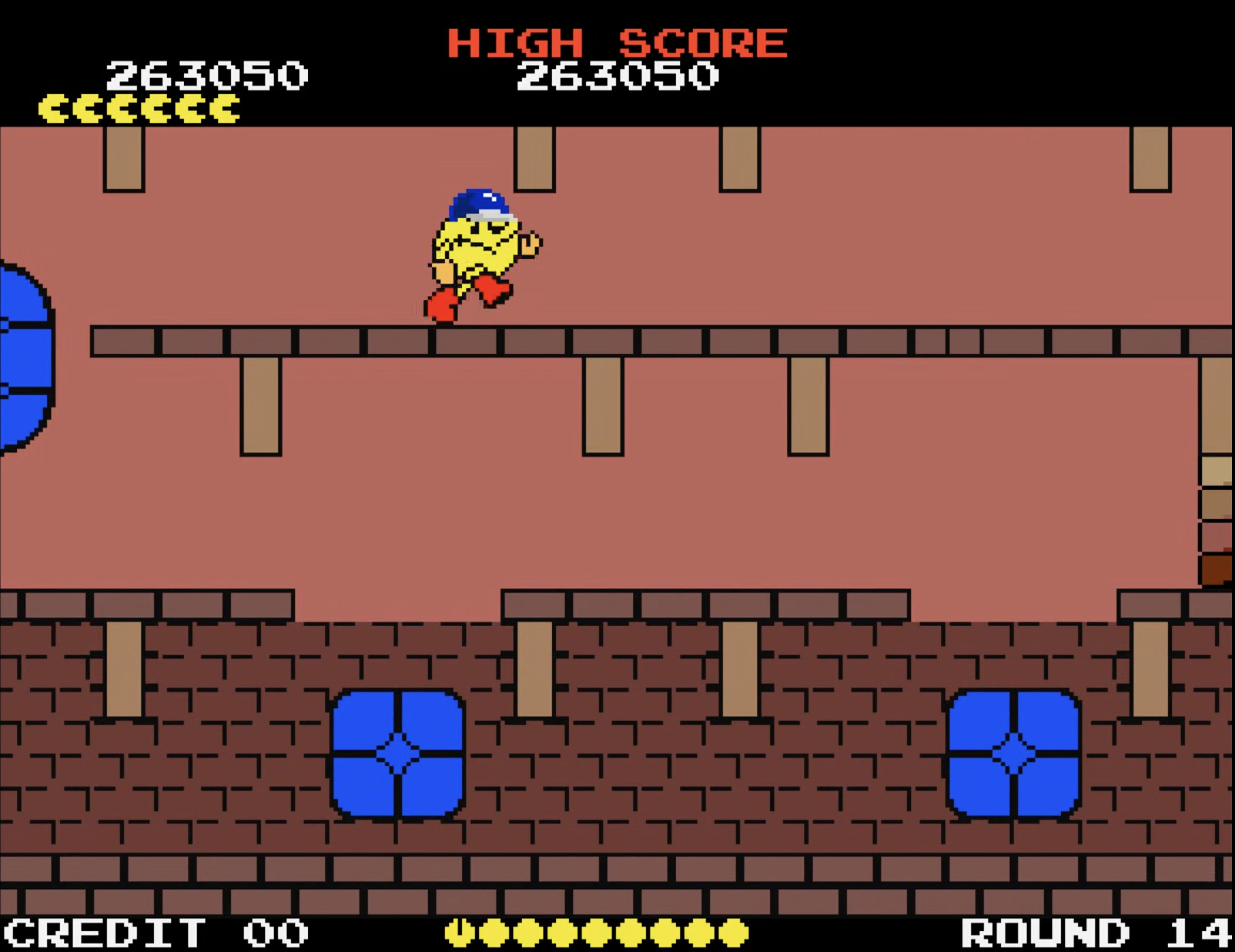
Pac-Land is legally one of the most encumbered games in arcade history, and the reason is structural rather than incidental. The game was built on assets that Namco didn't fully own.
The music, the theme that plays throughout every round, the arrangement of the Hanna-Barbera cartoon's title song, belongs, or belonged, to Hanna-Barbera, now Warner Bros. Console releases of Pac-Land are less common than the other Namco-owned Pac-Man games, which is speculated to be due to Hanna-Barbera, now technically Warner Bros., owning the music tracks. The music is the game's affective core, the loop that lodges in the back of the skull and refuses to leave, that is inseparable from the experience of playing, and it doesn't belong to Namco.
Ms. Pac-Man's situation is more convoluted still. She appears in Pac-Land in her cartoon incarnation, named Pepper. But Ms. Pac-Man as a character was not Namco's creation. She was developed by General Computer Corporation as a conversion kit for the original Pac-Man, licensed through Midway, and Namco was not happy about the whole situation, stating it had never authorized the release of Ms. Pac-Man. Namco canceled its distributor agreement with Midway in 1984. When AtGames acquired Ms. Pac-Man royalty rights from GCC in 2019, the lawsuit that followed resulted in Namco effectively excising her from its back catalogue. Pac-Mom first appeared in the Arcade Archives release of Pac-Land through graphical modification to the original ROM.
The game that is now officially available is not quite the game that was released in 1984. The wife has been replaced. The music question hangs over every re-release. The ghost personality swap introduced because the Hanna-Barbera cartoon swapped Blinky and Clyde, the orange ghost became aggressive, the red ghost cowardly, persisted for decades, sometimes even spilling over into American-developed games, and wouldn't be smoothed over until around the turn of the 2010s. A continuity error embedded in Pac-Land became canonical across the franchise for thirty years.
Position
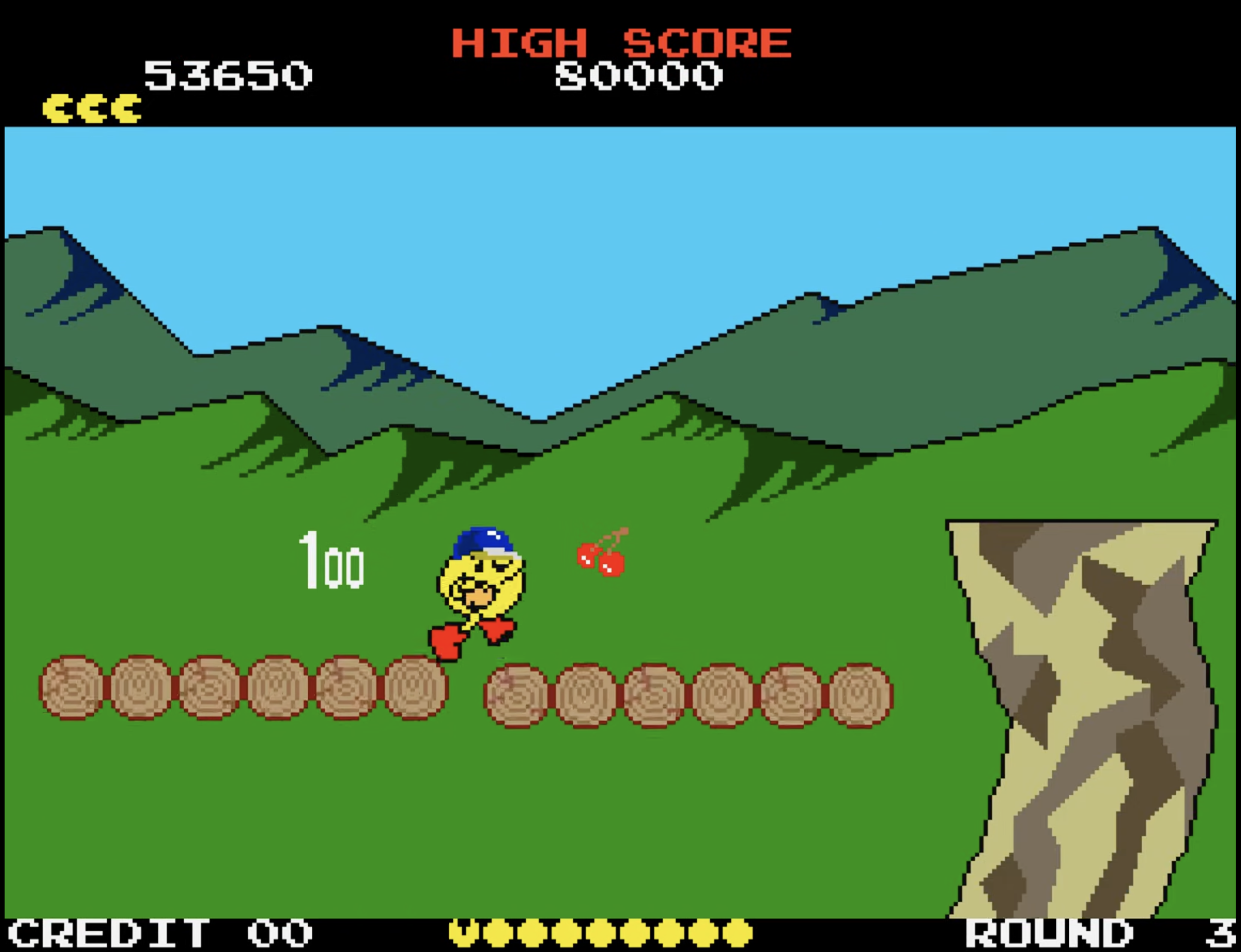
The argument that Pac-Land is a precursor, a rough draft of what Super Mario Bros. would perfect, is accurate but insufficient. It is the argument that history always makes about the thing that arrived first. What came after was better, so what came before was preparation. This understates what Pac-Land actually was.
Pac-Land is the record of a character being forced to confront what it would mean to have a body. The original Pac-Man is one of the most economical design arguments in the history of the medium. Hunger without interiority, appetite without physicality, action without consequence. The maze is solved or it defeats you. There is no dwelling in it, no inhabiting it, no returning home. The odyssey which gives Pac-Man legs also gives him a home to return to. It gives him a wife, a fairy, magic boots. It gives him an outward journey and a homeward journey. It gives him a life.
That Namco did this not from artistic conviction but from franchise management, because the American cartoon had made Pac-Man suburban and domestic, and Namco wanted a game to match, does not diminish the design consequences. Kishimoto's 24-frame animations, the parallax scrolling, the momentum-based controls, the return trip's aerial freedom: these are real achievements that emerged from a commercial brief and became something more than that brief intended.
The game's central irony is that in making Pac-Man move through a world, it inadvertently demonstrated what was lost when he did. The maze is a perfect system. The suburb of Pac-Land, with its roads, its springboards, its fire hydrants and cacti and quicksand, is a world that is just real enough to feel arbitrary. The hazards don't have the internal logic of the maze's ghost patterns. They have the logic of obstacle courses, which is no logic at all. Pac-Man with a body is subject to the same indignities as any embodied creature: things get in the way for no reason. The maze never did that.
"Outside of the original Pac-Man within the maze-game concept," Iwatani said, "there was the Pac-Land arcade game in which Pac-Man appeared as more of a full character with hands and feet giving him more abilities, the game also took him out of the maze." Iwatani calls Pac-Land one of his favourite games in the series and describes it as the pioneer of the horizontally scrolling platform genre. He also, in that sentence, identifies the loss. The game took him out of the maze.
The maze is where Pac-Man makes sense. Pac-Land is the forty years of sequels, spin-offs, reboots, and licensed adaptations trying to work out whether anything outside the maze does. The answer the franchise keeps arriving at, from Pac-Land through Pac-Man World through Pac-Man Championship Edition back to the maze itself, is that the original design was right. Appetite without body. The circle. The mouth. The dots. Pac-Land is the game that got there first, built the hardware to do it, influenced the genre that would replace it, and gave away the rights to its own music in the process.