Pyjamarama: The Definitive History
The Name
In February 1973, Roxy Music released their second single. "Pyjamarama," Bryan Ferry's first composition on the guitar, finds the sleep-deprived singer longing to be close to his elusive lover. Ferry was dating French supermodel Amanda Lear, who appeared on the For Your Pleasure album cover as a femme fatale leading a black panther on a leash. The song is a glam rock meditation on insomnia as a symptom of desire. Wakefulness not as obligation but as exquisite suffering, the inability to sleep because the mind is full of someone who remains elsewhere, mysterious, just out of reach. The title "Pyjamarama", a playful nod to pajamas, does not appear in the lyrics. It is pure sonic invention: pyjamas plus panorama plus the suffix that turns things into spectacles.
Notably, the title of the song inspired a ZX Spectrum game manufactured by Mikro-Gen in 1984. What Mikro-Gen made of the title was almost its precise inverse. Where Ferry's Pyjamarama is insomnia as glamour, the lover, the supermodel, Amanda Lear and her black panther, the AIR Studios and the art rock, Mikro-Gen's Pyjamarama is insomnia as working class catastrophe. Their Wally Week can't wake up because he forgot to wind the clock. He needs to get to work. This is not desire keeping him horizontal. This is panic. The gap between these two uses of the same word is the game's entire cultural logic.
Wally Week and the British Everyman
Mikro-Gen was founded in 1981 by Mike Meek and Andrew Laurie in Bracknell, Berkshire, a new town built after the war to rehouse London's overspill population. The company had a solid reputation but became more prominent with its series of games featuring Wally Week and his family, all of which got excellent reviews in the highly respected computer magazine Crash. Wally had first appeared in Automania, also 1984, in which he worked at a car factory. In Pyjamarama he is in his pyjamas and nightcap, asleep in a terraced house, trapped in a nightmare of his own domestic space.
The character's cultural genealogy is worth establishing. The Wally Week character, depicted with a flat cap, oversized nose, and penchant for beer, was initially reused from Hinsley's earlier prototypes for efficiency, but his popularity prompted Mikro-Gen to commit to a franchise exploring Wally and his family's comedic exploits. The flat cap, the beer, the car factory, the terraced house, the wife Wilma: Wally Week is a direct descendant of Andy Capp, Reg Smythe's long-running strip from the Daily Mirror in which a layabout Northern working man spends his days drinking, avoiding work, and outwitting his long-suffering wife. Andy Capp had been running since 1957. By 1984, the template was so culturally embedded that Mikro-Gen could deploy it without explanation. Everyone knew what a man in a flat cap with an oversized nose meant.
What's significant is what Mikro-Gen did with that template. Andy Capp is a study in refusal. He refuses work, refuses responsibility, refuses bourgeois aspiration. Wally Week is the opposite: his nightmare is that he won't make it to work. His domestic catastrophe is not that he's skived off but that the alarm clock didn't go. The comedy and the anxiety are entirely bound up with the obligation of employment. Wally doesn't want to be in his nightmare. He wants to clock in.
This is the game's class politics, and they are precise. In 1984, British manufacturing was in structural collapse. The miners' strike had begun in March. The car industry that Automania had placed Wally inside was being dismantled. The terraced house in Pyjamarama is the locus of everything that was becoming economically unstable. Wally needs to get to work because work might not be there much longer. The nightmare is not abstract.
The Developer
Chris Hinsley spent a month and a half turning it into an all-colour all-action reality. He was nineteen years old, had caught the computer bug from a ZX81 three years ago, and had been working full-time for Mikro-Gen in Ashford, Middlesex since pulling out of a college computer course the previous Christmas.
The Mikro-Gen management philosophy was explicitly anti-auteur. "Eight or ten of us sit down and it's an initial think tank. We don't really believe in making a star, it's not the way a software house should work. We cannot say that Chris Hinsley programmed Pyjamarama. Andy Lawrie who is the technical director comes in. Andy oversees the whole operation, you can't say that Chris alone programmed it because there are things in there that wouldn't have been in it if Chris alone had done it."
This is a direct contrast to the model that had produced Manic Miner. Matthew Smith, alone, at night, on a TRS-80 that crashed when someone put the kettle on. Mikro-Gen is a production unit. The game emerges from a design session, passes through multiple hands, gets its graphics helped and its routines supplemented. The result carries collective labour rather than individual obsession. This matters for what the game becomes: Pyjamarama has the quality of something designed by committee in the best sense, its difficulty is calibrated, its rooms balanced, its puzzle logic tested. It does not have the quality of the singular vision, the game that contains Matthew Smith's 1983 Liverpool the way Manic Miner does. It is well-made rather than fevered.
Paul Denial, Mikro-Gen's sales manager and the person who drew the company's advertising, is credited as the originator of the Wally concept. "Paul, technically labelled Sales Manager, actually visualised Wally, and to my surprise emerged as the man who actually draws the striking adverts." This means the character came from the commercial side of the company rather than the programming side — from the person thinking about how to sell games, not from the person thinking about how to make them. Wally Week is, at his origin, a marketing concept. That he became a genuine character, capable of sustaining multiple games and a Your Sinclair comic strip running from July 1986, is a measure of how well the template worked.
The Game
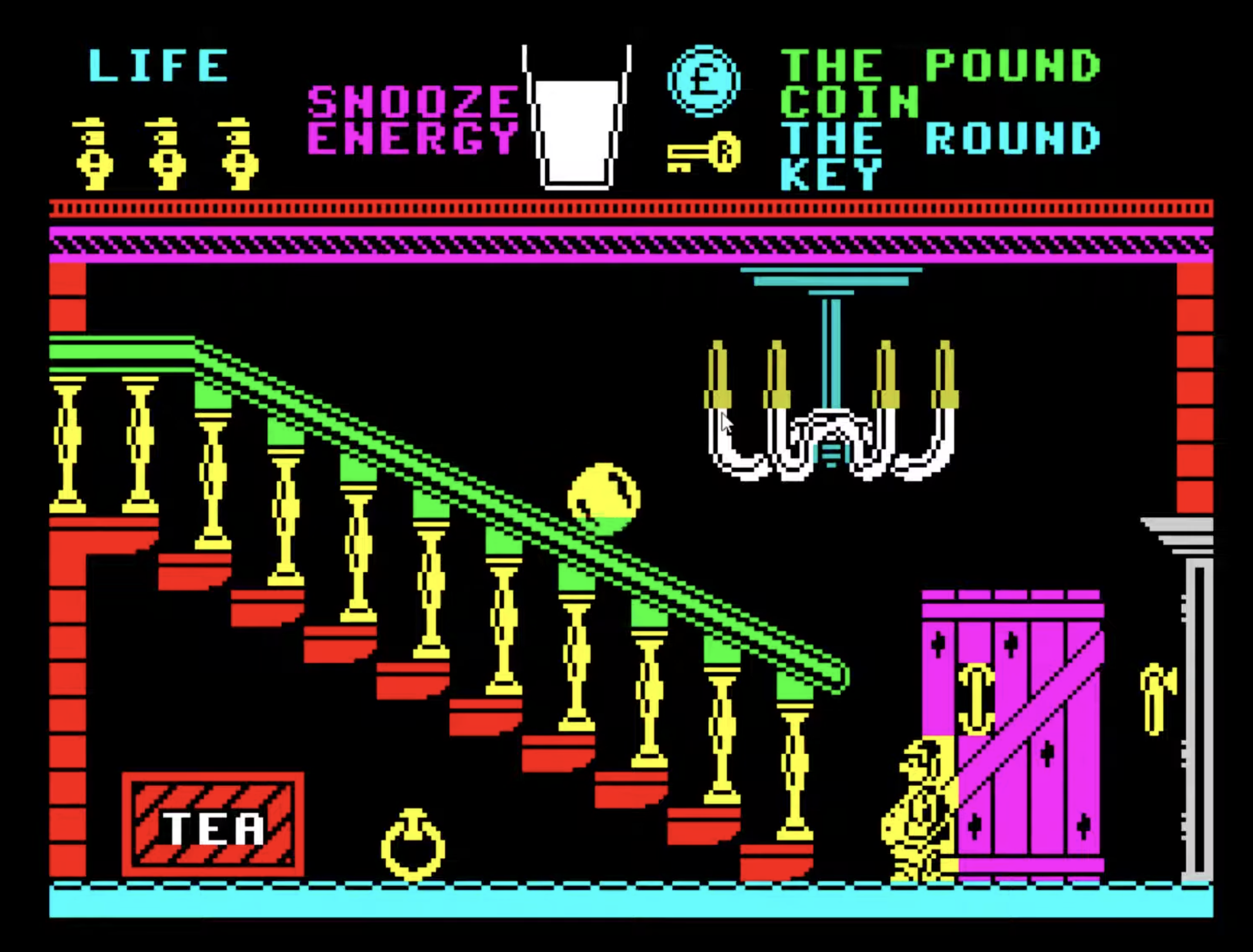
The premise is economical and strange in equal measure. Wally is asleep. The real Wally, the large sleeping body in the bed, is not playable. The player controls a miniature version of Wally, a dream-self, a psychic projection, a little man in pyjamas and a nightcap wandering through the rooms of his own house, which the dream has populated with inexplicable threats.
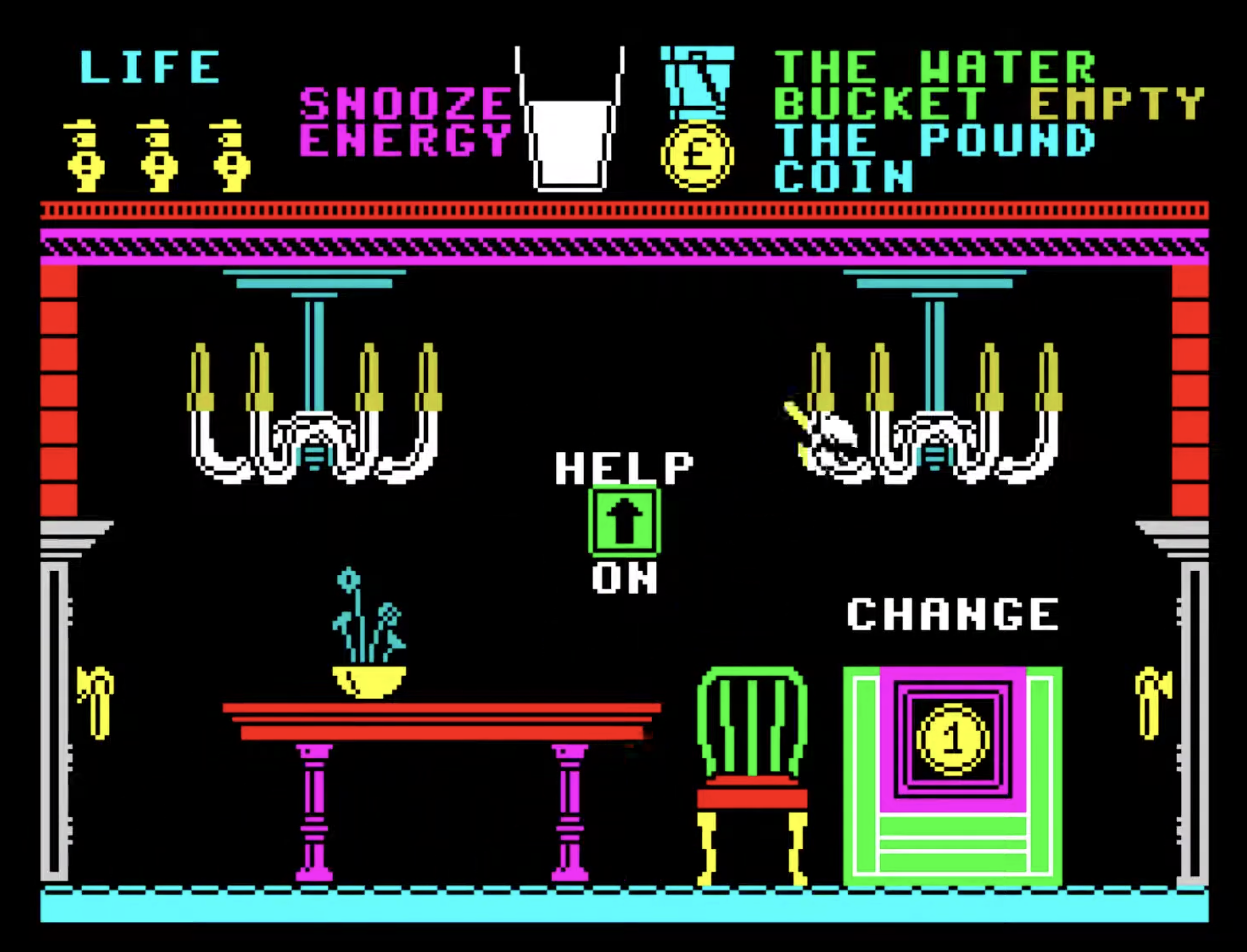
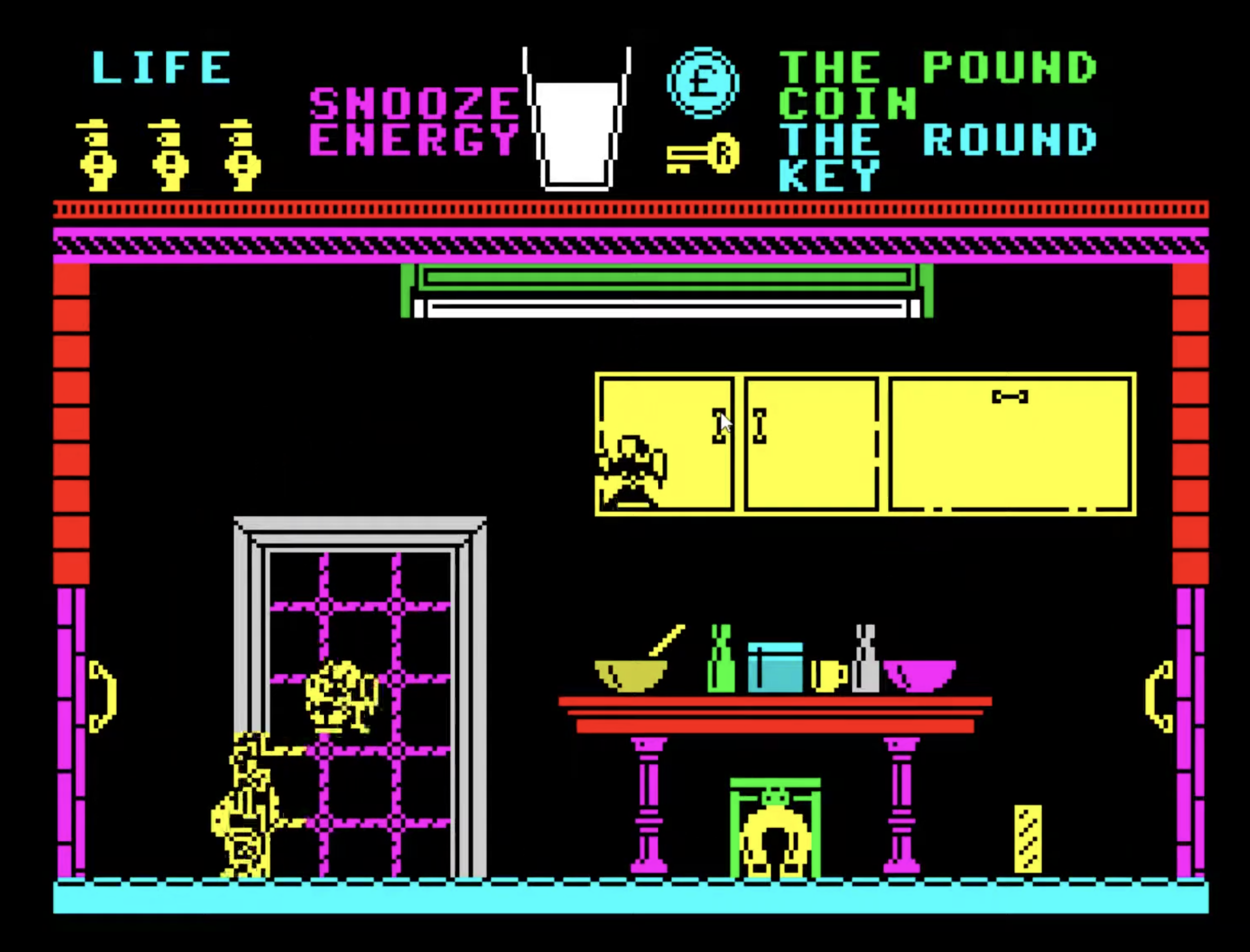
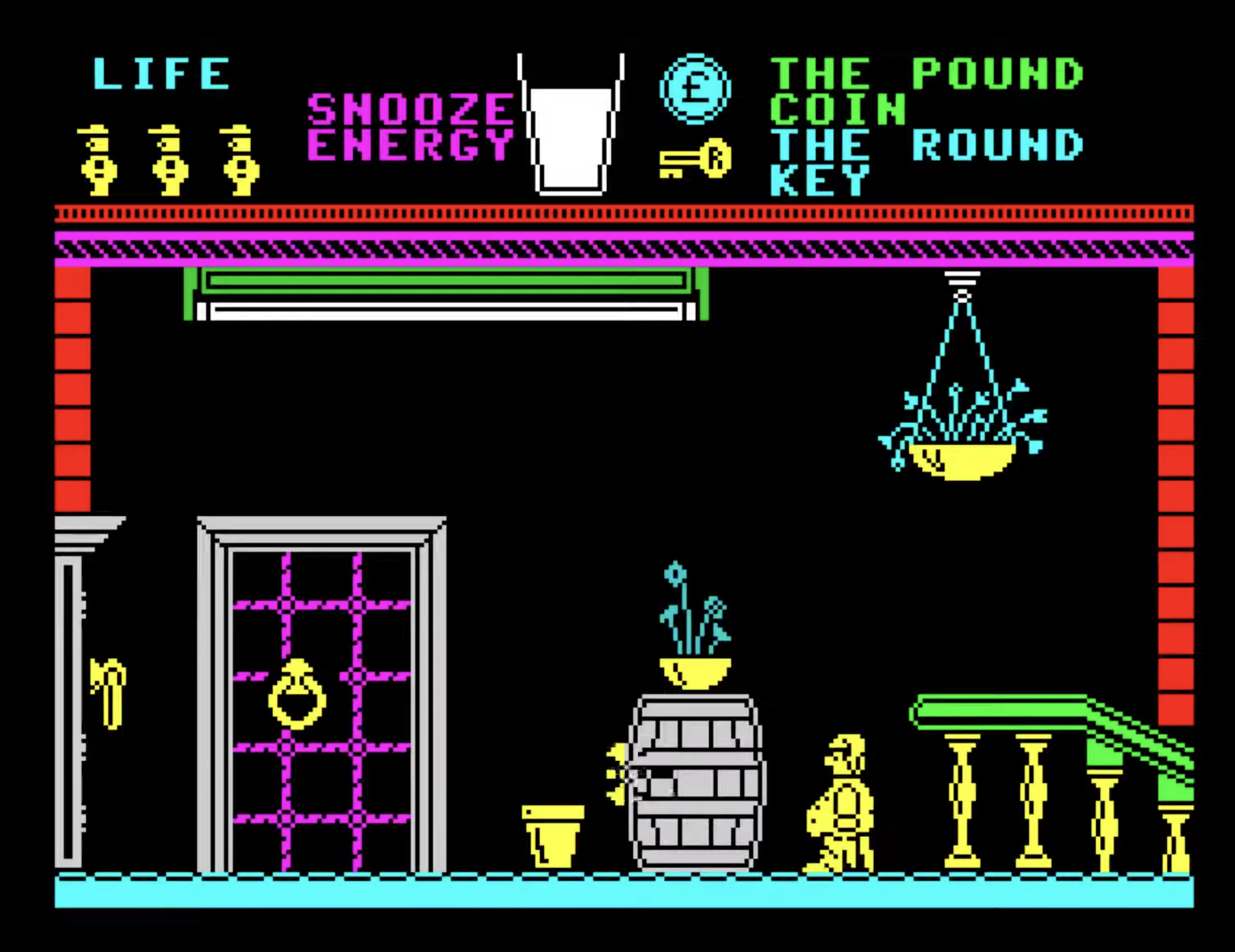
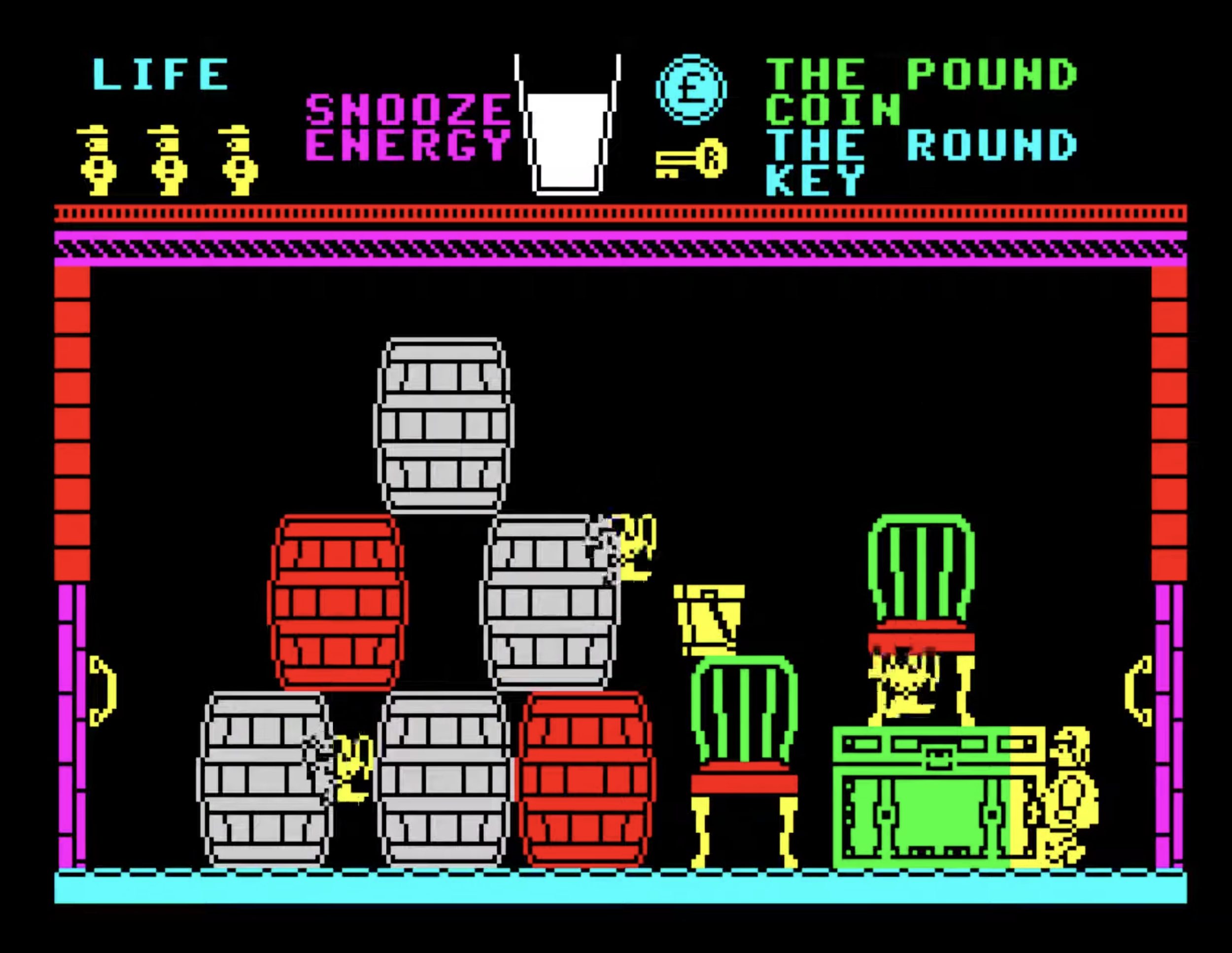
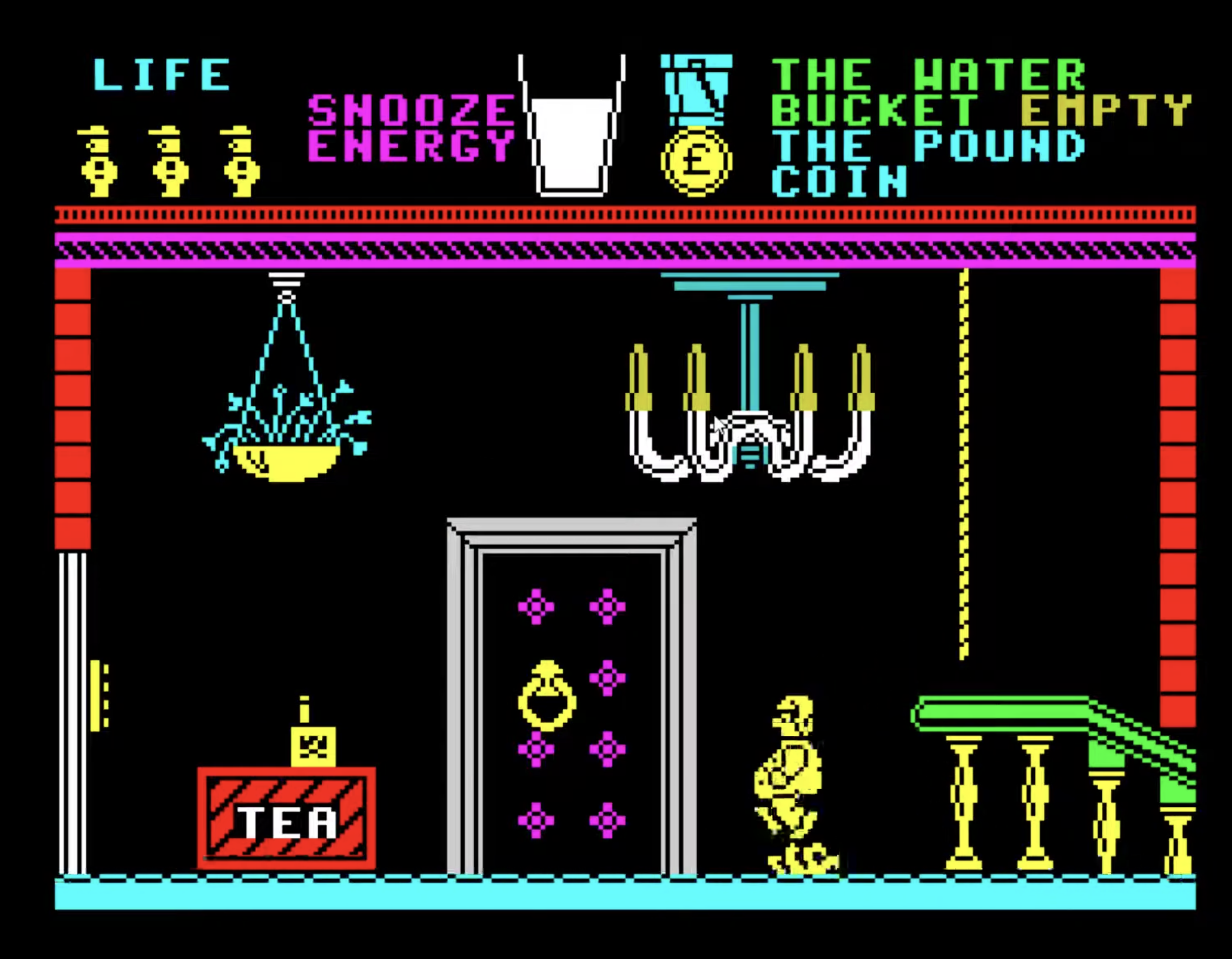
The house is not a nightmare in the Gothic sense. There are no monsters from the unconscious, no expressionist distortions of the architecture. The rooms look like rooms. They have furniture, stairs, doors, lifts. The threats are domestic objects that have gone wrong: roast chickens that pursue him, boxing gloves that knock him down when he's not expecting them, rolling balls, grabbing hands. These are not fears; they are inconveniences that have become lethal. The dream logic is not Freudian, it is Bergsonain. The world has become mechanical where it should be fluid. Wally's house is operating on its own terms and he is in the way.
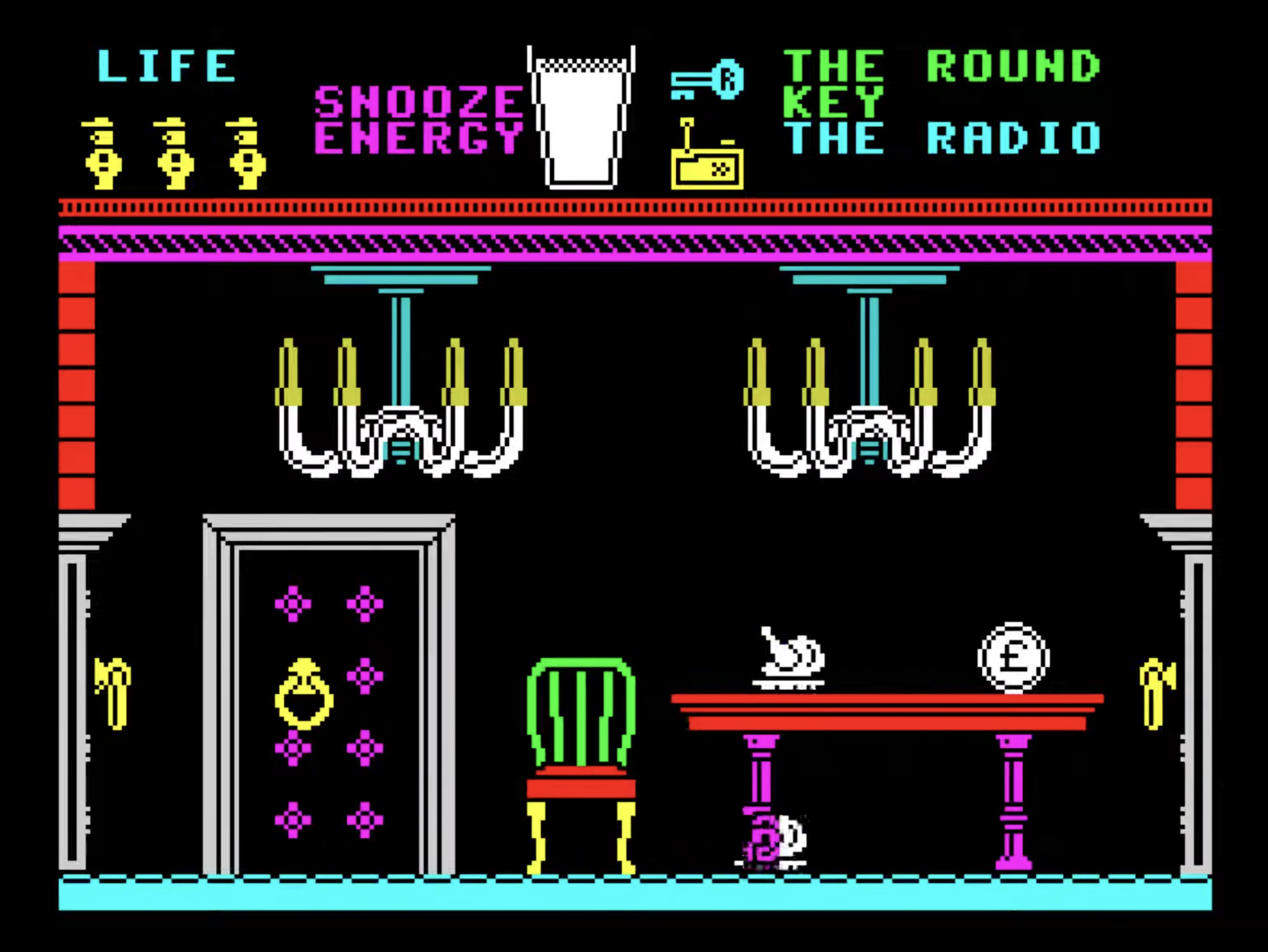
The structural problem is a key. Not a metaphorical key: an actual, physical key that will wind the alarm clock that will wake the real Wally in time for work. The key is somewhere in the house. To reach it requires navigating the rooms in the right order, collecting and placing objects in a two-item inventory, operating lifts and doors, working out which objects interact with which hazards. There are surprises everywhere: the prat-fall boxing gloves knock you down when you're not expecting them, and it takes an experienced hand to spot the difference between a lift seen from the side and an ordinary door.
The two-item inventory limit is the game's central design constraint, and it functions as a direct encoding of the dream's logic. You cannot carry everything you need. You must make decisions about what to hold and what to leave behind, knowing that leaving something behind means returning for it, knowing that returning for it means traversing hazards again, knowing that every traversal costs energy. The energy is represented by a glass of milk. This is an extraordinary detail. Not a health bar, not a life force, not a power meter. A glass of milk. The working class British domestic object as the measure of life.
The rooms contain a taxonomy of the early 1980s British home: the kitchen, the bathroom, the sitting room, the bedroom with the real Wally in it, the garden. And then, with a logic that is either commercial commentary or pure surrealism, a room marked Video Games in which Wally can play a complete, functional game of Space Invaders. "The program's full of neat touches and I especially like the room behind a door marked Video Games where you can play a good game of Space Invaders, so you're really getting two games for the price of one!" The game contains within itself an embedded game, which is simultaneously a joke about the Spectrum bedroom culture that produced it and a genuinely practical feature: you can play Space Invaders while you work out what to do next.
The Context: 1984 and the Sleep Problem
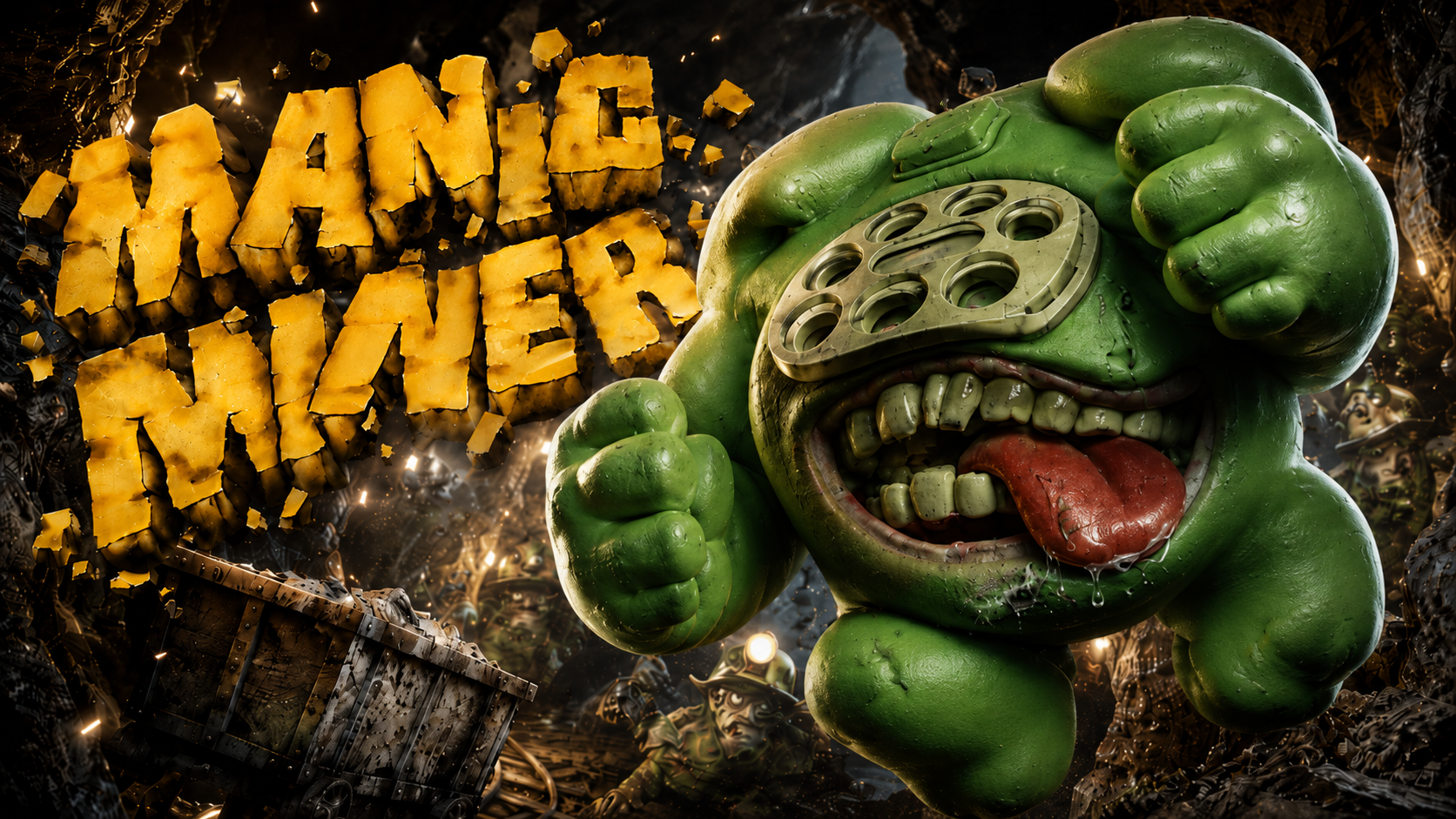
To understand what Pyjamarama is, it is necessary to understand what else was happening on the Spectrum in 1984. Manic Miner (1983) had placed its protagonist underground. The mine is the original working class space, the workplace that is also a trap, the space you descend into and must escape. Miner Willy's reward for completing twenty caverns, for escaping the underground, is the surface. His house. His car. A sunrise or a sunset.
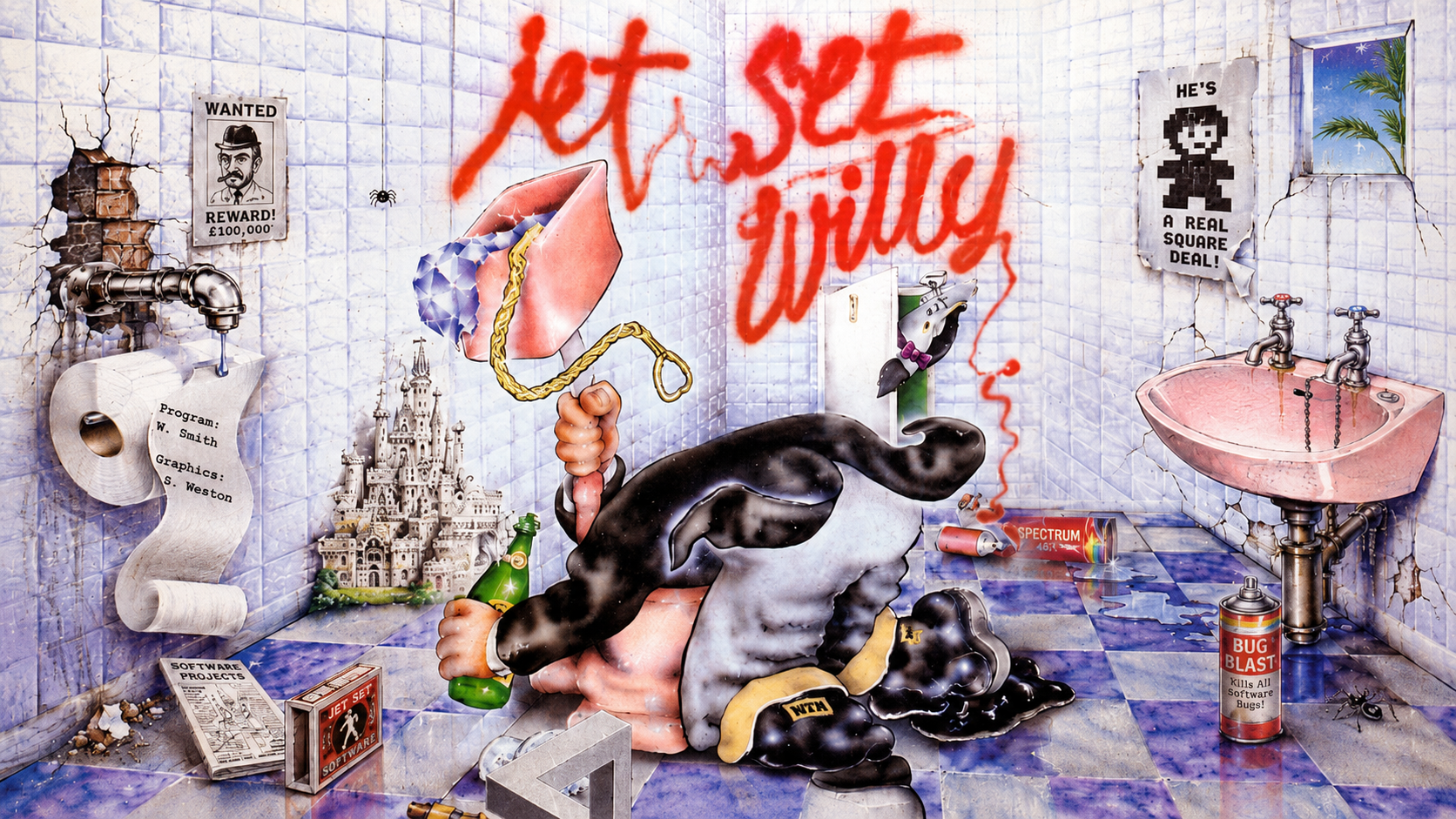
Jet Set Willy (1984), the sequel Matthew Smith spent the next eight months making, took that reward and inverted it. Willy is now obscenely rich. He has bought a mansion and thrown a party. He cannot go to sleep because the housekeeper Maria will not let him go to bed until he has tidied everything up. The game's comedy is class aspiration turned into domestic servitude: the man who escaped the mine is now trapped in the consequences of his own wealth, unable to rest, surrounded by the surreal detritus of a life he doesn't know how to manage.
Pyjamarama, published the same year as Jet Set Willy, is the third point in this triangle, and it is the most psychologically direct. Wally is not underground and not in a mansion. He is in his own terraced house. He has not escaped anything and has not acquired anything. He is trying to get to work tomorrow. His nightmare is not the mine and not the party; it is the alarm clock that did not wind, the job that will be lost, the ordinary obligation that has become inescapable.
The three games constitute an accidental triptych of working class British anxiety in 1984, each in a different register. Manic Miner is escape fantasy. Jet Set Willy is aspirational nightmare. Pyjamarama is domestic panic. Together they map the imaginative terrain of what it meant to be working in Britain in the year the miners went on strike, the desire to escape, the fear of what success costs, and the quiet terror of simply not making it in on time.
Reception
The ZX Spectrum version received the Game of the Month award in the November 1984 issue of Personal Computer Games, beating the BBC Micro version of Elite to the title. The significance of this outcome is worth dwelling on. Elite, David Braben and Ian Bell's procedurally generated space trading simulation, a game of almost unprecedented technical ambition for the period, was beaten to Game of the Month by Wally in his pyjamas trying to find a key.
This is not a failure of critical judgment. It reflects what Personal Computer Games' readership actually valued in November 1984: warmth, humour, character, the particular kind of surreal domestic comedy that Pyjamarama delivered at a higher pitch than almost anything else on the platform. Crash magazine awarded it 92%. Commercially, Pyjamarama achieved strong success in the UK market, with thousands of players contacting Mikro-Gen to report completions shortly after launch.
The critical vocabulary used around the game consistently reaches for the same word: warmth. Reviewers describe Wally as "cute." They note the nightcap fluttering as he slides down banisters. One Crash review calls him "cuter-than-ever." This is a significant critical register for 1984 Spectrum reviews, which were more often concerned with technical achievement, playability, and value for money. Pyjamarama generated affective response in its critics, they liked Wally, were charmed by his predicament, wanted him to make it to work. The game that beat Elite for Game of the Month is the game that made the player care about a small man in a flat cap trying to get out of his own dream. This is an achievement.
The Series and What Came After
Everyone's a Wally was the first arcade adventure game to feature multiple playable characters: Wally Week (a builder and handyman), Wilma (his wife), Tom (a punk mechanic), Dick (a plumber) and Harry (a hippie electrician). The player can change character when in the same location as another, those not being controlled wander around the village carrying on their own chores and business. The design advance from Pyjamarama to Everyone's a Wally is remarkable: from one character navigating one domestic space to a simulated community in which every character has an independent existence. "What we are doing with Life of Wally is we're taking Pyjamarama one step further into adventure whereby you're controlling five central characters." This is not a modest ambition. Everyone's a Wally in 1985 is gesturing toward what would later be called emergent simulation, characters with their own logic, their own tasks, their own needs, contributing to or interfering with your objectives by virtue of simply existing.
Dave Perry, who programmed Herbert's Dummy Run and Three Weeks in Paradise at Mikro-Gen, went on to found Shiny Entertainment and make MDK and Earthworm Jim. Chris Hinsley, who wrote Pyjamarama and Everyone's a Wally, went on to work on TaOS, a multitasking operating system that almost became the next operating system for the Amiga. Mikro-Gen was bought out by Creative Sparks Distribution in 1987, which subsequently went into receivership six months later. The company that had made Wally Week was gone within three years of its peak.
Position
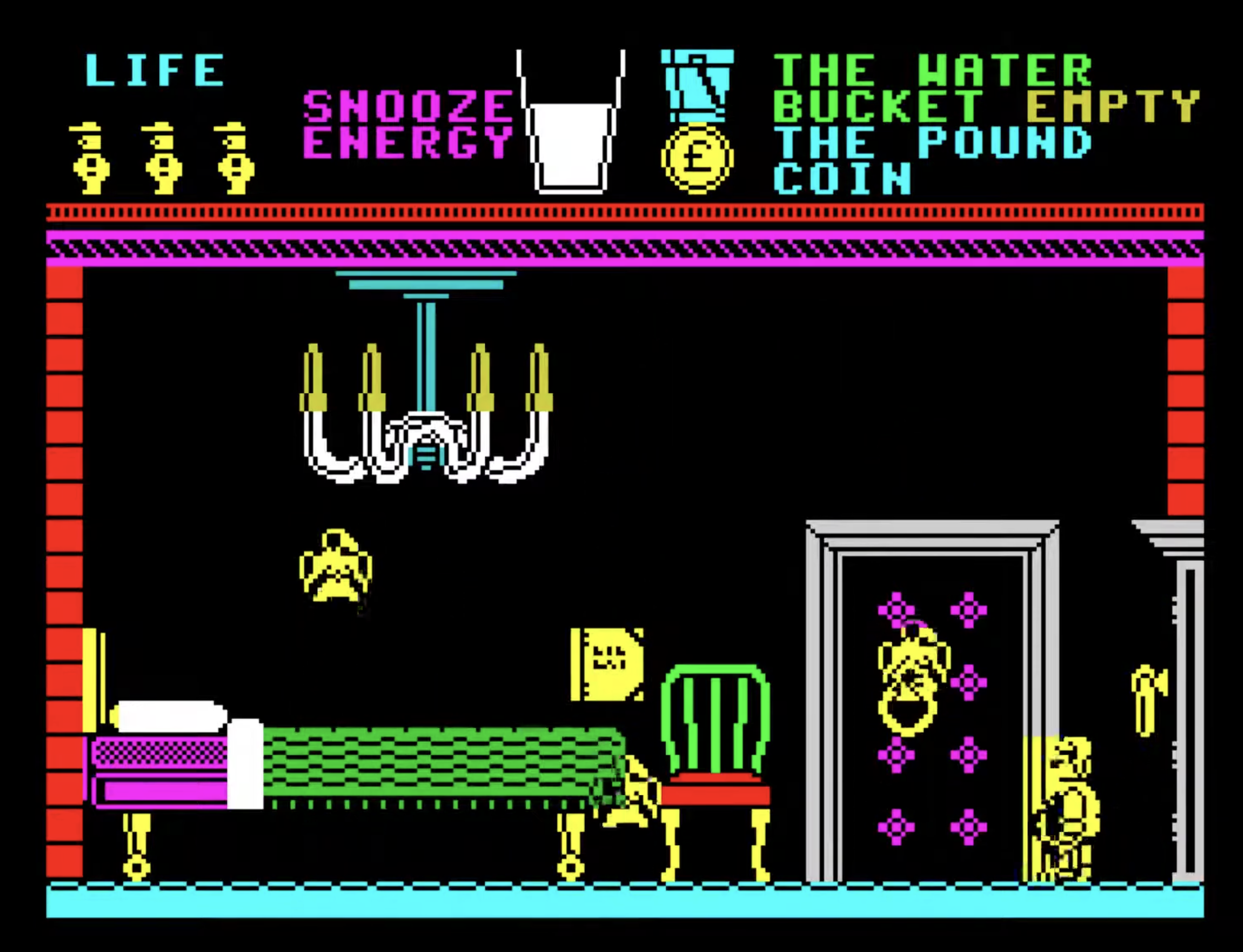
The canonical account of 1984 Spectrum gaming places Manic Miner and Jet Set Willy at the centre and Pyjamarama somewhere in the supporting cast. This is wrong, or at least incomplete. Pyjamarama is not a lesser cousin of those games; it is their precise complement, the third panel of a triptych that neither of the other two panels knew they were part of.
What Pyjamarama understood, and what the other Willy games didn't quite grasp in the same way, was that the dream is not an escape from the working class domestic space. It is a confrontation with it. Manic Miner puts Willy underground; the dream is elsewhere, fantastic, strange. Jet Set Willy puts him in a mansion; the dream is aspiration, a life beyond his origins. Pyjamarama puts him in his own house, in his own pyjamas, surrounded by his own furniture, and makes that house the nightmare. The dream is not escape. The dream is being unable to leave.
This is the more honest psychology. The anxieties that most persistently invade sleep are not fantastic. They are domestic: the alarm clock, the job, the obligation. Pyjamarama understood this. It gave that understanding a flat cap, a nightcap, a glass of milk, and a room where you could play Space Invaders while you worked out what to do. The title is borrowed from Bryan Ferry's most glamorous insomnia. The game is about the other kind.