Space Harrier: The Definitive History
The Hundred-Page Document
The game began with a document that did not survive in the form its author intended. A Sega designer known only as Ida wrote approximately a hundred pages proposing a three-dimensional combat flight simulator. It was detailed, ambitious, and technically impossible. The word "Harrier" appeared in it, referring to the British Aerospace Harrier, the VTOL jump jet capable of hovering and vertical takeoff: a plausible choice for a game about an aircraft navigating complex terrain at speed. The document outlined a player-controlled fighter jet shooting missiles into realistic foregrounds, rendered in a third-person perspective with full rotational animation.
The problem was memory. To animate a large jet sprite realistically, you needed it to have frames for every viewing angle as it banked and rolled: at minimum sixty-four distinct animation frames for a large sprite, and that was only if you were being parsimonious. At the arcade hardware specifications available in 1984 and 1985, this was a VRAM problem and a memory overflow. You could have a small sprite with sixty-four frames, but a small sprite would not have visual impact on a large arcade screen. A large sprite with the required frames was simply beyond what could be held in memory.
The document was handed to Yu Suzuki.
Suzuki had joined Sega in 1983, two years earlier, at the age of twenty-five. His first project was Champion Boxing for the SG-1000, a home console game that Sega's management found impressive enough to install in an arcade cabinet essentially unchanged. He was promoted to project leader while still in his first year. His second project, Hang-On, had been a motorcycle racing game with a full-scale motorcycle cabinet that players physically leaned to steer. Hang-On was released in 1985, the same year Space Harrier would ship, and it established everything that Space Harrier would build on: the Super Scaler hardware, the taikan cabinet philosophy, the three-dimensional sprite-scaling technique that produced the illusion of depth through size variation alone.
When Suzuki received Ida's document, his response was to keep one word.
The Simplification
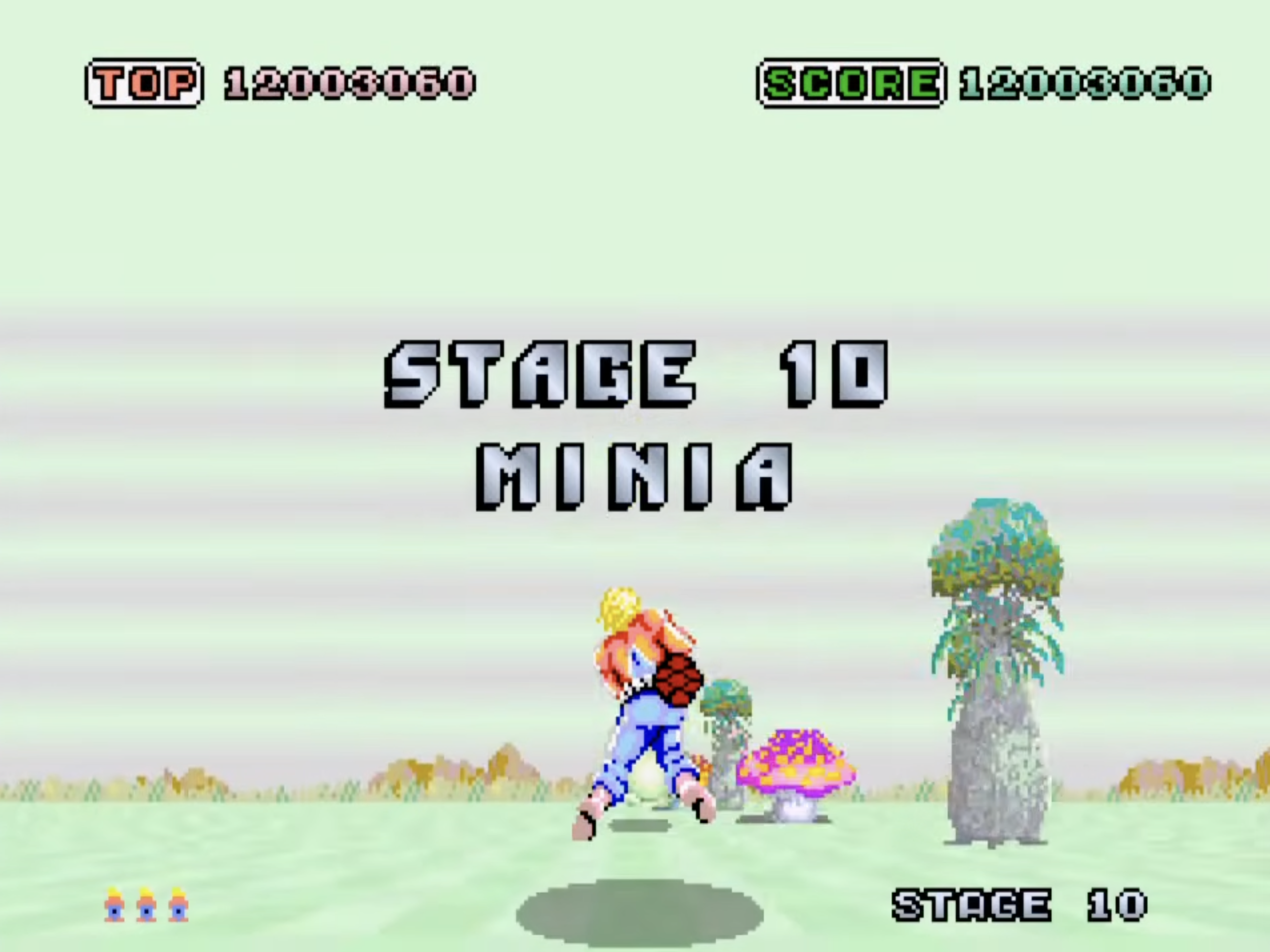
A human requires far fewer animation frames than a jet fighter. A human seen from behind, flying forward, is essentially the same human at every viewing angle in the axis of movement. The sprite complexity collapsed. The memory problem dissolved. What had been technically impossible became technically feasible in a matter of redesign.
But the human needed a world to inhabit. The realistic military setting that had justified a fighter jet was now incoherent. A running, flying human in a cold war combat scenario made no sense. Suzuki threw out everything else in the document and began again, keeping only the name Harrier and transforming it from a specific aircraft type into a character name.
The new world came from three sources that Suzuki has named consistently in interviews across the decades. The first was Hayao Miyazaki's fantasy art tradition filtered through the 1984 Wolfgang Petersen film The Neverending Story, adapted from Michael Ende's novel: the white luck dragon Falkor, the child protagonist riding through an endless sky, the sense of a world that was both dying and luminous. The second was the 1982 anime Space Cobra, which provided the spatial register of science fiction action, a future without specifying its technology, an aesthetic grammar of energy weapons and impossible mobility. The third was Roger Dean.
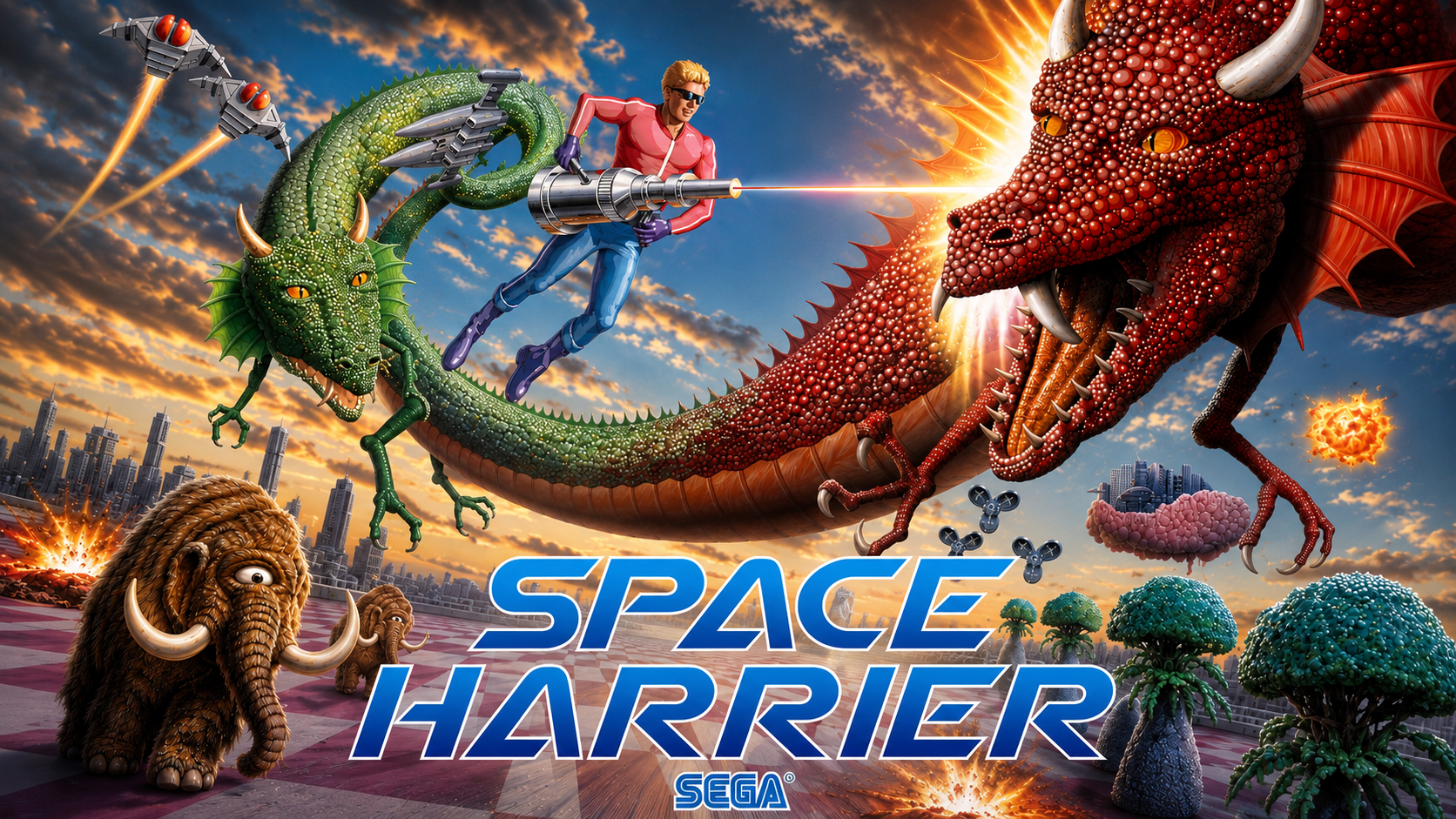
Roger Dean was a British artist whose album cover paintings for Yes, Asia, and other progressive rock acts had given him a specific reputation for the kind of floating, organic, impossible landscapes that could not be found in nature but felt as if they might exist in a different physics. Mushroom columns rising from desert floors. Rock formations balanced in ways that defied gravity. Architecture that had grown rather than been built. Suzuki described the appeal with precision: "If we had used a realistic setting with realistic objects, then we would have had to create extra sprites to capture the changing perspective as the player approached those objects. But with a fantasy world, we could use imagery like the mushroom columns, objects that wouldn't need a lot of complicated frames to animate, because they look the same from all visual perspectives." The Roger Dean aesthetic was not only visually suited to the game's emotional ambition; it was technically ideal. Radially symmetrical objects, which look the same from multiple angles, required fewer sprite frames.
Necessity and vision produced the same answer simultaneously. The checkerboard floor, which would become the game's most immediately recognisable visual element, arose from similar logic. The checkerboard pattern imparted a sense of speed and did not consume the sole frame buffer, permitting a separate layer for the background sky. The pastel colour palette allowed for a sky with many colour gradations, suitable for a fantasy world. These were engineering decisions that looked like artistic choices.
The Team
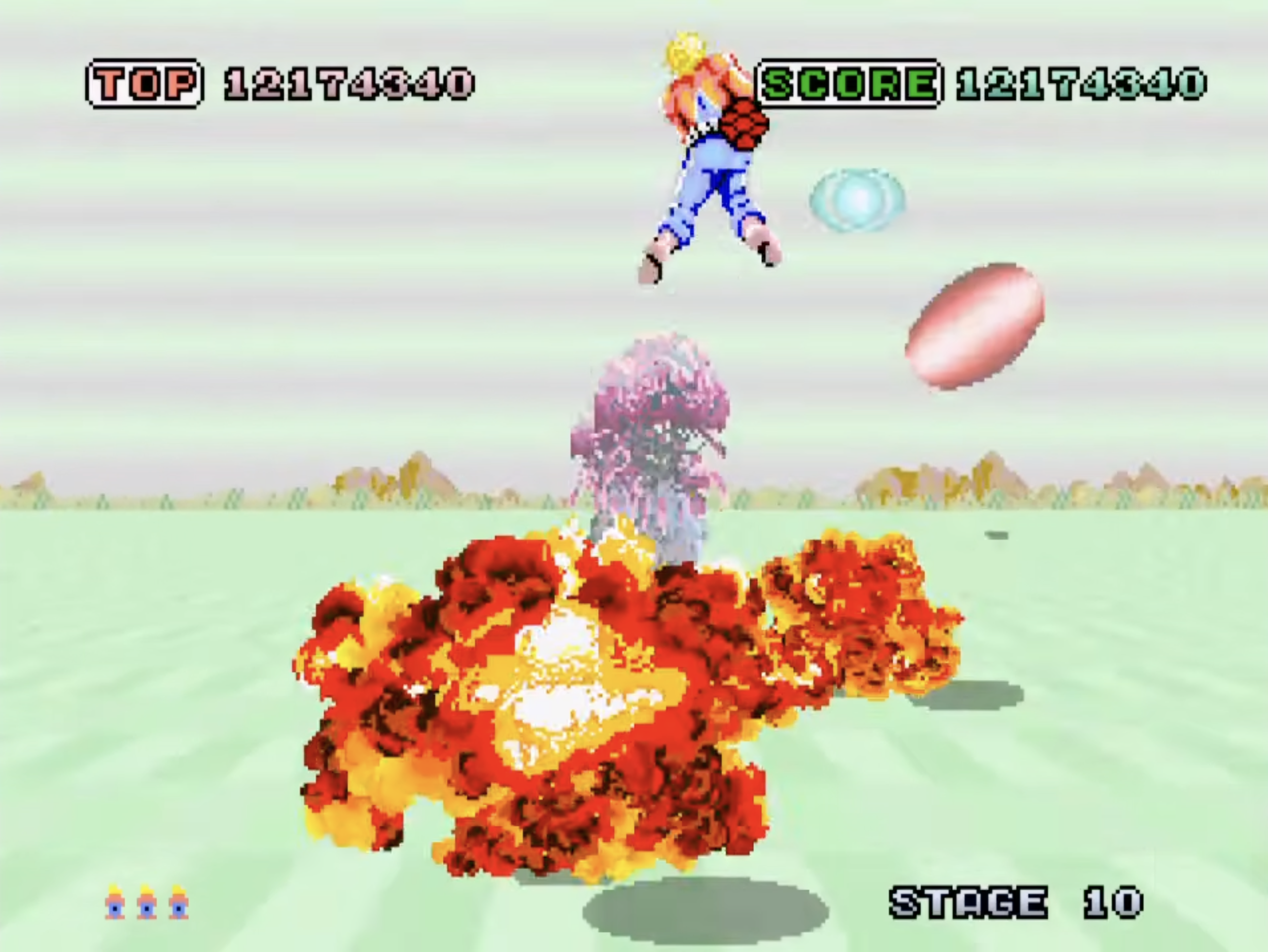
The development team was small. Satoshi Mifune, programmer and one of the names in the highscore table (listed as BIN), had moved directly from Hang-On to Space Harrier. In a 1996 interview collected by Shmuplations, he described the transition: "As soon as I joined Sega, they put me to work on Hang On, and as soon as that was finished, Space Harrier began. After Hang On, I was saying I really wanted to work on a shooting game. And I thought if we did one, we should maybe go for a 3D game."
The circumstances of development were physically distinctive. Sega had moved their main offices. The Space Harrier team alone was permitted to stay behind and continue working at the old office, on the fourth floor. The moving boxes that surrounded them served as improvised beds for all-nighters. Mifune recalled this without apparent complaint: "We used all the moving boxes to sleep on, when we had to pull all-nighters." The game was exhibited at the AM Show in September 1985, establishing an unusually compressed development cycle from initial concept to public demonstration.
Suzuki's role was hybrid in a way typical of Japanese arcade development of the period: simultaneously programmer, designer, and hardware engineer. He designed the game. He co-designed the hardware it ran on. He coordinated the graphic design, sound, and programming pipelines. His description of the original planning document's relationship to the final game is telling: "Our very first plan was actually a helicopter. The initial planning doc for Space Harrier was this thick tome, very detailed. But Suzuki wanted to make the player a human, and so we ended up not referring to the plans that much, and actually used the back pages more as a notepad for our own ideas."
The planning document became a notepad. This is how it was made.
The Cabinet Question
Sega was reluctant to build the motion cabinet. The engineering and construction costs were high. The cabinet that Suzuki had proposed would move dynamically, pitching and rolling in response to the player's analog stick inputs, synchronising the physical world of the player with the virtual world on screen. This was the taikan concept, the Japanese term for "body sensation": the idea that an arcade game should engage the player's entire body rather than just their hands. Hang-On had pioneered this with its full-scale motorcycle. Space Harrier's proposed cabinet was its extension into flight simulation.
Suzuki offered his salary as compensation if the cabinet failed. It did not fail. The cabinet became one of the most photographed objects in the mid-1980s arcade world: a large white enclosure with a cockpit seat that swung left and right, forward and backward, responding to the analog flight stick mounted on the armrest. Two motorised linear actuators in the base tilted the cabinet in two axes. It was often mistakenly called hydraulic; the actual mechanism was electromechanical. The distinction was invisible to the player. What the player felt was flight.
Three cabinet configurations existed. The standard upright cabinet had the flight stick and screen but no motion. The sit-down cabinet added the enclosed seating but retained a stationary base. The deluxe "rolling" cabinet added the full motion. Each configuration was a different price for arcade operators and a different experience for players. The full motion cabinet was the intended experience and the promotional image. Most players, outside Japan, encountered the standard versions.
The deluxe cabinet was the object. It is the thing people who played Space Harrier in 1985 and 1986 remember when they remember the game. Not the sprites or the checkerboard floor or the music, but the moment when they sat in the cabinet and felt it move.
The Super Scaler
The hardware behind Space Harrier was the Sega Space Harrier arcade system board, an evolution of the board used for Hang-On. The key addition over Hang-On's hardware was an Intel 8751 microcontroller running at 8 MHz. The practical effect was dramatic: where Hang-On had occasionally suffered framerate dips and sprite flickering when multiple vehicles appeared simultaneously, Space Harrier ran at a constant sixty frames per second with multiple enemies at different scales, obstacles, bullets, and the continuously scrolling background, without any detectable slowdown.
The Super Scaler technology at the heart of the board worked by calculating positions, scales, and zoom rates in three dimensions and then converting the results back to two-dimensional display data. Suzuki was explicit about this in a 2010 interview: "My designs were always 3D from the beginning. All the calculations in the system were 3D, even from Hang-On. I calculated the position, scale, and zoom rate in 3D and converted it backwards to 2D. So I was always thinking in 3D." This is the accurate technical description of pseudo-3D sprite scaling: true 3D mathematics producing a 2D output that mimicked the appearance of a 3D space.
The system could display 32,000 colours on screen simultaneously. For 1985, this was extraordinary. It ran on 16-bit graphics hardware when the dominant home computing landscape was 8-bit. The visual gap between Space Harrier and everything else in a 1985 arcade was as wide as the gap between a colour film and a black-and-white newsreel.
The audio hardware was a Zilog Z80 CPU controlling a Yamaha YM2203 FM synthesis chip and Sega's own PCM unit for digitised voice samples. The voice was the game's most immediately memorable audio element: "Welcome to the Fantasy Zone. Get ready!" spoken at the start of each credit, and "You're doing great!" at the end of each successfully completed stage. Even after dying, as Harrier screamed and fell, a friendly text message appeared: "Many more battle scenes will soon be available!" These voice samples were among the first clearly intelligible digitised speech in an arcade game.
Hiroshi Kawaguchi
The music was composed by Hiroshi Kawaguchi, credited in later releases as "Hiro." He had joined Sega in 1984 initially as a programmer, coming from prior experience on home computers. He had composed the music for Hang-On in his spare time, and that work led to an invitation to score Space Harrier. At the time of Space Harrier's development, he had no access to a professional music sequencer. He composed drafts on a Yamaha DX7 synthesizer, one of the defining instruments of 1980s recorded music, and transcribed the final versions as sheet music.
Suzuki had described his visual concept as a "Neverending Story" image, and he wanted each piece of music to be long enough to play through an entire stage without looping. The main Space Harrier theme, the one that saturates almost every memory of the game, is built on this specification: it runs long, builds progressively, and contains enough material that a player who is good enough to survive an entire stage does not hear it repeat. Kawaguchi described the compositional challenge: the first thing he wrote was too long, they discussed it, and decided to change the stage for it rather than the music.
The theme is energetic, expansive, and slightly martial, with a melodic structure that manages to convey both urgency and a particular kind of wonder. It is not background music. It is the emotional argument of the game made audible, and it is inseparable from the visual experience of the checkerboard floor rushing toward you. Yuzo Koshiro, one of the most celebrated video game composers of the subsequent decade, credited Space Harrier as the first time he heard FM synthesis music and said the game inspired him to become a game music composer. He described Kawaguchi as one of Sega's best ever composers.
The soundtrack was released commercially multiple times. A 1987 compilation, Sega Taikan Game Special, collected music from the taikan games. A 1997 release, Yu-Suzuki produce Hang-On / Space Harrier, was a Sega anniversary retrospective. In the 2000s, Data Disc released a vinyl edition with Kawaguchi's original sheet music reproduced in the liner notes, available in a limited signed edition.
The Game
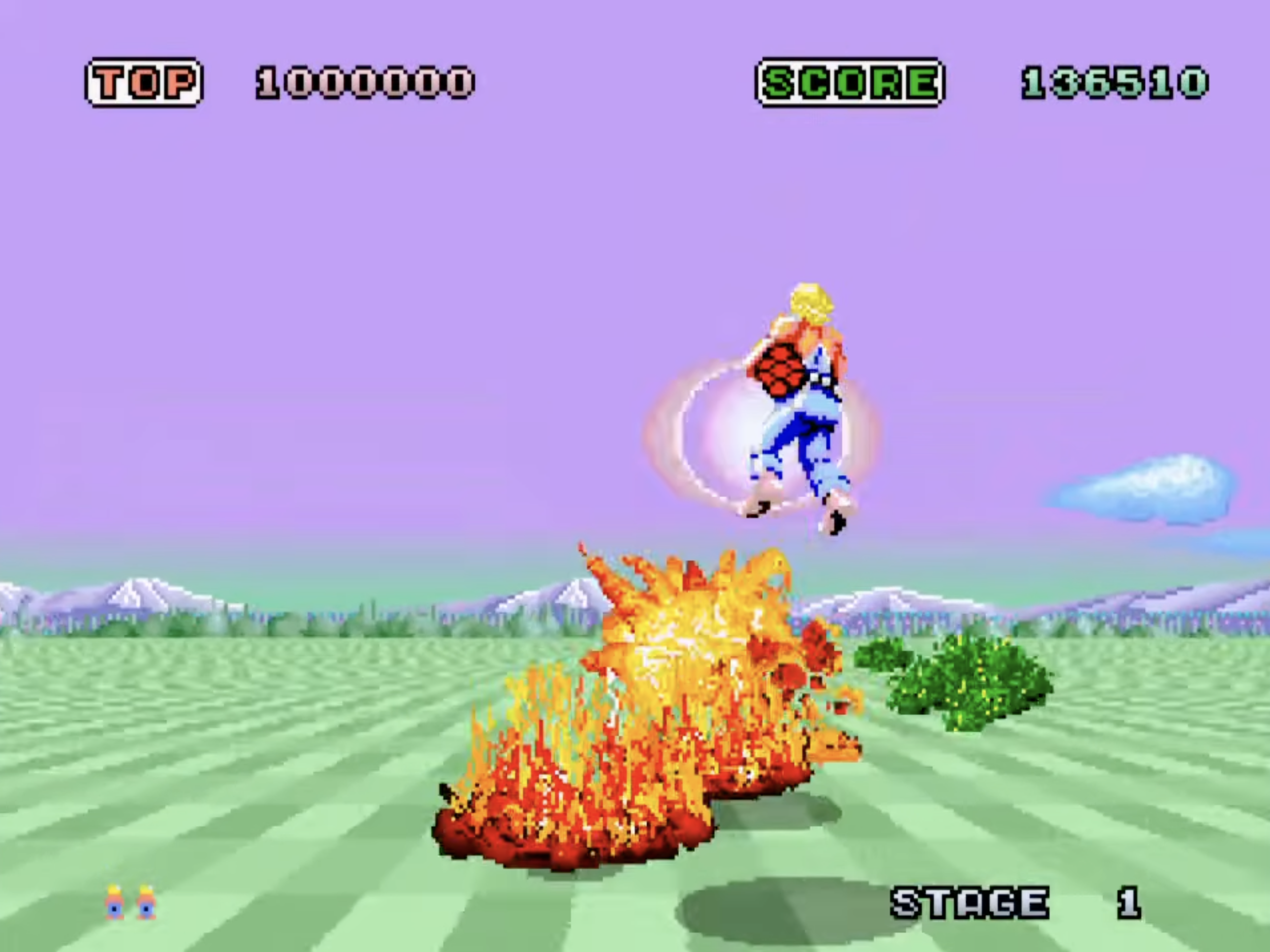
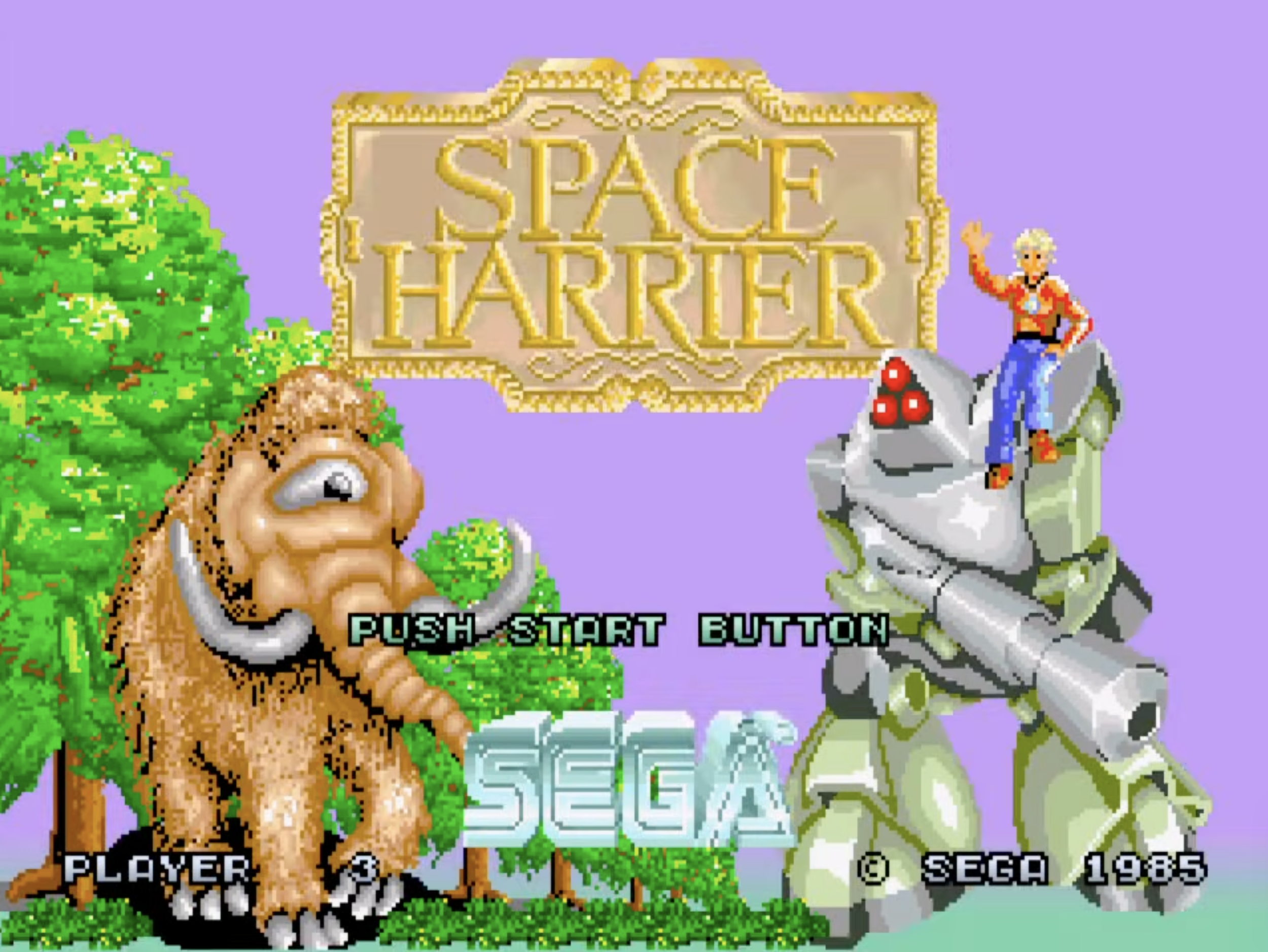
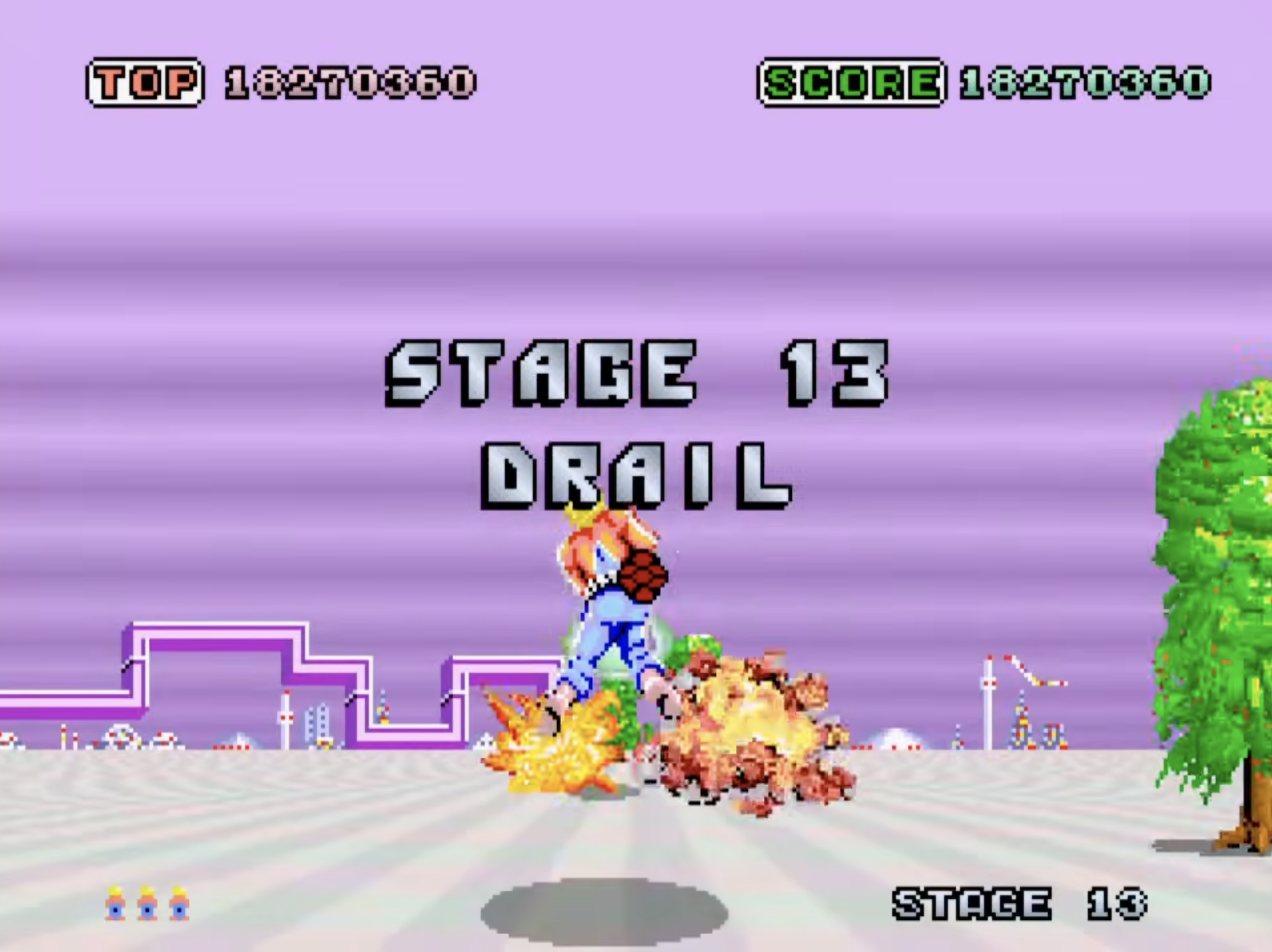
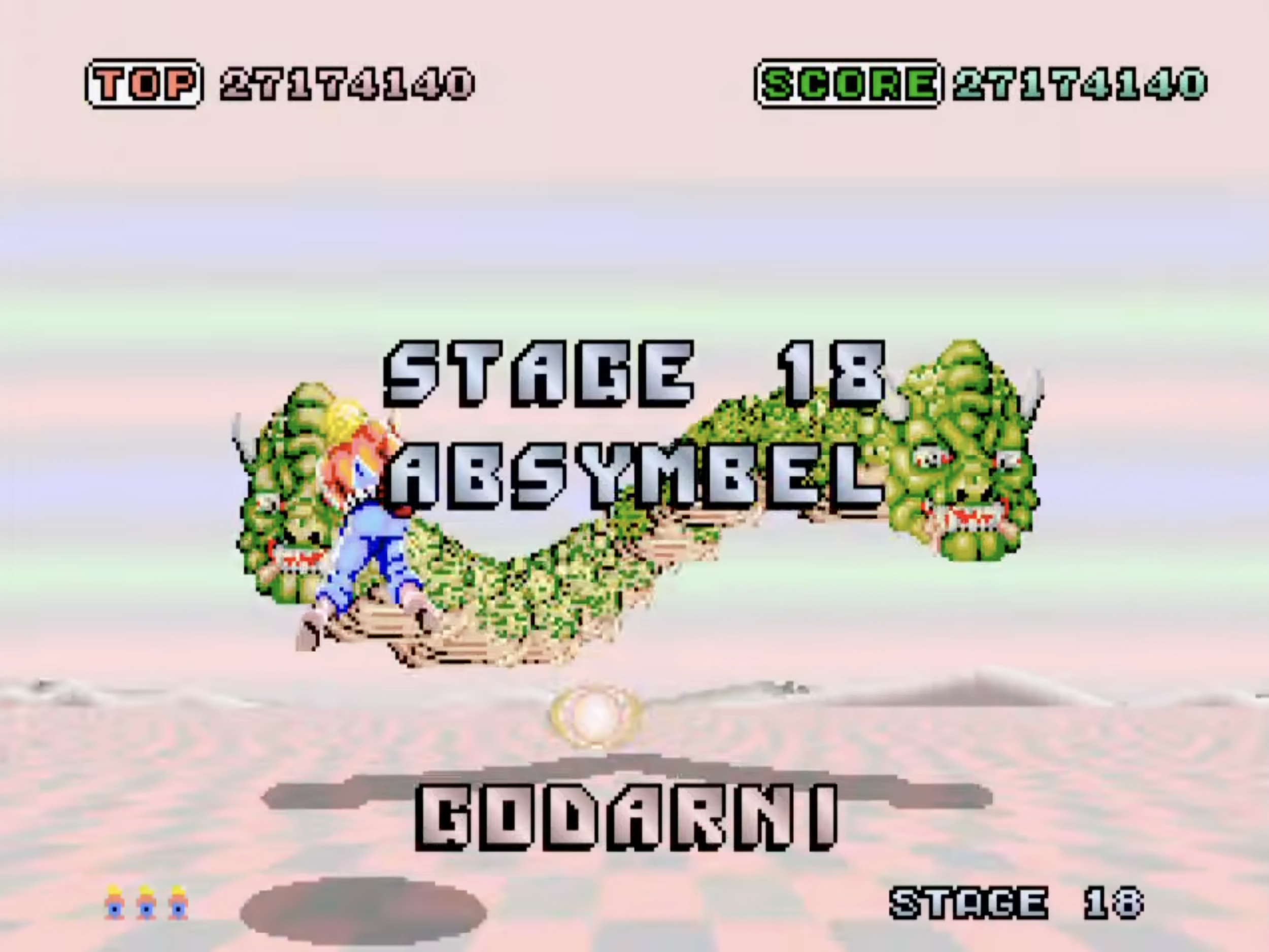
Space Harrier has eighteen stages. Fifteen of them end with a boss. The other two, stages five and twelve, are bonus stages in which the player rides Uriah, a friendly giant dragon, smashing through obstacles for points without danger. Stage eighteen is a boss rush: seven previously encountered bosses appearing in sequence, identified by name at the bottom of the screen as you face them.
Harrier moves through the stages in constant forward motion. The player cannot slow down or stop. The analogue stick moves Harrier across the screen in all directions, repositioning him against the continuous stream of enemies and obstacles. When the stick is released, Harrier returns to the centre of the screen. There are no power-ups. There is only the cannon, which fires automatically in a continuous stream in the direction the player faces. The aiming assistance is proximity-based: shoot in the general vicinity of an enemy and the shots will curve toward the target when within range.
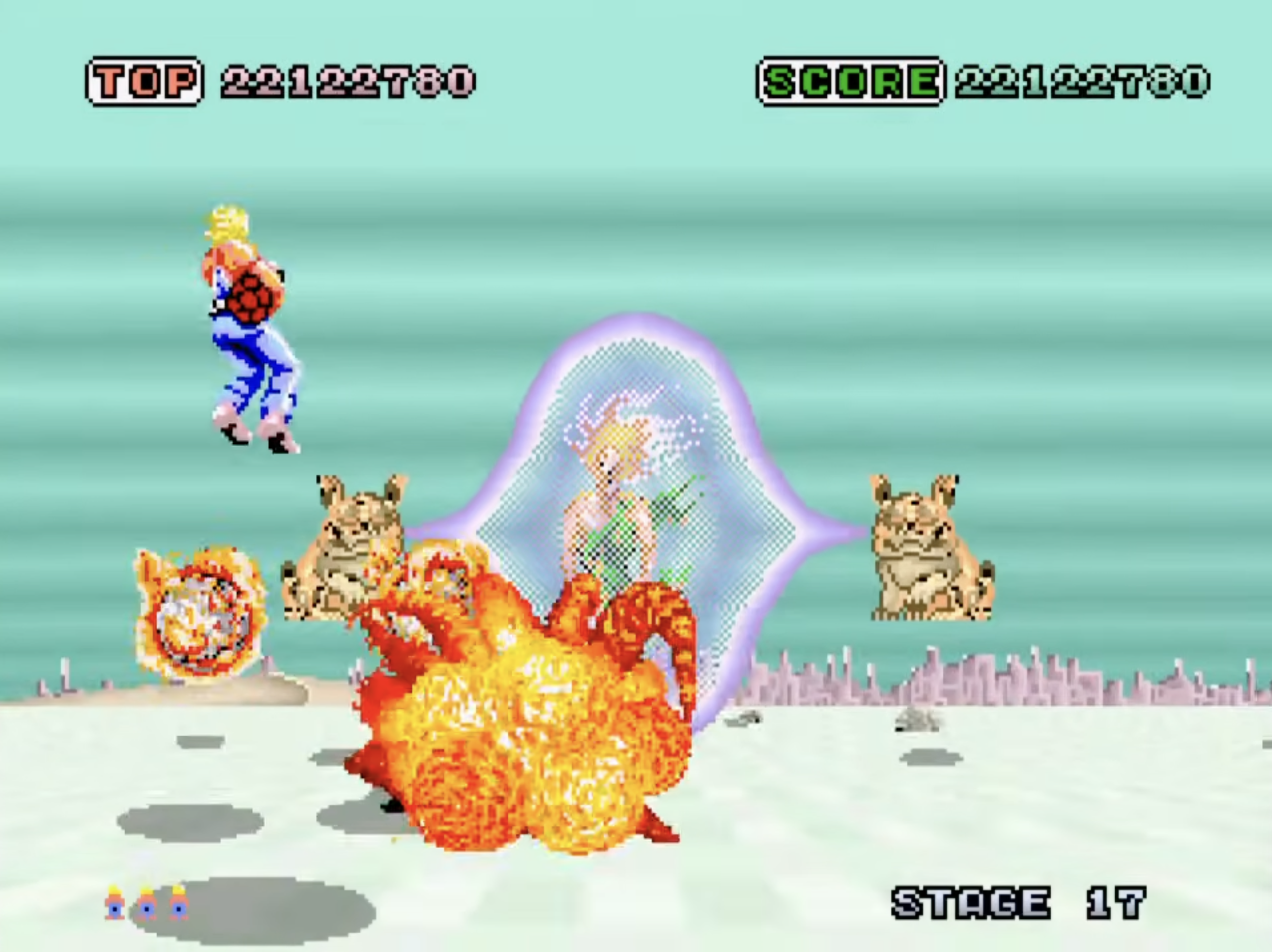
The enemies constitute one of the most genuinely surreal bestiaries in the history of arcade gaming. They include prehistoric mammoths with single eyes, bulbous yellow squids, Chinese dragons whose heads and body segments form flowing serpentine shapes during movement, stone heads, cybernetic geodesic sphere-things that cannot be shot down and deflect Harrier's laser, alien pods, flying robots modelled partly on Gundam mobile suits, giant mushroom columns that serve as obstacles rather than enemies, and the Valkiria heads, which are the game's most iconic recurring boss: a giant face that launches at the player with trailing body segments, named across the game's stage list with a rotational series.
The stage names are a roll call of a place that does not exist in any coherent way: Ceiciel, Amar, Drail, Garuda, Heigh Lee, Balma, Killard, Valcano, Haum, Absas, Elios, Boin, Kaima, Babe, Vicel, Jaura, Meows, and Boss Rush. They have the sound of a language constructed for the purpose and then not quite used: evocative without denotation, names that could belong to anything and therefore suggest everything.
There are things in the Fantasy Zone that cannot be shot. The stone pillars and the geodesic spheres are indestructible. The only way to deal with them is to avoid them, which requires reading their position in the pseudo-3D space and predicting where they will be when Harrier reaches their location. This is the game's core skill demand: reading the space accurately. The checkerboard floor is essential to this. It provides the depth cue that allows the player to judge how far away an obstacle or enemy is, calibrate their movement accordingly, and arrive at the correct position at the correct moment.
The homing quality of the shots means that accuracy under the game's reading demand is more forgiving than it might appear. You do not need pixel-perfect aim. You need to be in the right spatial region when you fire. This design choice makes Space Harrier significantly more accessible than most of its immediate contemporaries in the shoot-em-up genre without reducing the difficulty of the evasion component. Dodging is hard. Shooting is not. The game is split cleanly between these two activities and each requires a different kind of attention.
Commercial Success
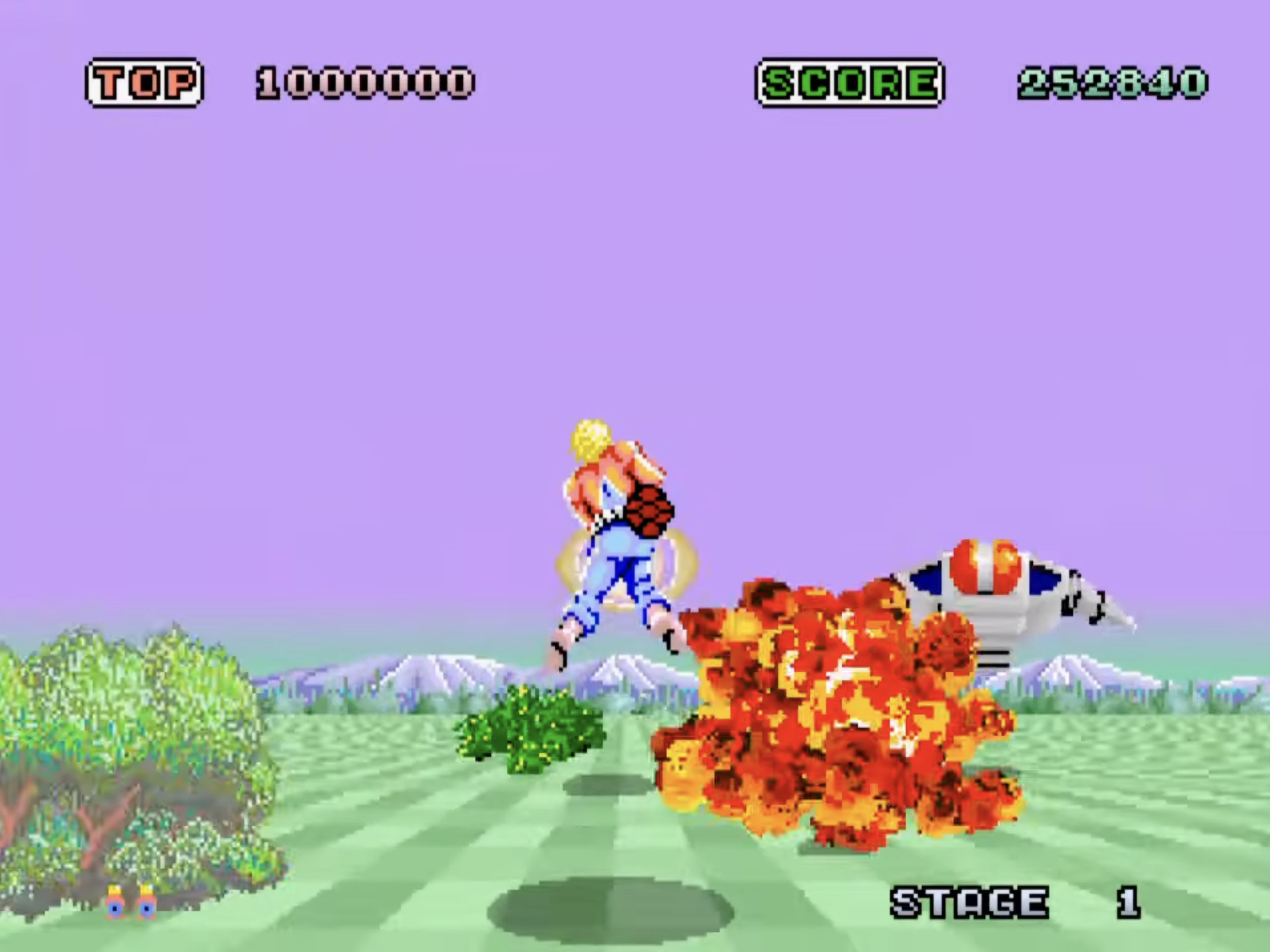
Space Harrier was released in Japanese arcades in October 1985. It became one of the top two highest-grossing upright and cockpit arcade games in Japan in 1986, sharing the position with Sega's own Hang-On. The combination of the two games constituted Sega's dominance of the Japanese arcade market in that year.
The game's commercial impact in the West was more complicated. The deluxe motion cabinet was a significant investment for arcade operators, and many Western arcades operated with standard upright or sit-down cabinets. The game reached the West, but the full experience of the taikan cabinet was rarer outside Japan. In Japan, Space Harrier became a touchstone. In the West, it became primarily known through home conversions.
Computer and Video Games magazine reviewed the arcade version in its March 1986 issue, after reviewer Clare Edgeley played it at the 1986 ATEI trade show in London, alongside Space Harrier's sister game. The review was enthusiastic about the technical achievement and the cabinet experience.
The Ports
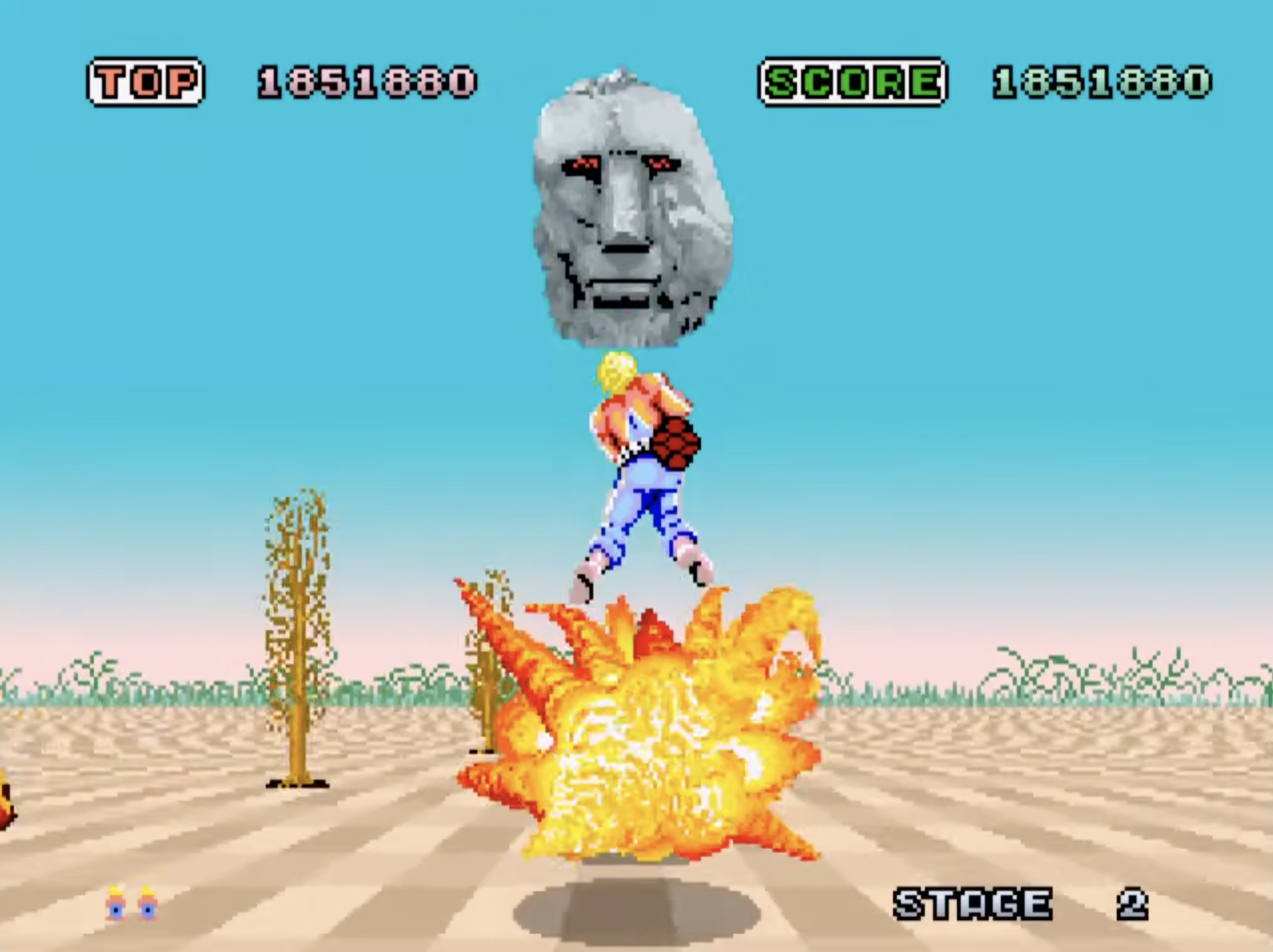
Every home platform that could theoretically run Space Harrier received a version. The history of those versions is a history of what it costs to translate an experience that depended on hardware specifically built for it.
The Master System port was developed by Mutsuhiro Fujii and a young programmer named Yuji Naka, who would later be the primary programmer of Sonic the Hedgehog. It was the first two-megabit cartridge released for the console. All eighteen stages were present but the landscape backdrops were omitted, leaving a monochromatic horizon behind the checkerboard floors. Fujii and Naka added elements that Suzuki had not included in the arcade version: an exclusive final boss, a twin-bodied fire dragon called Haya Oh, named after then-Sega president Hayao Nakayama, and a proper ending sequence in place of the arcade's simple "The End." These additions became part of subsequent ports.
The Sharp X68000 version, released exclusively in Japan in 1987, is considered one of the most faithful early ports. The X68000 was a home computer with significantly superior specifications to anything available in the Western home market, and its Space Harrier reflected that advantage.
The European and North American home computer ports were handled by Elite Systems, a British software house based in Farnborough, Hampshire. Elite had established a reputation for ambitious arcade conversions, handling titles including Commando, Ghosts 'n' Goblins, and Paperboy. They released versions for the ZX Spectrum, Amstrad CPC, and Commodore 64 in 1986.
The Spectrum version was generally regarded as a decent effort within the machine's constraints. It was playable. The sprites were recognisable. The checkerboard floor was present. A programmer named Keith left his credits visible in-game during play, an unusual act of self-inscription that became a small piece of Spectrum games folklore. The speed was obviously compromised. The colours were necessarily limited. But it was Space Harrier on a ZX Spectrum, and for British Spectrum owners in 1986 that mattered regardless of its technical shortcomings.
The Commodore 64 version fared worse in contemporary assessments. Jerky action and poor collision detection were the repeated criticisms. A second C64 conversion emerged from the United States with somewhat different characteristics but no greater success at capturing the source material's momentum.
The Amiga version, released in 1989, is where Elite's ambitions finally had hardware capable of meeting them. The Amiga had the graphics capabilities, the sound chips, and the processing power to produce something that looked and moved recognisably like Space Harrier at speed. Due to the volume of data involved, Elite split the content across two separate games: Space Harrier and Space Harrier: Return to the Fantasy Zone, the latter containing the stages from the arcade that had not fitted in the first. Owning both was necessary to have the full experience. The Amiga version, despite this structural peculiarity, is widely cited as the best of the 8/16-bit home computer ports.
The Atari ST version was slower than the Amiga version and contained an unexplained visual anomaly: a graphic on the right side of the screen depicting a Barbarian, apparently from an unrelated game. The DOS port was, by common consensus among those who played both, a disaster.
The PC Engine/TurboGrafx-16 version, released in 1988, was the best non-Sega home console version available before the 32X. It had the processing power to handle the scaling at something approaching the right speed, and it contained the full soundtrack. Hardcore Gaming 101 described it as "probably the most accurate port aside from the X68000 version."
The Sega 32X version of 1994 is the point at which a home version finally delivered the arcade experience with reasonable fidelity. The 32X was an ill-fated hardware add-on for the Mega Drive that Sega released in the same year as the PlayStation and Saturn, gambling on an interim solution that satisfied almost nobody strategically. Space Harrier was one of the few genuinely good arguments for the hardware's existence. It ran at thirty frames per second rather than sixty, but the sprite scaling, the visual quality, and the sense of speed were finally close enough to the original that the experience was recognisably the same. The Beep Game Center analysis described it as "probably the first arcade-perfect port, except for the slightly slower framerate."
The Sega Saturn version of 1996, released as part of the Sega Ages label, was genuinely arcade-perfect. It ran at the right speed, contained the Haya Oh boss from the Master System version as a bonus, and included true analog control mimicking the original arcade stick. It was bundled with OutRun and After Burner II for the Western release. The wait from 1985 to 1996 for a home version that fully delivered the original experience was eleven years.
The Nintendo 3DS version of 2013, developed by M2 in collaboration with Sega CS3, took eighteen months to produce and was described by producer Yosuke Okunari as "almost impossible." The challenge was converting sprites originally conceived in 2D into a 3D stereoscopic presentation: "When you take a character sprite that was originally in 2D and bring it into a 3D viewpoint, you have to build the graphic from scratch." The 3DS version added widescreen graphics and stereoscopic 3D, and used the handheld's gyroscope sensor to simulate the rolling motion of the deluxe arcade cabinet.
Shenmue and the Living Preservation
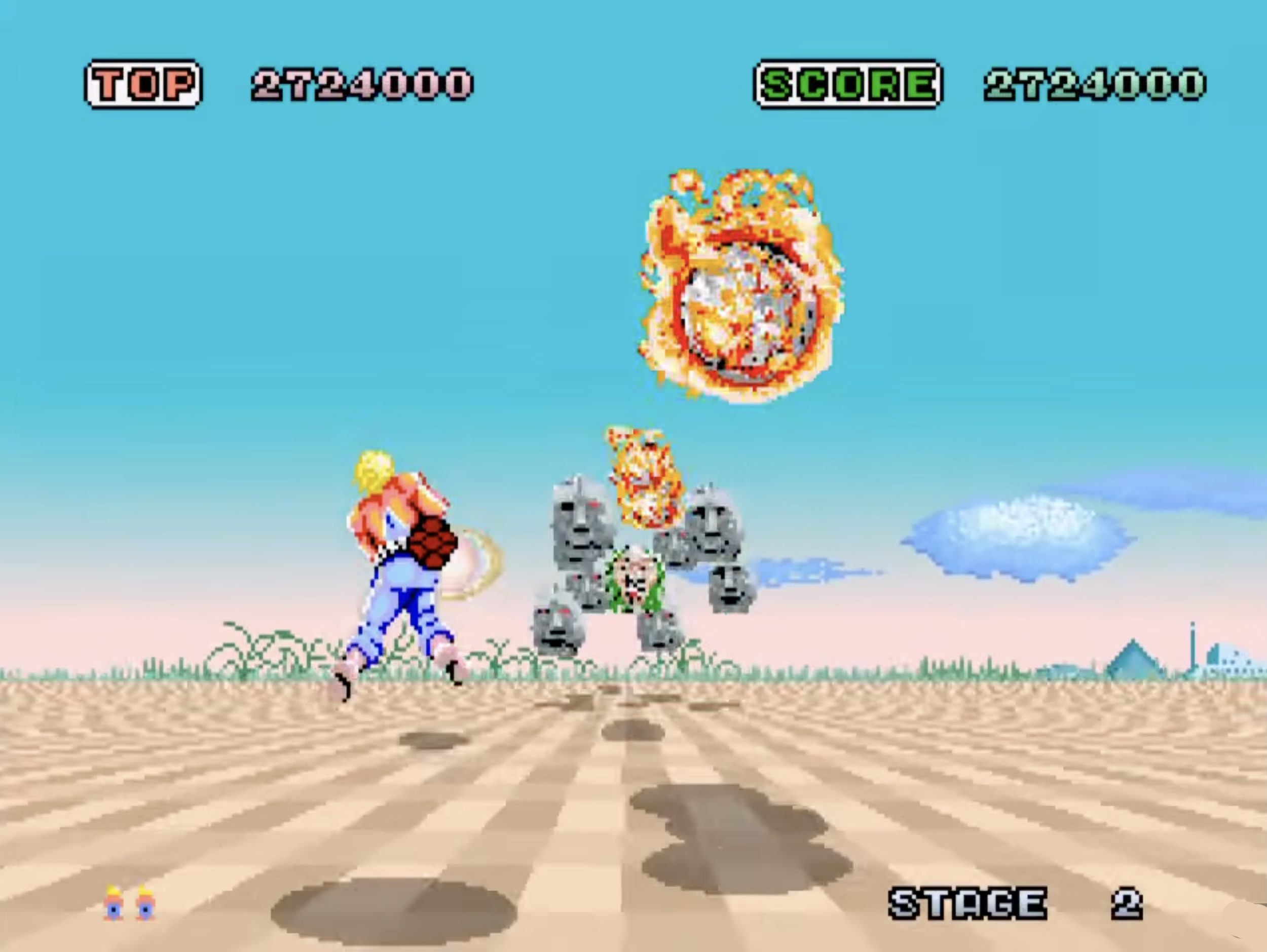
In 1999, Sega released Shenmue for the Dreamcast. Shenmue was an open-world adventure game set in Yokosuka, Japan, in 1986, the year after Space Harrier's arcade release. The game included a playable Space Harrier cabinet in an amusement arcade that the protagonist, Ryo Hazuki, could visit. The cabinet in Shenmue was the full arcade game, not a simplified version, embedded in the fabric of a realistic 1986 environment.
This was Suzuki serving as both designer and archivist. He had made Space Harrier. Now he was placing it in a world where it existed as an object with historical weight, something that was present in 1986 and meant something to the people who encountered it then. The Space Harrier cabinet in Shenmue is not presented as a curiosity or a nostalgic reference. It is presented as a piece of the environment, because in 1986 it was.
Shenmue II, the 2001 sequel, also included the playable Space Harrier arcade. The Yakuza series, starting with Yakuza 0's 2015 release, embedded Space Harrier as a playable minigame in its depictions of Japanese entertainment districts of the 1980s and 1990s. Bayonetta's 2010 Space Harrier tribute stage was named by Kotaku among the trippiest video game levels of that year. In Sonic and All-Stars Racing Transformed, a holographic statue of Harrier and a flying dragon appear in the background of the Race of Ages stage while a remixed version of the main theme plays. The Yakuza 6, Fist of the North Star: Lost Paradise, and Judgment inclusions followed the same pattern.
Space Harrier has been preserved not through museum archiving but through active inclusion in living games, games that are themselves successful and widely played. This is an unusual form of preservation. The game survives not in emulation sites but in the texture of worlds that recreate the period in which it first appeared.
The Sequels and Spinoffs
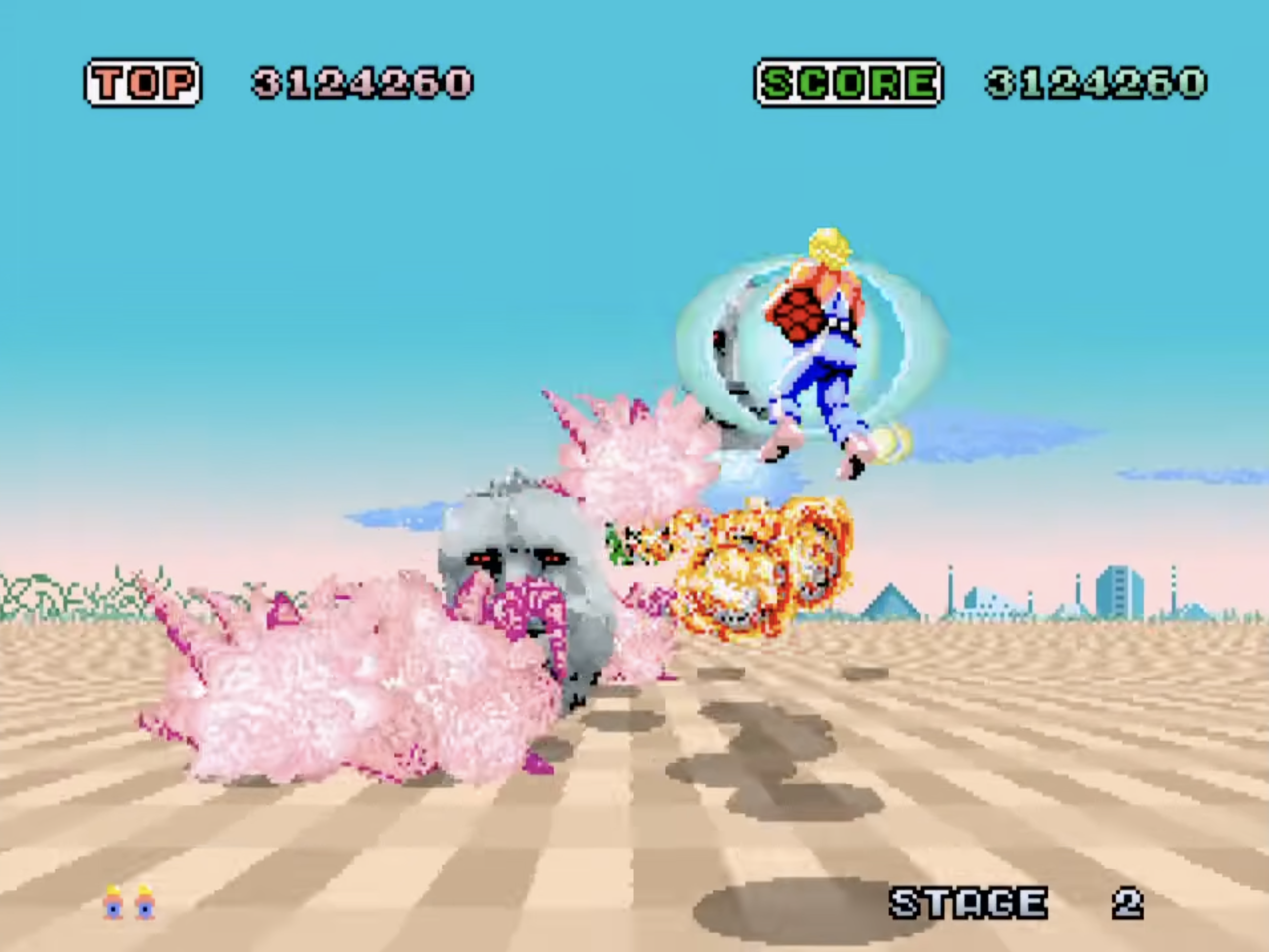
Suzuki had little direct involvement in the sequels. He had made the game. The game succeeded beyond what anyone had anticipated. Sega was not going to leave it alone.
Space Harrier 3-D (1988) was a Master System exclusive that used Sega's SegaScope 3D glasses, shutter-based stereoscopic glasses that alternated the image between left and right eyes at the display's refresh rate. It contained new stage, enemy, and boss designs. It was a functional if technically limited experiment with stereoscopic gaming a full two decades before Nintendo revisited the concept with the 3DS.
Space Harrier II (1988) was a Mega Drive launch title, designed to demonstrate the new hardware's capabilities. It looked considerably better than any previous home version and played well. The difficulty was that the Mega Drive did not have Super Scaler hardware. Everything had to be drawn as static sprites. The result was competent but visually static in a way the original never was, lacking the sense of forward momentum that the scaling produced. The hardware that made Space Harrier what it was could not be reproduced in a home console of 1988.
Planet Harriers (2000) was an arcade spinoff that arrived in the final years of the traditional arcade market. It featured multiple playable characters including a hidden Opa-Opa from Fantasy Zone, and had only a minimal presence in the United States due to the collapsing arcade scene. It was never given a home release.
The cancelled Space Fantasy Zone (1991), developed by NEC Avenue for the PC Engine CD-ROM, would have combined Space Harrier's gameplay with Fantasy Zone's visual aesthetic and Opa-Opa as the player character. A fully playable beta version existed and was subsequently distributed informally on the internet. The official version was killed by a legal dispute over NEC's unauthorised use of Sega's Fantasy Zone property.
Roger Dean and the Yes Debt
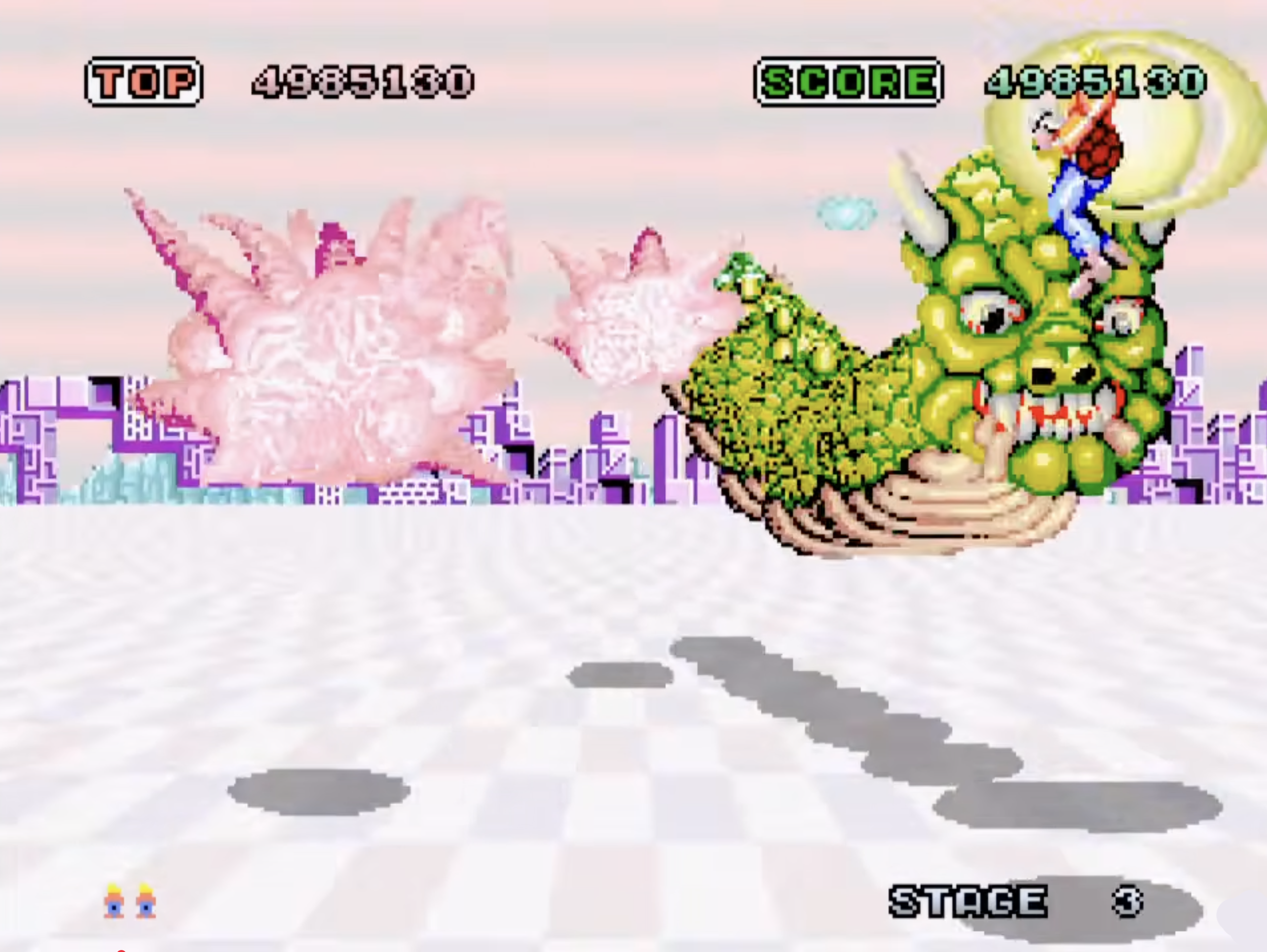
The influence of Roger Dean deserves more than passing mention. Dean's paintings for the progressive rock band Yes in the 1970s, particularly the covers for Fragile, Close to the Edge, and Tales from Topographic Oceans, established a visual vocabulary of floating continents, organic architecture, and impossible landscapes rendered in a palette of earthy greens, ochres, and blues. The world had a geological quality: things had been here long before you arrived and would remain after you left. The structures were grown, not built.
Suzuki and the Space Harrier character designer both cited Dean as an influence, and the debt is visible in the game's terrain objects. The mushroom columns, the floating geometric structures, the sense that the ground is a surface of a much larger and stranger thing extending in all directions: these are Dean's visual grammar translated into sprite art. James Cameron, who made Avatar in 2009, also cited Dean as an influence. The floating mountains of Pandora and the checkerboard floor of the Fantasy Zone share an ancestry.
The Fantasy Zone as a place is not just a setting for a game. It is an aesthetic position: a refusal of the utilitarian geometry of most virtual environments in favour of something that looks as if it grew. The reason every stage is different is not gameplay variety. It is that the Fantasy Zone is not one place but an argument about how a landscape can be: how color can function, how scale can be manipulated, how the checkerboard of the floor can be made to carry the emotional weight of movement.
The Aiming Mercy and What It Means
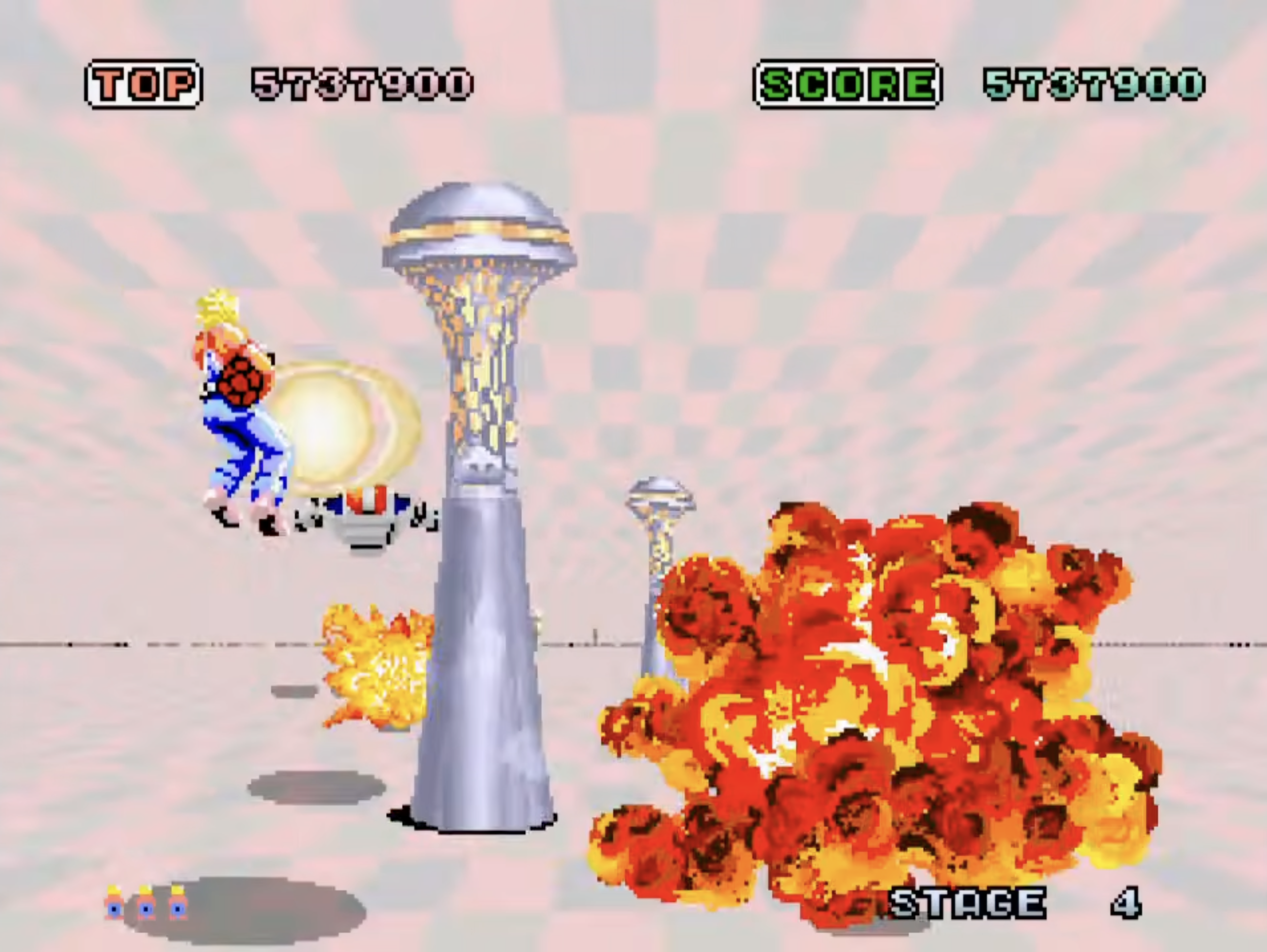
The near-automatic homing of Harrier's shots deserves analysis because it is what makes Space Harrier play differently from virtually everything that came before and after it.
In most shooting games, the challenge is divided approximately equally between dodging and aiming. Missing a shot feels like a failure of accuracy. In Space Harrier, missing a shot is nearly impossible unless you are nowhere near the target. The shot curves. The game is about evasion, almost entirely. The enemy projectiles are fast and numerous and move toward Harrier's position with intent. The obstacles are fixed and must be read spatially. The bosses have specific patterns that the game does not tell you and that must be learned through repeated failure.
The homing mechanism was likely a design compromise: the analog stick was already demanding significant attention for constant directional evasion, and a game that also required precise manual aiming would have been unplayable at the speed the Super Scaler hardware delivered. The compromise produced something structurally unusual. Space Harrier was a shooting game in which shooting was not the skill. Looking was the skill. Reading the space, predicting the trajectories, maintaining awareness of the full screen area simultaneously: this is what Space Harrier required and what it rewarded.
The analogy to a kind of kinaesthetic reading is not forced. The checkerboard floor is, among its other functions, a reading guide. Its grid tells you where things are and where they will be. The player who performs well at Space Harrier is a player who reads the floor.
The Disappearance of Yu Suzuki
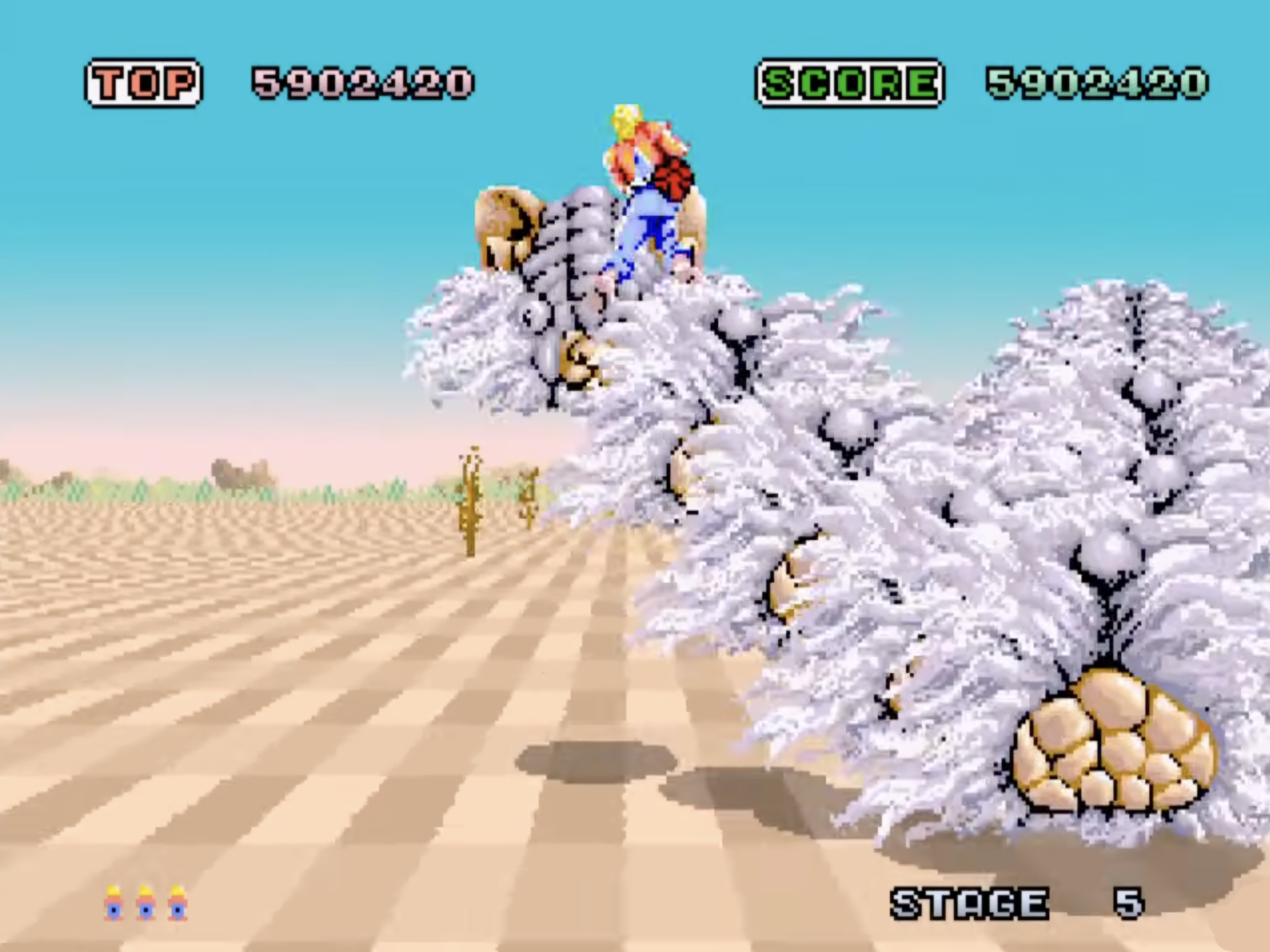
After Space Harrier came Out Run (1986), After Burner (1987), Power Drift (1988), G-LOC (1990), Virtua Racing (1992), Virtua Fighter (1993), and then Shenmue (1999), one of the most expensive games ever made, which sold modestly and cost Sega an estimated $47 million including marketing. After Shenmue II (2001), Suzuki's role at AM2 diminished. He worked as producer on Out Run 2 (2003) and Virtua Cop 3 (2003). He formally left Sega in 2011 to concentrate on Ys Net, his own development studio.
A 2010 feature by James Mielke for 1UP, titled "The Disappearance of Yu Suzuki," found the former Sega giant in an ambiguous position: still technically at the company, with diminished responsibilities, no longer the figure who had defined an era. The feature ran in two parts and its title expressed a genuine cultural anxiety. Where had the person gone who had made Hang-On and Space Harrier and Out Run in a single year, who had built the hardware those games ran on, who had been the most influential arcade designer on the planet for a decade?
He had not disappeared. He had simply moved through his era and arrived on the other side of it. The post-Shenmue period, during which the kind of expensive, ambitious, technically pioneering single-author arcade games he had made ceased to exist as a market category, had nowhere for him. The world he had built Space Harrier for no longer existed.
In a 2015 interview with Retro Gamer, he said he would have liked to create a new Space Harrier by himself, and was pleased to see it ported to the Nintendo 3DS. This was twenty years after the last game in the series and the statement of a man who knew the distance between what he wanted to make and what could be made.
He launched a Kickstarter campaign for Shenmue III in 2015, which raised over six million dollars from fans who had waited fourteen years for a sequel. The campaign demonstrated that the audience for his work had not disappeared. It had simply had nowhere to put its attention.
The Fantasy Zone Is Not Real
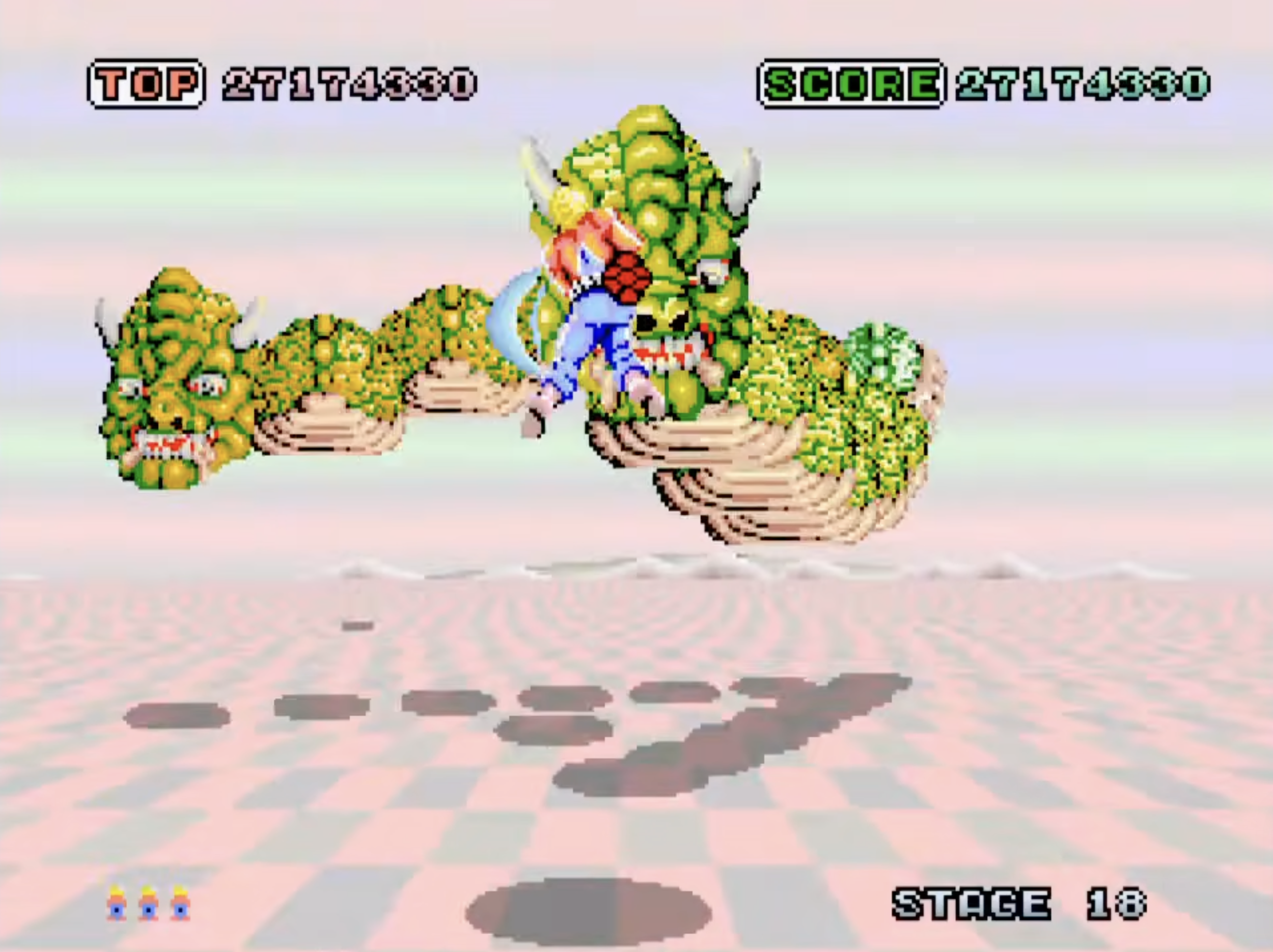
The Fantasy Zone is named in the game's opening voice sample. "Welcome to the Fantasy Zone. Get ready!" It is described nowhere else. The game offers no backstory in the arcade version, no explanation of why the Fantasy Zone exists or what Harrier is doing there. The Master System port added a narrative: Harrier is the last of Dragon Land's Sentinels, defending the Land of the Dragons against destruction. But this was Fujii and Naka's addition, not Suzuki's, and the arcade game from which the experience derives was made without it.
What the phrase "Fantasy Zone" actually names is a space defined by its own visual logic rather than by the rules of the world outside it. The checkerboard is not a natural landscape feature. The mushroom columns did not grow from anything recognisable. The Chinese dragons that function as bosses have no biological ancestors. The mammoths with single eyes are not related to the woolly mammoths of the Pleistocene. Everything in the Fantasy Zone is a quotation of something from another context: mythology, science fiction, progressive rock album art, anime, naturalist illustration. These references do not cohere into a world. They cohere into an aesthetic.
This is what the Fantasy Zone is. It is a space defined by feeling rather than logic. It feels like movement should feel, like a forward rush through a visual argument that keeps changing its terms without losing its conviction. The Roger Dean landscapes feel like something could live there if the physics were different. The mammoths feel like something that might have existed in a world more extravagant than this one. The checkerboard is an abstraction that makes sense of what would otherwise be a flat surface without information.
Eric Francisco of Inverse wrote in 2015 that the visuals resembled "an acid trip through an '80s anime, a Robert Jordan novel, and early Silicon Valley binge coding sessions." This description is affectionate and accurate. The Fantasy Zone was built by a small team sleeping on moving boxes in an evacuated office in 1985, and it looks exactly like something made under those conditions by people who had encountered The Neverending Story, Roger Dean, and Space Cobra, and who had a new hardware platform capable of doing something no one had done before.
Hideki Kamiya, who would go on to direct Devil May Cry and Bayonetta and Okami, described encountering Space Harrier in a 2014 interview: "There were so many trend-setting definitive games that came out in the 1980s, like Gradius and Space Harrier. All these game creators were trying to make original, really creative games that had never existed before." He cited Space Harrier as an inspiration for entering the video game industry.
Yuzo Koshiro heard the FM synthesis music coming from the cabinet and went away and learned to be a composer. The floor rushes toward you. The music begins. Something enormous is coming. Welcome to the Fantasy Zone.